Home Blog Page 25

Chris Shepperson of Nightfall Games talks SLA Industries

The SLA Industries roleplaying game first appeared twenty-five years ago.  As an entirely new setting, SLA (pronounced “Slay”) Industries was praised for its originality and iconic themes, for which it won numerous awards.

The game is based around a far-future dystopia.  Much of the known universe is owned, or indirectly controlled, by the eponymous corporation SLA Industries. The game combined themes from the cyberpunk, gothic horror and conspiracy genres.

The World of Progress, the universe in which SLA Industries is set, is a retro-futuristic image from the 1980s; fax machines endlessly spew information alongside green-screen computers and vat-grown biogenetic monsters, whilst humans and exotic aliens compete for work in a vast overgrown city that plunges deep underground.

With the successful SLA Industries kickstarter recently finishing, Chris Shepperson took the time to discuss what makes The World of Progress come to life.

How do you describe SLA Industries to those who are unfamiliar with it?

Horror Noir is my go-to description, though most people stare at me blankly when I say that. I think it’s important to highlight the horror aspect to newcomers to the franchise though, as it’s pretty easy to be blinded by the powered armour, big aliens and even bigger guns.

It is a sci-fi game. It is a dystopian dark future, but it’s far from cyberpunk. The technology level is almost 80’s-like, with no internet and an abundance of fax machines, which makes it both interesting and tricky to describe.

It’s a bit of a cop-out, but an easy way to describe SLA Industries as Se7en meets Blade Runner (the original one, 2049 is a too high-tech); a dark psychological thriller meets biogenetic engineering in a huge mega-city.

What is your role in Nightfall?

We’re a pretty fluid organisation, as there are four of us and we’re all just ‘director’. We made up some job titles at one point, but other than Dave being the Art Director, we all just do what needs to be done. Predominantly, I’m a writer and the majority of my time not spent on social media or Kickstarter is spent writing. I’ve also become ‘the rules guy’, firstly by finalising the Cannival Sector 1 skirmish game when I came onboard, then finalising all the rules and stats for the RPG content in Cannibal Sector 1, then building the new 2nd Edition rules set from the ground up.

I enjoy rules and mechanics and have worked on a number of board games for publishers in the past, but it’s been great to have free rein on something much larger. I’m not all rules though, in fact I enjoy writing lore and fiction more than anything else.

Why have you chosen to release a new edition of SLA Industries?

For as long as Dave and Jared can recall, people have been asking for a new system. The old system was fairly forward thinking in 1993, but it was quite involved, especially the combat system. SLA was a game that was cursed by people who loved the setting to death, but struggled with the system, which led to a lot of home brew versions and unofficial conversions to World of Darkness and Savage Worlds etc. For a publisher, you obviously would like people to use the ’official’ version of your game and 2nd Ed was the perfect way to address that call from the fans.

At the same time, the game has been through many publishers over the years and the writing and production of content has moved between a few different teams. Ultimately this has led to some of the material out there being out of line with the original view of the game. Not bad by any standard, but not really how Dave saw the setting panning out over time.

With the intellectual property now back in the hands of Nightfall, and with myself and Mark Rapson on board, we wanted to move things along, both for the good of the game and for Nightfall as a company. A second edition was our chance to retcon a few bits that didn’t feel right, iron out contradictions between a few of the old books and laydown a refined canon for the future of the game. It has taken twenty-six years to do it, but the second edition core book will serve as the spring board for the future of the game.

SLA Industries was ground-breaking at the time due to its themes and setting, how do you retain that freshness?

I think the themes are still fairly relevant. Firstly, many of the themes are very dark and ‘adult’ in nature, and cover aspects that other publishers don’t want to tread: human trafficking, drug abuse, serial killings and televised violence are all subjects that are rare in the gaming genre. We don’t really fear to step into these subjects, though we are far more mindful of their impact on gamers these days.

The original game came out of a post-Thatcher Glasgow in the 90’s, where the setting and politics in the game were an exaggeration of the time. The current political scene in the UK is constantly throwing up discussions that tie well into SLA, and a few of our newer developments feel scarily relevant, despite their extreme manner.

What are the quintessential elements of a SLA Industries game?

Violence, extreme horror and a deep resounding feeling of dread. The players take on investigations that put them in the middle of living nightmares, all for a bit of cash and that promise of an increased SCL (Security Clearance Level). They are sold the dream that a high SCL means glory, sponsorship, more money and better guns, but most never get there.

Those who do get the sponsorship deal and the free armour immediately realise that there is nothing for them to do but to try and get a better sponsorship. The World of Progress is bleak and those small glimmers of hope are usually shattered by someone kicking you when you’re down.

Mort is the bleakest place you could ever imagine and through that constant torrent of crap comes laughter, dark humour and great stories. It always amazes me how you hand people contract killers, powered chainsaws and a sewer tunnel and what you get are gaming groups having a riot.

As roleplaying games have evolved, has SLA Industries had to evolve to?

I think it’s fair to say that for a long time, SLA didn’t change with the times, resulting in it getting left behind a bit when the RPG industry started to shift. RPGs as a whole had a quiet patch for many years, but the resurgence that started a few years ago allowed the hobby to explode again. RPG mechanics rapidly became more accessible, with less mechanics and more cinematic play in mind. This seemed to be a very popular approach and many publishers followed suit.

It also became the era of big-screen IP, with movie and television franchises dominating the scene, as well as many other long-running games refreshing themselves with a new core rules, moving to full-colour art and hardback publications.

SLA was ticking along with PDF releases that led up to Hunter Sheets 2, but the focus was very much on the lore and setting, with the old school rules being a struggle for many newcomers to the RPG scene. SLA has always been followed and supported by fans who we are honoured to have, but it was a hard few years, with a couple of guys just wanting to create the thing they loved while they paid the bills working in their respective industries.

As a company, we’ve drastically increased our social media presence and engagement with the audience, we’ve moved to second edition, introducing a more streamlined system that fits better with the current marketplace, we’re using Kickstarter in a way that is sensible (a single book, to be delivered in a sensible time frame) and we’ve built relationships that should get the game a stronger retail presence again.

As a game setting, we’ve evolved the storyline and planned out what the next few years look like ‘in-game’, which we’ll be exploring over the coming publications. We’re pursuing the horror angle more than ever before, whilst ensuring we remain true to the feeling of the setting. We’re also making sure that we don’t evolve ‘too much’, bringing back a few things from 1st Ed that had drifted out during the publications, such as Tek Trex and Thresher.  These have remained fan favourites over the years, despite never really getting their time in the limelight, until now.

What have been your key influences when developing SLA Industries?

Firstly, I was driven by SLA itself. As a teenager I lived and breathed the game, playing it a few times a week, every week for a couple of years. Now, twenty years later, to be a huge part of the IP is a real honour.

Rereading all that original material after many years really fired me up. Those years of playing SLA were an influence in themselves as well. Despite it being many years ago, some of my most memorable RPG moments and stories came from playing SLA with various groups and I’ve been able to draw from those experiences and feelings with the writing.

Outside of the game, I’m inspired by other RPGSs, as well as lots of cinema and literature. I am a huge fan of the cyberpunk genre. SLA has always had the curse that people lump it into that genre, despite the fact that there are no cybernetics or really any of the stuff that makes that genre what it is, other than the constant rainfall and densely populated urban landscape.

It would be a lie to say that that genre doesn’t inspire me though; I just de-cyber it all in my head. I guess the vibe, creativeness and dystopian aspects of that genre are good at inspiring me to write more.

I also read a lot of RPG books, of all genres. I’m inspired by good creative writing and, there’s some really great content being produced in this industry at the moment. I think any writer that works on RPGs (or anything else for that matter), who doesn’t bother to check out what other writers are producing, is doing themselves an injustice.

The metaplot to SLA Industries revealed in the writer’s bible was imaginative. Is this still canonical or has it been retconned?

It was imaginative, but it was also not fully developed or ready for public consumption. Once it was out there, parts of it were incorporated into the data packets that were released in PDF form over the last few years. This in itself was problematic as the stuff that came into play during The Dream data packet, and then evolved further in the recent Cannibal Sector 1 is becoming more forefront in the game and making reference to parts of that ‘truth’ while not really giving the full story.

For those who read that document, although I wouldn’t recommend it, they’ve been left for years wondering, “is the truth a truth, or a lie?”.

As such, the second edition retcons the content of that old document and will present what the meta plot of the game really looks like. Some concepts and aspects remain, but can finally be properly explored, whilst others have been dropped or changed.

We’ll be more forthcoming with the fact that there absolutely ‘is’ a meta plot behind SLA Industries, building on the seeds that were planted in Cannibal Sector 1 and explaining the truth behind The World of Progress over the coming publications. We sat down as a team for four days to nail down what this looks like, what the implications are and how it ties into the game setting.  We are really excited to take this from a confusing old document that was shared around forums and chatrooms to being a part of the story for the game.

Has the advent of the internet, apps, and tablets affected the development of this new edition of SLA Industries?

It hasn’t influenced the setting.  The World of Progress has the same technology level, but its certainly changed the way we work as a team. Email and Facebook messenger has allowed easy and constant communication between the Nightfall team, artists, proof-readers, play testers and fans.

Google Docs has made writing a breeze to share and edit as a team, and Google Sheets has done the same for schedules, writing and art allocation, as well as a range of other business-related functions.

From an art perspective, back in 1993, Dave was a pen on paper man, but the advent of artists tablets has meant he can work digitally, which in this industry is becoming a must. Jared is also a legend using Adobe and can do things with InDesign that I can’t even dream of, which has given us wider options in terms of layout and graphics etc. It is fair to say that technology has enhanced the way we work, but sometimes writing pen on paper still feels very ‘right’.

What is the current stage of development for SLA Industries and what do you have planned for the future?

The core book is in a good place. Most the writing allocated to me is finished and everyone else is well into their stuff. We’ve completed well over half of the writing for the core book and much of the GM screen insert as well. Artwork is progressing well; SLA has always had a high density of art and producing that much at a very high quality takes time.

The success of the Kickstarter means that we can outsource some to artists we know and love, rather than locking Dave in a room on his own for four months and forcing him to draw everything on his own. I think he’s happy about that.

We have a production plan for coming releases, some of which we’ll announce soon, but we need to meet and discuss a few things again before we make that announcement. A good way to look at it is that we chose to keep the page count on the core book to a tighter amount, using it to plant seeds for all the aspects of The World of Progress.

The book gives you everything you need to explore and play in the setting, with enough insight to all the major elements to excite and inspire, whilst allowing us to complete it in a timely manner. Those seeds need to grow, so we’ll be using the coming publications to expand the content you find in the core book, going deeper into the geography, the threats and the company.

What games do you play when not testing SLA Industries?

I play a lot of games at home with my kids and other half. We’re very much a gaming family and play something every day, whether it’s a full game of Scythe, or a quick game of Magic: The Gathering over breakfast.

The game I play the most is Android: Netrunner, as I organise a lot of local events and play the game competitively whenever possible.  I have great love for that game and when I’m not thinking about SLA or other writing, I’m usually thinking about Netrunner.

I don’t really get to roleplay that much these days, though I am pretty deep into a The One Ring campaign with my kids. When I get to roleplay, I am almost always the GM and its usually SLA, In Nomine or Conspiracy X.

Artist Spotlight! – Stu Mackay Fine Art

In the lead up to MCM London (October 25th – 27th) we caught up with Stu Mackay of Stu Mackay Fine Art to discuss his art, motivations, Comic Con and more!

Stu MacKay is an International renowned Fine Artist, who’s visual creations infuses fine art painting with innovative graphic design.

Stu can often be found at London Conventions or at THE APPLE MARKET, COVENT GARDEN, London WC2E 8RD throughout October


What initially inspired you to create the types of pop culture art that you make?

I use knowledge and practical techniques of the various creative disciplines I’ve undertaken in my life. My adoration of the detail within Victorian fine art masterpieces is combined with a decade working in publishing on sci-fi film and TV publications. This period of art and sci-fi are both riddled with metaphors and symbolism, making a prefect marriage from which to cultivate and harvest my creative mind.

Can you tell us about the process of making your work?

That’s all top-secret and part of the Stu MacKay visual magic.

Was there a pivotal moment when you decided to follow your path as an artist?

My artistic path has alway been there – as a young children I’d doodle, and my uncles would draw for me with the excitement of knowing that one of them had studied at the same art college as John Lennon. In my mid-teens, I fell in love with liquidity of acrylic paint. Then followed further education, the universe-ity and beyond…

 A painting of Darth Vader, with typical British punk aesthetics superimposed

Darth Punked via Stu Mackay Fine Art

Do you have a favourite photograph or painting, which inspires you?

The grand masterpieces of John William Waterhouse. The playful visual stimulation of Bridget Riley. Jimmy Cauty: I take my hat off to him and his ice cream van. Jamie Hewlett (even if his thank you message to me got sent to the wrong recipient). And Jeff Noon, who helped me to understand my natural spoonerisms.

What visual references do you draw upon in your work?

There are many references within my work, from the surreal mashup of visual images, to their title and the hidden gems … Everybody loves a good Easter egg!

So Daleks – what is the appeal design wise or meaning wise for these iconic British Villains?

Doctor Who is part of the British institution like the Queen, Big Ben and Phone Boxes, making Daleks the most iconic shape to celebrate British Sci-fi design. I also appreciated the urban myth that the man who designed them wasn’t credited by the BBC. Raymond Cusick died in 2013 whilst I was working on my tribute to the story of his design ‘Marvin the Prequel’, and later that year I completed my collection of twelve paintings. In 2016, the Beeb eventually credited Raymond Cusick as the designer and art director behind these evil directors that want to take over time and space.

What advice would you give to a young artist following in your steps?

Research in depth, study hard, practice and practice techniques and, most importantly, learn from your mistakes.

Oh and try to do something creative everyday – it’s good for the soul!

What work do you most enjoying doing?

The excitement of developing new images from concept, painting, and the pleasure I get back from people’s engagement with the finished creation.

What superpower would you have and why?

I would need to cross reference my Marvel and DC encyclopaedias on a daily basis to create mashup characters that suits my moods. Some days I have my ‘justice’ head on like Batman, but also want all of the toys from Stark Industries. Or to be able to merge into any environment like Mystic. And who wouldn’t want to try out somebody else’s skills and abilities like Rogue. But I’m more of a Michelangelo.

Time Machine via Stu Mackay Fine Art

What is your dream project?

To create interactive art environments in public places.

What’s the best piece of advice you’ve been given?

I think I’m just a little bit stubborn and learn from my own experiences. After all, we’ve only got one go at this life and it’s only you holding yourself back.

What has been the best or most memorable experience since you began exhibiting at MCM Comic Con?

Just enjoying meeting people from all over this planet who have prints or have heard about my painted images – it’s one of those ‘I made that!’ moments.

Anything else you would like to add?

Paintings and prints of Stu’s work are available from his website, plus he ships all around this planet.

A massive thanks to Stu for taking the time to talk with us! Stu can be found at MCM London STAND NV14 (North Hall near the Comic Village).

Check out his Website today for other incredible works!

Joker – Review

Joker is as far away from the the current phase of superhero / antihero films that I don’t think you could even classify itself as such. It’s a psychological thriller that happens to be set in a superhero universe and man is it gloriously dark.

With subtle nods to the universe it is a part of it manages to tell THE origin story one of DCs most iconic characters without repeatedly hitting you in the face with “IM BATMAN!” This film is all about Arthur Fleck aka Joker and Joaquin Phoenix plays this complex role beautifully.

Arthur is a troubled character, who from the off, is shown to be mentally ill but not a bad person. He loves his mother, looks after her and dreams of being a famous stand up comic. Unfortunately for him the world is selfish, greedy and has no time for people struggling with anything, let alone mental illness. It is from this, and after being pushed too far, that what will become the Joker starts to bubble up to the surface…


He is not only a product of his environment but the catalyst for change in a city that cares little for the underdog and more about the 1% . In this way he becomes a hero himself, in a very dark and twisted form but one that people gravitate towards. Gotham and it’s favourite son, Thomas Wayne, care little about the plight of the many and the complexity of the society but the joker, in a simple act of retaliation gives birth to a rebellion and in effect creates Batman.

Joker isn’t an action packed, explosion filled, Superhero trope laden caper, replete with cheesy jokes and one liners. No, it’s a dark, gritty, in some ways brutal and disturbing cautionary tale of how society, ignored, abused and left to fester, will retaliate and lay low those who ignored it for years; the avatar of its rage and dissolution manifesting in Arthur Fleck’s Joker.

If you want to see the generic comic book joker, you won’t get it; if you want cheesy lines and Easter eggs galore ( there are some) you won’t get it; if you want a cliffhanger ending and an after credit scene that links into a new film… you won’t get it. What you will get is a realistic and dark origin story that lays the foundation for THE greatest Joker portrayal the DCU has managed to date; Heath Ledger included.

A must watch.

Dark Ink by Gary Kemble

0

I recommend this because: this book is darker and much more visceral than its predecessor in subject and tone. It may be uncomfortable reading for some, but Kemble doesn’t shy away from tough issues, creating a tense ride for the reader whilst drawing them into another spellbinding dark case which needs solving as a matter of life and death.

Deeper Dive: (mild spoilers for Strange Ink included)

Having just finished Kemble’s debut horror, and Harry Hendrick’s first outing in Strange Ink, I couldn’t wait to pick up Dark Ink to find out what else could happen to this unfortunate protagonist since he had solved the mystery of the grisly story of the tattoos belonging to murdered Rob Johnson, which had somehow found their way onto Harry’s body, as well as uncovering major conspiracy and corruption linked to the military, politicians and his own past along the way. Thankfully I only had to wait until the following morning, and eagerly dived in.

Like the previous book, Strange Ink, the prologue throws the reader straight in at the deep end with a chilling scene unfolding which really had me questioning what was about to happen. Was this another nightmare Harry was having? Was this something actually happening to Harry? Demons?! Kemble pulls no punches here in his graphic depiction of a man wrestling with some sort of demon, whether physical or metaphorical, his desire to protect his family, and his struggle and eventual realisation that he has lost.

We then move to the main story and find Harry is fighting his corner quite literally, as he spars at his martial arts class. We very quickly establish that Harry is still tattooed, and has seemingly picked up a few other traits from his time spent with Rob Johnson.

It’s been about a year since Harry’s big scoop and subsequent brush with his own death. He is no longer at the local paper, wanting a break from the endless questions about the story behind *that* story and has instead decided to go freelance in the hope of finding another big scoop and proving that he isn’t just a one hit wonder. He needs to find it soon though, as his previous exploits are no longer paying the bills, and when contacted by a woman who probably needs a private investigator to investigate her cheating husband rather than a journalist, takes the case, especially as she offers to pay him whether he runs the story or not, but soon uncovers there may be more to this than run of the mill infidelity.

Given his freelance status and new found reputation for being a bit odd, he’s also contacted by the Queensland police, who ‘encourage’ him to look into a string of grisly deaths, all with similar notes left by the victims pointing towards atonement towards ‘the goddess’.

As Harry investigates these and other cases, including an alleged paedophile ring with high influence perpetrators, all clues point towards Mistress Hel, a dominatrix with an agenda being involved. As the story pushes towards a high stakes conclusion, Harry once again finds himself placed in a do or die situation to uncover the truth and confront the demons which lay ahead.

Once again Kemble crosses and interweaves different aspects of both horror and other genres with skill, connecting everything together in unexpected ways to a gripping conclusion, whilst bringing back supporting characters, Harry’s best mate Dave and Sandy the Psychic, giving a genuine insight into their relationship with Harry, and providing us with an alternative way to show Harry’s struggle and strife as he becomes more enchanted by Mistress Hel’s wiles. We also get to see more of Bec in this book as well, which for me, even though at times Harry was thoroughly unlikeable, provided another reason for me to cheer him on to break through and overcome his struggles. I also really liked the touches of Rob left behind after the first book, which not only serve to help flesh out Harry even more, and show his growth from the beginning of our peek into his life, but also gives a good rationale for Harry ending up involved in another bizarre and grisly story.

I do hope that this is not Harry’s last encounter, as Kemble is building up a well thought out not-so-nice world that I can’t wait to see more of!

Strange Ink by Gary Kemble

0

I recommend this because: it’s a well crafted book which, whilst a little slow to start, has weird things happening at every turn, rapidly depositing you into the midst of this seamlessly blended dark thriller, with criminal, political, military and supernatural elements intertwined throughout.


Deeper Dive:

In truth, it’s been a while since I’ve picked up a horror book to read, as I can be quite picky about *my* brand of horror, preferring a bent towards the supernatural, the occult and a bit more psychological than gore-ridden, which can be a tall order to fulfil. Having heard some good things from people I know, however, I jumped at the chance to give Strange Ink a go, and I am very glad I did.

The cover was the first thing to grab me, as it’s high contrast of black on white with red highlights paint an intriguing image. Is this the tattoo mentioned in the blurb? Are there clues to the main story? Skulls and poppies; both common tattoo requests, beautifully brought together by means of a watercolour style blood spatter and gunshot residue – colour me interested!

The prologue begins with a grisly scene being depicted in detail. A man is being buried, but not before he’s mutilated, and he is acutely aware of every single thing happening to him, and now, so are we.

Not quite so for Harry Hendrick though, who has woken up with the mother of all hangovers, and is in pain, wondering what the hell happened last night. As Harry realises that he’s woken up with a tattoo he starts to piece together fragments of the nightmare he had (and we’ve just witnessed in the opening). I will say here, that Kemble uses this tool to great effect, giving a great noir feel to the story, and allowing things to fall into place piece by piece, and layer by layer.

Harry is at a particularly low point in his life when we first meet him. He’s split up with Bec, his long-term girlfriend, moved out into a rather run-down old house in the suburbs (with surprisingly reasonable rent) his best friend Dave is about to get married (hence the hangover, which we soon find out is due to Dave’s ‘buck’s night’ a.k.a Stag Do) and things at the local paper are mediocre at best. A promising journalist back in the day, we learn that whilst he was still studying he uncovered a career making story, which was promptly buried, and Harry never really recovered from this.

As he begins to piece together the broken fragments of his nightmare, we witness him slowly coming to terms with the idea that what he’s seeing in his dreams may in fact be real. Especially when the nightmare changes, and a new tattoo appears.

Without giving too much away, we follow Harry’s investigation into the story that’s emerging from the strange ink appearing on him from nowhere, juxtaposed against his normal mundane day-to-day survival, which abruptly pervades  into both his own past, and a chance for him to revive his failing career, taking us into war-zones, international crime, biker gangs  and political corruption, as well as some more oddities along the way, building to an action packed climax with Harry’s battle for the truth, and justice for the horrible crimes he’s witnessed via his experiences coming to a head.

The one minor niggle for me when reading, which if I’d known before wouldn’t even be that… The story could be set in any major city, but is actually set in Brisbane, Australia, which leads to a few Aussie specific acronyms and colloquialisms which did throw me out of the story a little because I couldn’t work out what they were immediately, so if that might do the same for you, be sure to have google nearby. They were all towards the beginning though, so I didn’t find they interrupted the story as it picked up the pace.

It’s clear that Kemble has done his research when looking at his story, and his attention to detail really shines through, especially when describing some of the military aspects and in the action sequences. He creates a brilliantly intriguing story which like a runaway train, starts a little slowly but builds and builds momentum before impact and I for one really enjoyed reclaiming the feeling of a book I really hated having to put down to deal with real life, and can’t wait to see what’s next in the life of Harry Hendrick.


Blade (1998) – Original Motion Picture Score. REVIEW

Who remembers 1998? Or even a time when the cinema wasn’t swamped with superhero movies? Yes, there was such a god-less era! Films based on comic books were rare, but not  unheard of. But it isn’t just the films themselves that stuck out for those who went to their nearest UCI, Odeon or…whatever cinema was around in the 90’s. Anyone remember Warner Village Cinema? Well, the music was also something that stuck with many of us.

Aside from Danny Elfman’s legendary Batman soundtrack and the unmistakable excellence that was John William’s Superman music, there wasn’t many superhero films that had a collection of songs that were as note-worthy as the movie itself. In steps the 1998 horror-comic adaptation of Blade. The film that showed Wesley Snipes could be cool, rude but not exactly a party dude! I watched this film a long time after it was released, and while the movie itself may not hold up to well, the soundtrack that was actually a good reflection of its time.

Mark Isham composed the songs to fit around the rest of the soundtrack, which consisted of hip-hop, techno and rock tunes which for the late 1990’s was indeed what you would get in the charts at that time. The music is never overpowering, in fact if you are watching Blade you may accidentally not notice the themes at all in certain areas.

The album begins rather quiet, down and non-intrusive. All of a sudden, the tempo does suddenly build and you can almost hear the beats that would later help define the Sam Raimi Spider-Man era. It’s not a copy of what was to come, but the influence to what was to come is definitely present. Also, why did I think I could hear Metal Gear Solid? I swear Kojima must have heard these tunes and thought “Yes, I want something like this!”.

Apart from one or two spikes, I realise listening to this album that there isn’t a lot of big orchestral pushes. The soundtrack works more for background to fill the void than actually stand out on its own. It is sad, because there are moments that truly define this album and I just wish there was a little more excitement in this first half.

Starting the next side of this album, the range of vocal approach and tight piano work is just excellent. Have we suddenly been given another composer? There are little moments that are reminiscent to classic horror movies and big budget action films, there are sudden rises which sound like the intro for the perfect Dracula movie and we also get beats that bring to mind Point Break and Timecop (funnily enough, both were actually given their soundtracks by Mr Mark Isham as well!).

I reach the conclusion; we are treated to a haunting mix of whaling voices trying to be heard over a beat which sounds like a Caribbean beat. This then suddenly cuts off to become this powerful heroic theme where we know Blade must now be about to kick the arse of the big bad. That tune to indicate this is the final confrontation and that all the stakes have built up to this (Stakes and vampires, didn’t intend to make the joke, but it happened). Then, amongst the sounds that sounded like the superhero standard we may now know, there are glimpses of industrial metal which help propel this short composition to its grand ending.

Overall, this soundtrack is not in my top ten of all time. The second half is just epic, exciting and uses a great mix of influence from many other films and albums that have come before it. But, the first half does seem to lack. There is a lot to enjoy, but this film just can’t provide a blockbuster sound throughout.

Blade the movie may have its issues and possibly can’t hold up as well as it used to two decades ago, the soundtrack is very much in the same camp. There are redeeming qualities in this album, but I feel that without the various other songs that are littered across the film itself, the soundtrack just isn’t that exciting. It’s good and that is as far as it can go. But, I reckon hearing it in vinyl in its upcoming release will possibly give it an extra mark.


Written by Jonjo Cosgrove

Medioevo Universale – Review

0

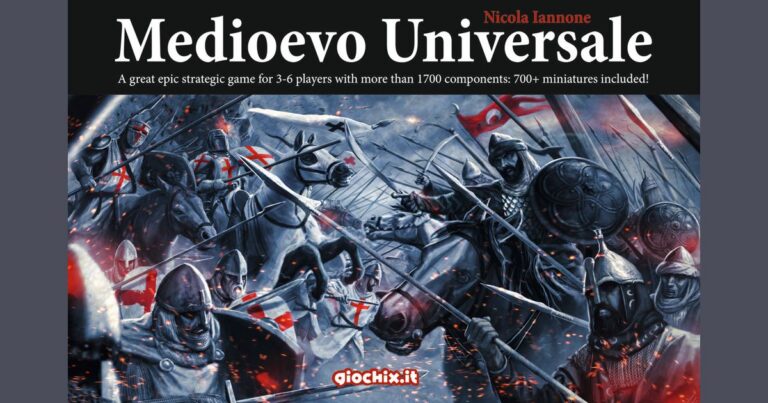
Medioevo Universale is a HUGE game and for those who know me, there is nothing that floats my proverbial, tabletop gaming, boat more than big, complex games that take half the day or more to play and make casual gamers sigh. Until now though the only way to slate my thirst for such rare behemoths, was to play my brother at Axis & Allies Global… a monster of a game that can take, if you go for full conquest, 12 hours + (one game of ours took 3 days, it was glorious) but while looking around Kickstarter for my monthly fix I stumbled across Medioevo Universale. It promised to be a big game, so I went all in….. only when I received it, late last year, did I realise how BIG it really was!

MU is a grand strategy game for 3 – 9 (3-6 if you didn’t buy the expansion) that encompasses technology trees, commerce, diplomacy, natural disasters, rebellion and battle in the middle age; Its basically Medieval total War in board game form.

Note: the minimum of 3 players is just so you can make the most out of the diplomacy side of the game, but you can play 1v1 if need be and ignore the diplomatic side of the game.

Components

Depending on what version you backed / bought will depend on if you got basic counters or resin and metal. I, because I have no self-control when it comes to things like this went for the all-in version and so found over 1700 components including:

  • Metal coins of 1, 2, 5, 10, 50, 100 and 500 florin denominations – there is something seriously cool about playing a game like this with what feels and is weighted like real money; very nice touch.
  • A nicely printed box for each nation, containing their units – Captains, Archers, light infantry, Heavy infantry and cavalry – the sculpts are ok, if a bit flimsy but to be honest in games like this, anything is better than a cardboard counter and they do the trick.
  • Resin Catapults, trebuchets, bombards, castles, towers, merchant ships, galleys, war wagons, caravans, villages, towns, cities and cathedrals – these are quite nice sculpts though, as is generally the case more mass resin manufacturing, there are a few warped pieces.
  • Counters, all the counters for your tech tree, trade routes, traded goods, castle control, ownership and additional pieces for a prototype version of the game that was provided also.
  • Cards, lots of cards – 4 types of cards seem to be provided for you, but two sets are for the game as it is, Empire and event cards and the others are for the prototype game.
  • Player screens – 2 for each nation (1 for the newest version of the game and one for the prototype.
  • A set of coloured dice (D4, D6 and D8) for each nation
  • 2 large board sections and one smaller one – this makes up the board for the game, comprising of Europe, North Africa and some of what is now Russia / the Ukraine. You WILL need a big table for this, or the floor.

Note:  the boards are double sided for use with the current game and the prototype.

  • 2 sets of rules – 1 for the current game and one for the prototype
  • 9 sheathed daggers … that’s right, you get 9 daggers in the version I got, nicely made, in scabbards and useful for when the inevitable fight breaks out, after betraying you long term allies.

Rules Complexity

I have to say the rules aren’t overly complicated; despite the numerous phases. Something I feel was refined from the prototype version which includes supplies, religion and terrain. Bolt on rules like terrain and debts can be used but are not essential in playing initially.

The only major gripe I would have was that there isn’t a glossary for the main rule points  and so when you have issues about a certain phase or how something works you have to look back and forth to find things, which, especially when learning the game, can take some time.

Other than that, it is no more complicated than a lot of strategy games, it just has a lot of different options on how to play and win. Just be advised that reading these rules thoroughly before hand is a must, if you want to make the best out of it.

Myself and my brother played and learned as we went along but this meant we missed out on certain things and had to shoehorn them in later to make sure it was fair for both of us.

Victory conditions

How do you win? Well it’s all about Honour points and these can be achieved by taking on barbarian lands, building certain buildings, completing a supply road , defeating rebellions, conquering enemy towns and cities, as well as achieving objectives, set out on Empire Cards. At the end of a set period of time, this can be turns or a time limit decided by you all honour points are added up and the winner is the person with the most. Just bear in mind that breaking diplomatic pacts, attacking without a declaration of war and losing to barbarians, reduces your honour points so this needs to be weighed up when figuring out your game plan.

For example, myself and my brother had been using barbarians as a sort of proxy way to fight each other without actually fighting each other, allowing for trade routes and movement to stay open between us but it got to a point when I was getting quite strong and felt a declaration of war was needed to finish off the Spanish in the south and to prevent the French from getting too strong in central Europe. It was duly declared and, I as an honourable leader, assumed that I would have 1 more turn of taxes and unit purchases before war began; I was wrong.

The Machiavellian mastermind that is my brother figured out that, despite attacking without a declaration might bring him down a few honour points, if he attacked now and took my poorly defended cities, he could rack up enough points to supplement this loss and cripple me at the same time. Which he did and managed to seriously weaken me in the east; something I only recuperated from after I reconquered Jerusalem and he failed miserably to take one of my fortified towns.

Phases and Game Mechanics

MU has 6 distinct phases.

Turn Order Phase – Where in everyone makes a bid on being the first player by placing in their hand a certain amount of coin from their reserve. The winner is the player who bided the most BUT he must give the money he / she bid to the person who bid the least; as they will be going last. Everyone else goes in order of their bid amounts (keeping their money) with ties being sorted at random.

Now why is first place so important? And why wouldn’t I just bid low, so I have the chance to get the first players money? Well that leads into the next phase. (Event Phase) first off, there is a negative modifier to player’s dice rolls when they go second or lower, increasing the lower the placement, with a -1 for 2nd and a -3 for 6th. This negative modifier may seem poultry but when you are rolling attack dice it makes all the difference. On top of this the first player not only gets to choose what affect event cards have, restriction of movement, loss of commerce, loss of army units or even los of buildings but they also get to roll the dice to see how strong the Barbarian units are each turn.. AND move / add some as well. This can be frustrating for other players who suddenly find their lands ravaged by barbarians moved by the first player and helps you fight proxy battles / undermine nations without officially going to war with them.

Note: some technological advances enable you to move barbarians as well, so position in the game becomes very important and means you must hold back Florins each turn to make sure you have enough for a decent did.

The Event Phase – as described above the First player, who won the bid decides how strong the barbarians are, where they are moved and choses an event card, which represent famine, desertion, raids and sabotage. Initially these cards won’t have a huge effect but as your empire grows and the amount of men, building and merchants you have increase, these cards become devastating; something my brother found out when a plague hit central Europe and killed most of his garrisoning units.. no units in a territory and it reverts to barbarian control; no more taxes for you!

At the end of this phase you have a rebellion step, which basically decides if you have taxed your lands too much and if they will put up with it or not. If the card has a tax value equal or higher that your current tax rate, it fine, your peoples are happy. If its lower then a rebellion breaks out in your territories, one per level of tax.

This is a very interesting mechanic because it makes you think long and hard on how much you are going to tax your people. Do you risk it and bump it up to 50 Florins per territory and risk potentially 4 or 5 rebellions breaking out in your lands or do you play it safe, meaning you have less money to buy troops, technology and Empire cards.

The Tax and Maintenance phase – in this phase you change your tax rates and then collect the money owed to you by your territories; you also must pay for the upkeep of your armies and transports. You get the tax rate for every territory you own plus a bonus for owning villages, towns and cities. You then subtract the number of units you have in your army, including transports etc. and that’s how much you have for purchases next phase.

The Purchase phase – Like it says on the proverbial tin, this is where you use your taxes to buy technology advancements, which you need to build specific units, towns and military buildings, as well as merchant carts, transports, military units and war wagons. On top of this you can buy Empire cards which provide you with 3 potential uses.

The first use is for the objective it will give you, providing Honour Points, the second use is for the bonus it will give you advantages like +2 to attacks, increased commerce, add military buildings to land and increase the amount cogs for technology. The Third use is for the cogs. Each card will have different coloured cogs and can be used to provide these for technological advances; all technology needs these to be bought and used so Empire cards are very important.

Combat and Movement phase – this is the phase you have be waiting for and gives you two options to either move units or attack areas. BUT unlike all other similar games, you can’t just move units around without transport, including land units. Strange you may feel but originally the prototype game used to incorporate supplies and forage but to simplify it makes you buy battle wagons, which for all intents and purposes are transports but really represent supplies for your army; no supplies no movement. The only way you can move units without these wagons is by sea, on galleys and when you have a Castle, allowing you to move into a neighbouring territory.

Once units have been moved you either fight another nation or you fight a set number of barbarians; this is where an interesting dice mechanic comes in.

Combat is not based on the number of units you have but more on the dice you roll and the special abilities each unit brings to the battle. A Captain can negate abilities, a Light infantry man gives +4 to the attack if no other light infantry is involved, heavy Infantry negate damage (if not other heavy infantry is opposing, cavalry give +2 to the damage if you win a battle and archers let you strike first and kill units before the battle proper starts. Siege engines and bombards can be used to attack buildings or land units but need land units to man them.

As the dice roll goes, you have 3 dice, all the time, irrespective of how many units. A D4, a D6 and a D8 and you battle score is a combination of your highest rolls added together, or, if you are supper lucky and get doubles those two numbers multiplied together (a critical roll) the lowest number is then how much damage your army will take irrespective of win, lose or draw, so you need it to be low. Additional casualties are then worked out using the difference in score between the two sets of dice and that is the extra damage caused to the loser.

Note: you cant cause any more damage than you have units in an army, bar with cards and cavalry bonuses.

Commerce phase – this phase is for you to move you merchant ships and caravans around the board, purchase items and then sell them on. More can be earned if you use Trade roads or if you sell at a great market, this is an inhabited area that already has good being sold there.

After this phase is over, it returns to the first phase again.  now, you’ll be wondering what happened to the diplomatic phase? Well, there isn’t one. Diplomacy is figured out in an ad hoc way as the game plays.

Game Flow

Once you get the phases down and understand how the main mechanics work, the game can flow quite quickly, especially as unlike other games, massed attacks, with lots of guys, isn’t as common until later in the game. Flow is also made a lot easier / quicker because many of the phases are carried out at the same time by players, with only attacks and placement really being turnabout. I have no doubt though that when more players are involved, diplomacy will become a lot more important and therefore take up more time as nations talk, make deals and stab each other in the back! Might not be a good idea to have the knives…..

Conclusions

A beautiful looking game that is a lot easier to play than it looks. Just be sure to read the rules carefully as there are a lot of sub steps and special rules to bear in mind. Bearing this in mind though, we felt that a reference book would have gone a long way to help with specific rules and help reduce initial games when rules aren’t widely known.

Playable by 2 people but something that will be better, if longer, when more people are involved.

A great game, with some very interesting mechanics, you just need to find the right sort of people who can stick out this monster for the time it will take to do it justice.

Incy, Wincy Spider…. “The Spider Dance” by Nick Setchfield

0

Reading more like Harry Palmer than James Bond, the Spider Dance is memory of a simpler time, when World War 2 was a recent memory, and the Iron Curtain carved the battered, burgeoning and caged chaos of the late 40s and 50s asunder. But it’s also a reminder that we shouldn’t take things for granted – things were rarely as cut and dried as we have been told. So many things are being declassified and revealed, but so much more is unsaid, or forgotten. It’s not so hard to believe there might have been space for magic in the chaos of war, whether hot or cold?

The Spider DanceWhile there are touches of glamour in winter’s travels, they’re more of the mystical and deceptive kind. Scenes are painted against a background of grimy, cluttered London streets, and damaged European cities trying to rebuild from the recent rains of bombs and artillery. Wedged into the corners are clutttered, forgotten old churches and graveyards, pregnant with secrets.

Nick SetchfieldThe author, Nick Setchfield, is probably best known as an editor and writer for SFX magazine and Total Film, though he has also been a script writer for the beloved, and departed British satire show Spitting Image.
Setchfield’s hero, Christopher Winter, is both more, and less than he seems. We find him working in the London underworld, having separated himself from the service of Queen and country. Trying to figure out who he is to become from a shabby little hired room in Wembey, he has only some sour milk milk for company. He once wore another name, but the same face – he just can’t remember who that was. But that name refuses to stay dead – like a number of other things!

A chance encounter with something too fast, ugly and deadly to be human sees Winter dragged back into the ordit of his former boss. Just one last job behind the Iron Curtain – except it’s not him that was requested, but the man he once was. Meeting people from his past, and learning things he isn’t sure he wants to know, he finds himself embroiled in a world he had forgotten about – Something older, stranger and both more brutal, and yet more civilised than the one he, and we, know.

He stared up, blinking the soot from his eyes. Something had disturned the rafters of the old station. There was a shape there – but barely there, almost indistinguishable from the darkness that hid the rotted joists. A coiled, compact mass of shadow, as if the dark had contorted itself into something solid.

The darkness uncurled and dropped from the rafters as a man.

While he bounces back and forth across Europe and Britain, things are never quite what they seem, and he unearths secrets, buries friends and makes new ones. He slowly finds a new place for himself in the world – if a little loose and unconstrained. Along the way he learns that the ‘real’ world has a lot in common with the world beneath, and about the edges – it can be beautiful, it can be shabby and petty, and sometimes the only way to solve a problem is with a knuckle duster and a large dose of stubborn.

The writing is clean and clear, sometimes stark in common with the brutalist architecture that was so beloved of the 50s and early 60s – harsh and grey and with deep, straight edged shadows against the grey of concrete. Yet things look back at you from the shadows, and it’s worryingly easy to look into them, and step too close. It has a very cynical view of magic and religion that fits well with the shabby, worn appearance and spirit of the time, but it never forgets to show glimmers of optimism. There are slivers of wonder & beauty, even dulled down by the grubbiness and pettiness of jealousy, greed and despair. But sometimes it’s easy to forget what rot and danger can hide behind beauty.

I enjoyed the book overall, and once I started it, I found myself reaching the end a little to early for my liking. For all it’s grime and weariness, there’s a glimmer of passion and wonder hidden about the edges of the world, and more to see. The pacing was well judged, and varied appropriately as the story moved around and forward. If it had been flat out from start to finish, it wouldn’t have been enjoyable at all, and the reader would become exhausted partway. Our hero is only human, after all, and so he has to take things at a varied pace – sometimes driven by his enemies, sometimes taking it slow to make sure we understand what he’s gotten himself into. We ride his coat tails, dodging his enemies and seeing familiar places in a new light. His allies and enemies occupy a range of well-defined tropes – the noble villain, the wronged but promising colleague, the honourable, vicious gangland boss, and many more, but they’re engaging and work well as foils and challenges to Winter.

I look forward to seeing where Setchfield can take Winter, next. There’s a whole wide world for him to look at, on both sides of the Iron Curtain! With a number of secrets unearthed already, there are many more left. Whether we move forward, or we step back to learn some more about his past, there’s a lot of potential here.

Battletech – One Year On

It has been a year since Battletech was released (reviewed here) and Paradox Interactive have not rested on their laurels.  During this time, they have patched and expanded the base game, released two new pieces of downloadable content (DLC) – Flashpoint and Urban Warfare – and are developing a third and final piece of DLC in the form of Heavy Metal.

The core game of Battletech, now at Version 1.6, has been expanded to include a career mode alongside the existing campaign mode.  This means that those wanting to replay the game will not have to replay the story missions of the campaign mode, thus adding to the replayability of the game.

Flashpoint introduces inter-connected missions – called “flashpoints” – into the base game.  Urban Warfare, on the other hand, introduces new city-based maps, as well as further flashpoint scenarios.  Both of these pieces of DLC also provide the player with access to new mechs.

The career mode has the player starting out as the head of a mercenary company with four mechs, leaving them to do as they wish.  The career mode has been a joy to play, as it includes all the strategic management of the campaign, without having to replay the story.  The game has also been expanded to include a player’s reputation with each faction, which has a legitimate impact upon the game.  An example of this is if the player repeatedly takes missions against local pirate organisations, then the cost to join the black-market will increase.  Likewise, having a higher reputation with a faction will offer access to high-profile missions that promise greater rewards.

The flashpoints in the career and campaign mode are definitely the highlight of the first DLC.  Flashpoints are essentially mini-campaigns, usually about two to four missions long, but with no chance to repair mechs or heal pilots.  Told through the same style of painted cut-scenes in Battletech’s campaign mode, these offer higher rewards and necessitate new strategies for players managing their mechs.

The game’s battles have also been expanded to include new elements.  The first, and most fun, is that there is a chance that a second opposing force appears.  These are no longer reinforcements for the antagonists, but an independent third-party who share the same objectives as the other factions involved.  This encourages the player to revise their tactics to take advantage of, rather than be out-manoeuvred by, the opposing factions.

A new mission type that has been included is Attack and Defend, where swarms of enemy mechs attempt to destroy a base the player is defending, whilst the player attempts to destroy the enemy base.  Again, this requires players to rethink their tactics, to include these new elements, as players can no longer wait for the enemy to come to them.

The terrain has also been expanded to include Mediterranean biomes and urban cities.  The different environments have little impact on the terrain, but their atmosphere affects how well the mech operates, especially in terms of the heat generation/dissipation.

The urban environments introduce the greatest change by giving players the opportunity to battle within dense cityscapes.  Naturally, these cityscapes will require a new approach, due to the buildings blocking lines of sight.  Whilst this can be overcome by using jump jets to move over – or onto – buildings, the latter does mean the opposing mechs can destroy the building a mech is standing on.

The two released DLC bring five new mechs to the game.  As Flashpoint introduces the Hatchetman mech, a close-combat mech is now available for players who prefer more brutal style.  Expanding the combined arms approach are the new mech upgrades; Electronic Countermeasures (ECM) to hide mechs, and the Active Probe for finding hidden mechs.

Unfortunately, some of the downsides that were first in the game still remain.  For example, there are still occasional clipping and visibility issues, due to terrain and environment features obscuring what is happening during the cinematic mode as a mech carries out its orders.

Overall, what was an already great game, has become even better, with it being updated to include new features.  The expanded DLC are also excellent value for money by providing further replayability.  Needless to say, I am looking forward to the third and final release of the Heavy Metal DLC later this year.

San Diego Comic Con 2019: A Hitchhikers Guide

To say my first ever San Diego Comic Con was an experience coupled with a sharp learning curve is an understatement. Having seen so many people before me do the Con without a hitch i thought to myself “yeah i can do this!”. I Got my Press Pass, booked my flight and with a bag full of over confidence I made my way there; where upon it became very apparent that I was very much under prepared for the trials, mishaps and troubles that come with navigating around one of the largest Comic Cons in the world. Nothing will properly prepare you for the shear size of this event and for those coming from colder climates, the heat!

With this in mind, and in order to better prepare my fellow UK Geeks, who are thinking about making this great Odyssey, i have put together a short  guide, with the help of some other UK pilgrims who have made the journey more than once, to aid you in your quest for Nerdy Nirvana.

So sit back, relax, don’t forget to grab your towel and enjoy…..

Step 1. Do Your Homework

Comic-con.org

If you haven’t already, registered with www.Comic-con.org. Within you will be able to get a members ID and, if you aren’t Press register for your Comic Con ‘Badge.’ They also have information on hotels, Shuttle Buses and a valuable FAQ section where they answer most of the big questions. You can also see past comic cons on their website which includes a vast collection of pictures and also a Map of the surrounding area. I say surrounding but the con takes over the entire city; literally.

Facebook Groups.

Get on it. https://www.facebook.com/groups/comicconukattendees/ is THE group to join, the people are friendly and information is plentiful. Got a question? these guys will answer it in record time, usually coming from Garry Quigley the Oracle Admin of the group or from Patrons like Cassandra Queeley, Charlie Pearson or Graham Small. In fact when writing this article i reached out and asked for their input, so here’s some gold top tips from the group.

Dom Rand – “Top Tip – Learn what is and how to use. ….Deodorant” – A general tip really but with all that heat, and all those people, essential

Sal Ellis –  “Take snacks!” – There are numerous places to get food and drink BUT they will be full and you may need sustenance to keep you going, especially in that long winding Queue for Hall H.

Graham Small – “The first rule is join this group, going to SD from anywhere overseas is a large commitment, so its worth planning a trip before or after the convention at the same time – best cost flight routing may help shape your trip (flights direct into San Diego are limited).” –  A sound Idea… VEGAS BABY!

Simon Ellis – “San Diego Convention Centre is big, you may think it’s a long queue for a photo op at a UK comic convention but that’s peanuts compared to queuing for one of the big events in Hall H ” – Seriously I cant emphasise this enough, Queues are HUGE and if you want to get into Hall H, be prepared to queue over night in some instances.

Martin Head – Take a chair! – especially if you are in line for the above.

Do or do not, there is no try

Climbing the mountain that is SDCC without a plan isn’t a great idea. Having a plan for each day along with backups will help insure your experience is as rewarding and stress free as can be expected from such a large event.

Communication is key! Phones die, technology fails so having a meet up point and time can really help keep you and your friends comfortable and in contact. No one wants to be alone in the worst case scenario so taking the time each day to set this up will give your group peace of mind.

Step 2. Visa Application (ESTA)

The application process is relatively easy, costs about $14 and you can just follow the link here ;https://esta.cbp.dhs.gov/esta/ 

Now i know the idea of applying for a Visa sounds terrifying or at least a little daunting but i have to say the questions asked are straight forward and easy to answer. All it takes is a little common sense and you’ll be fine. If you are unsure about anything always refer back to the Facebook i linked at the beginning and the good people on there will help.

Step 3. Flights

Conventional travel methods would have you booking flights via a travel agent however this is not always the best way to secure the best deals. Sites like Expedia offer great deals, tailored to your unique needs. A top tip is to clear your computer cache before each search! This will make sure you’re getting the best deals of the day. (also search for flights on Tuesdays! This is a slow day for most airlines and the deals start there!)

It is important to check your baggage allowance for each deal, sometimes the ticket will require you to purchase your bags separate, driving up the ticket price.

You should note though (and thanks to Gavin Braiden for pointing this out to us), “a lot of the major airlines are now selling basic economy tickets which includes hand luggage only and no seat selection etc. These are usually the first and sometimes only option thrown up on price comparison websites like Expedia, Skyscanner etc and it’s very easy to miss this detail and get stung for an extra $60 each way for a bag, and, I estimate, maybe more for seat selection especially if you have connections and will have to purchase seats for each leg!! They’re all becoming more like low cost airlines these days!!”

Step 4. Hotels / accommodation 

There are three options for staying in and around SDCC: Hotel, Air BnB or stay with a friend. Having a friend in the area is obviously a bonus because it will most likely be free, or at least a fraction of the cost of anything else. Air BnBs are a double edged sword and can be great, and super cheap if there is a group of you, BUT I have heard horror stories and so it is imperative that you check reviews and feedback as the owners with little notice can cancel your booking.

Hotels are your final option and can be very expensive so either you suck it up and pay the big bucks, get a hotel in LA and travel or book well in advance to make sure you get a better rate. The hotels are more convenient but make sure you do your research first.

Step 5 . Travel to and from the Convention 

If you are lucky enough to stay in a near by hotel then this wont be an issue for you but if you are further a field then either get to know where the shuttle bus goes from or UBER is your friend, cheap as chips and abundant. Pro tip for new users! If everyone in the group downloads the app, you will each get a free ride code to share to first time users, once they use the code you will also get a free ride, with some planning a group of new users can get a fair amount of free rides!

Step 6. Reconnaissance 

San Diego is not your average Comic Con. It’s hot, humid, crowded and loud. To most of us in the UK it would resemble a herd of cattle being led to market while wearing their Warner Bros San Diego bags strapped to their backs. A day, or at least an afternoons recon/survey, when you first get there, is a must. Get the lay of the land, where everything is, best places for food, where the air con and meeting points are.

Therefore you need to pace yourself find out what’s happening, and when, so you have an itinerary personalised to you.

Step 7. Prepare to queue

Prepare to queue, I mean a lot. If you’re lucky enough to get the exclusive lottery you need to have the patience of a saint because other people won’t. Like Martin Head said, above, bring a chair, or a tent, if you attempt Hall H. (Hall H being the Main hall where MARVEL hold their announcements)

Step 8. Hydration and the right cloths for the day

Staying hydrated, especially for those unused to the heat is key. Make sure you have water easily accessible at all times, especially in lines.

Clothing, be comfortable in what you’re wearing, shorts and hockey jerseys are my go to dress sense. Sensible shoes and clothes will help to keep you cool and comfortable, lightweight fabrics and loose clothing for ease of movement.

Step 9. Shopping and Tipping.

With so much on offer, the amount of amazing merchandise you can buy is endless, but don’t weigh yourself down! Take the time to drop off large and heavy purchase back at your room, your back with thank you but also your exclusives will be safer from damage and theft. Keep in mind your baggage allowance, if you over do it you may gave to pay for postage home, not a cheap or safe option! Bring your own bags just incase they run out!

Tipping!

For many in the service industry in America, Tipping is used to make basic wage, to not tip is to stop a person making a basically liveable income. It is only acceptable not to tip in light of truly horrific service but keep in mind the livelihood of these people, you will not make friends with Americans by stiffing the staff on tips.  15% is considered a standard tip, feel free to go over that for excellent service!

Step 10. Take a day off from the convention proper

SDCC isn’t just the convention centre itself, its almost the entire city! Take a day to check out the different bars, pop up events and stages in and around the hotels and waterfront.. you don’t even need a pass for most of these and can enjoy the event without one! Remember you’re in a different country! Why not enjoy a bit of what they have to offer while you’re there!

So there we have it, a quick 10 step guide on how to deal with your first San Diego Comic Con. It will be hot, it will be crowded and it will be an assault on the senses (and wallet) but if you take these points in to mind, (and obviously bring a towel, it is Hitchhikers guide after all) you will have one of the best con experiences of your life.. UK conventions just wont be the same anymore.

Got anymore tips / Advice then please leave us a comment below

So until next time, Face Front True Believers and thanks for all the fish.