Following the successful launch of two new box sets for Classic BattleTech (an interview with Jordan Weisman, the creator of Classic Battletech, can be found here), “the tabletop game of armoured combat” comes to Kickstarter for the first time. The Clan Invasion box set will unleash new versions of Clan and Inner Sphere mechs, expanding the tactical options available to players.
The Clan Invasion of 3050 witnessed the true heirs of the lost Star League charge deep into the quarrelling Successor States. As the Clan in rolled across the Inner Sphere, the five great houses unified to devise some way to halt the invaders.
Utilising the same techniques that modernised the original BattleMechs found in the core sets, each of the new mechs have been re-imagined; holding to the spirit of their original design while embracing a modern aesthetic.
The Clan Invasion box set will also add five OmniMechs (highly configurable mechs), including the seminal Timber Wolf. It will also include a bevy of support materials, such as the rules needed to incorporate Clan technology in your games plus brand new maps.
The kickstarter’s stretch goals will expand the ranks with more mechs, boasting equally re-imagined aesthetics, available to be unlocked. The Clan Command Star expansion will include the devastating Dire Wolf and Shadow Cat, whilst the Clan Attack Star pack will contain the Warhawk and Nova Cat. Meanwhile, the Inner Sphere will attempt to stop the invasion, with the Inner Sphere Command Lance pack, incorporating the Marauder and Archer, whilst the Warhammer and Phoenix Hawk will drop from the Inner Sphere Battle Lance pack.
Other add-ons include a plethora of BattleTech merchandise, the latest rulebooks, sourcebooks, boxed sets, and more.
Alongside the Clan Invasion Kickstarter, the brand-new Chaos Campaign: Succession Wars has been released for free. This PDF provides rules for selecting a force and embarking on mini-campaigns, as well as tools for creating campaigns of your own.
The scenarios included with the original boxed sets are intended as one-off battles. Chaos Campaign introduces campaign play, which offers consequences between individual missions, a reason to chase down specific objectives while preserving your troops, and ways to improve your force as you progress.
Onyx Path Publishing have revealed their new vision of the classic table-top roleplaying game Scion, with the combined release of Scion: Origin and Scion: Hero last month. Scion: Origin contains the basic core rules for running games in the Scion universe, whilst Scion: Hero provides players with rules for playing characters who are descendants of the gods.
It would be fair to say that the original Scion, by White Wolf, was a flawed gem. It was a game that had a fantastic premise, but was mechanically broken. In Scion, the gods of myth are real, from the Norse Aesir to the Greek/Roman Theoi. Players take on the roles of the descendants, called “scions”, of these mythical beings. Opposing them are the titans, be they the Norse frost giants or the Fomorians of the Irish Tuatha Dé Danann. Whilst the gods are embodiments of human belief, titans represent primordial forces and care little about mortals, who define the gods.
In White Wolf’s attempt to adapt their existing Storyteller system, which had been used in every World of Darkness game at that point, they had inadvertently stretched it beyond breaking point. Much of this was due to the disparate power levels at play within Scion, meaning that conflicts could take well over an hour to resolve.
Scion 2nd edition developer Neall Ramon Price (interviewed here) could undoubtedly see the promise that lay within the game, but realised that something had to be done about the system. Rather than revising the existing game mechanics, he and Onyx Path created an entirely new system for the game, called “Storypath”. This new system was designed for Scion and thus addresses many of the failings within the original Scion, by introducing – amongst other things – scalability into the mechanics.
Anyone familiar with White Wolf’s Storyteller system, or the Storytelling system in the Chronicles of Darkness (“new World of Darkness”) games, will find Storypath easy to understand, as it shares many similarities. Players roll a number of ten-sided-dice, determined by the skill and attribute for a skill check. The number of successes is determined by the number of dice that roll seven or more, which players use to meet the difficulty of the task assigned by the storyteller. The harder the difficulty, the more successes they need, with excess successes being used to further influence the game to the player’s benefit.
Both books are required to play Scion: Hero for fully-awakened scions. However, Scion: Origin does allow players to take on the role of scions before they are aware of their divine patronage: these are known as “pre-visitation” scions.
The setting in the original edition was akin to today’s modern world, but with the pantheons operating as a secret society, and without taking the worship aspect of the gods into account. In the new Scion, it is still a modern-day setting, but with the gods very much a part of it. This reinforces the core premise that the gods are real and are influencing society.
That said, the degree to which the pantheons can influence the world is limited by “fatebinding”. In fatebinding, mortals can become bound to a god’s duties if their actions set a new precedent. This compels deities to empower scions to operate on their behalf.
The nature of the scions in this new edition of Scion have also changed. Previously they were always children of gods, whereas now they can be ones who have been chosen or even created by gods. This widening of scope allows more flexibility when creating characters, as well as being more in keeping with the original myths.
Scion 2nd edition also incorporates a lot more of the divine essence of the mythological deities into the game, with the rules for virtues and fatebinding. However, as the book states (in their own words), these rules – especially those for virtues – are “wobbly” due to abstract nature of the game.
Both Scion: Origin and Scion: Hero have a great game master’s guide at the back of each book, giving an indication of how the game should be played. It would have been helpful if the developers had also included a variety of story hooks for starting new games. However, Onyx Path recently recorded an actual play session on their podcast and YouTube channel, which gave a useful indicator of a typical game of Scion.
Scion: Origin and Scion: Hero have both been released and can be found in local game stores and online at DriveThruRPG. A subsequent Errata and FAQ document has also been released. Hopefully the errors will be corrected in an updated version of the PDFs. A gamemaster’s screen has also been released, but unfortunately only as a physical item from American suppliers, for which the shipping is more than double the cost of the screen.
Scion has a great system that is – mechanically – perfect for the game and is gorgeous to look at. The artwork is likewise fantastic and captures the epic fables of ancient myth.
However, the explanations of the different rules in Scion: Origin and Scion: Hero occasionally lack clarity, and would have benefited from being more succinct. In this regard, the pdf version is better than the physical book, as it is searchable and has a neatly hyperlinked index tab for quick referencing.
The content of the two books could have also been divided more appropriately, as there seemed to be some repetition, whilst other material – such as the skills – was only in Scion: Origin. It might have been easier to have the core Storypath system in one book, with Scion-specific content in another. It is not clear what the motive would be to play pre-visitation scions when the players can choose to be fully-empowered scions.
It would also have been useful to have reference sheets included in the games, as character creation can involve a lot of flicking between pages for finding lists of the different abilities that scions have access to.
That said, these are relatively minor quibbles for what is a fantastic game. Ultimately, we finally have the game that was promised to us all those years ago. This new Scion captures the spirit of mythological storytelling and provides the tools for playing epic fables.
Despite the mixed response to the recent Prometheus and Covenant films, the Alien series still hold a special place in many geeks’ hearts. The Alien and Aliens films are frequently praised and the colonial marine cosplayers remain a frequent sight at conventions.
There has been a slew of video game adaptations of varying quality, from the surprisingly good (Alien: Isolation) to the shockingly terrible (Aliens: Colonial Marines). Despite the frequency with which the films have been mimicked, there have been far fewer board games based on the films.
The Aliens Adventure Game by Leading Edge Games, released in 1991, specifically focussed on everyone playing a colonial marine, with little choice of players taking on the role of any of the myriad of other characters within the Alien universe. It also had an incredibly complex rules system, which made for a frustrating game to play.
It seems that I was not the only person who thought it was about time that we had a roleplaying game (RPG) where we could explore the rich mythology of the Alien universe. Tomas Härenstam, of Free League Publishing, obviously thought the same, as he is the game director for the forthcoming Alien: The Roleplaying Game.
With the UK Games Expo (reviewed here) behind us, I had the opportunity to talk to Härenstam about roleplaying in the Alien universe and how in space no one can hear you scream… Still…
How did you become involved in creating the Alien roleplaying game?
It started out in brainstorming session we had at Free League Publishing back in early 2018. We were discussing movie licences we would like to turn into RPGs, and we ended up with a very short list of dream licences. Alien was on that list – we’re all huge fans of the films, and we feel that their sense of wonder combined with the harsh and brutal world is a perfect fit for the style of games we design.
Shortly after that brainstorm, I happened to hear of Joe LeFavi, who runs Genuine Entertainment and works with brand management in Hollywood. I contacted Joe, and it turned out he was a big fan of our Tales from the Loop RPG. We immediately hit it off, and Joe quickly went to work on approaching 20th Century Fox on our behalf. We spent some weeks on a pitch for the Alien tabletop RPG, and after a short negotiation, the agreement was signed.
When is the game set within the Aliens universe?
It’s set in 2183 – that’s four years after the events of Aliens and Alien3. We chose the classical era, as it gives us so much amazing lore to draw from, both the older films and the new prequels. The only film that’s outside the scope of the game is Alien: Resurrection, which is set about 200 years later.
To what extent have 20th Century Fox been involved in the development?
20th Century Fox are the licence holders and as such, they review our work and make sure we stay true to the Alien canon. They have also helped put us in touch with other Alien licencees, so we can help each other out in different ways. Overall, Fox has been a great partner for us.
What characters will people be able to play in the game?
The full core game will include ten character careers, drawn from the Alien films and other media, including Roughneck, Scientist, Officer, and Colonial Marine. These careers work as character archetypes, great for quickly creating a character. From that stating point, there are lots of ways to fine-tune your character and make them truly unique.
Will the game be solely focused on Xenomorphs, or will there be other enemies?
That’s a great thing about creating this RPG; we get to explore the rich Alien universe that has been built throughout the decades, not only the films but also comics, novels, and computer games. There are many more dangers out there than the Xenomorphs – although they of course remain the signature Alien enemy to overcome.
Why did you choose to use the Year Zero engine and how did you adapt it to meet the demands of the game?
We feel that the Year Zero Engine is very adaptable for different themes and settings. It’s also built for fast and brutal gameplay with a high mortality rate for characters, which felt like a good fit for Alien. Thirdly, players familiar with Free League games will be able to grasp the system and get in to the game very quickly. Finally, the Year Zero Engine is tried and tested, and we knew it would do the job well.
That said, we have tweaked the engine a lot for the Alien RPG. as we feel it’s very important that rules and setting work together. For Alien, the key new mechanism is the Stress Dice. When you push a dice roll, or experience a stressful situation, you will accumulate Stress Dice. These will actually help you in at the start, making you sharper and more alert. But if you collect too many Stress Dice, you risk panic. It’s a little like a game of Blackjack – you’ll push your character to the limit, but if you push too hard, panic ensues.
How did you incorporate the variety of genres of the Alien films into the game?
We identified three core themes of the game – Space Horror, SciFi Action, and Sense of Wonder. These three themes are to some extent present in all official material for the game, but certain scenarios will focus more on one particular theme – just like the movies do.
How do the Cinematic and Campaign styles of play differ from each other?
In Cinematic play, you’ll play one-shot scenarios with pre-generated characters. All players are not expected to survive, and there can be a certain level of player-versus-player conflict – just like in the Aliens films.
In Campaign mode, characters explore known space freely, sandbox-style, using the huge star-map we’re making. In Campaign play, lethality is lower and characters are expected to last longer.
What expansions can we expect in the future?
Alongside the main book launch, we will release custom dice, a game master’s screen, and a set of maps and markers. After that, we’re planning two Cinematic scenarios which will be sequels to Chariot of the Gods, the introductory scenario in the core book. All three are written by our lead setting writer Andrew E. C. Gaska.
We’re also planning a source book for Colonial Marines, to be used for Campaign play, and more campaign books after that.
Fans of author A. S. Chambers have long been fascinated by the character Nightingale: a vampire who appears in several stories set in the world of paranormal investigator, Sam Spallucci. Hence, their anticipation of Songbird – the first story to focus on Nightingale – which is due to be published in July.
Since her first appearance in The Casebook of Sam Spallucci, readers have loved the enigmatic vampire Nightingale. Songbird tells of Nightingale’s rise from poverty as an orphan on the streets of Victorian England, through to leading the Children of Cain, a society of vampires.
Along the way, Nightingale suffers at the hand of a sadistic parish priest and his wife, before being rescued by her vampire father and subsequently travelling to the Wild West to track down her missing brother, Justice (yes, that is his name, poor lad). The book has already garnered excitement amongst Chambers’ readers and will be available for pre-order through a Kickstarter campaign.
Launched on Monday 27th May, the campaign reached its target in just six hours. As well as the novella, other items will be available as rewards. These include a taster book of the world of Sam Spallucci with The Case of the Belligerent Bard, as well as Sam’s first outing in The Casebook of Sam Spallucci.
There are also limited edition A4 prints of the cover art for Songbird, which was designed by the talented digital artist Liam Shaw.
How many Sam Spallucci books do think there will be?
I’m currently working on Sam Spallucci: Troubled Souls, the fifth Sam book (sixth, if you include the short story The Case of The Belligerent Bard). I think there are going to be about five or six more which are solely centred around Sam, but that doesn’t mean that the story will end there. Sam’s universe is constantly expanding and heading towards the apocalyptic “Divergence” which will be tackled in the two novels Fallen Angel and Beyond, before plunging into the Divergent Lands trilogy, set after the event itself.
Basically, I need to get a move on and get them written!
When did you realise Nightingale was so popular?
She had always evoked a certain fondness from the readers in the short stories that she appeared in, such as Family and Nightingale, but she (and the other vampires) really hit the ground running in the fourth Sam Spallucci book, Dark Justice.
I think I absolutely nailed their characters here because I’d spent so much time playing around with them beforehand. They come across as very complete and easy to relate to, even though they are paranormal. I think readers love Nightingale because she is so human in her outlook. She is a recent mother and has had leadership thrust upon her at a young age. At times this makes her appear very vulnerable.
Where did you get the inspiration for the character?
I’m not entirely sure. Certain characters in my books I can say, “Oh yeah, he was a chap I sat next to on a bus who just looked like a serial killer,” or “I once knew a priest who got up to all sorts of stuff that you would never believe.” With Nightingale, she just evolved.
I always had a mental image of Ezri Dax (from Deep Space 9) in my head when I was writing her, so I guess her physical image stems from there, although there is a good dose of the lass who played the ghost in the last season of Being Human too. As far as her personality traits go, I think they evolved with the situations that I placed her in. She responds in a kind, caring manner. In her early years (such as the Family short story) she is very naïve and innocent. By the time that we come across her again in Dark Justice, she is having to stamp down on more rebellious elements, such as the hot-headed Tigress.
What inspired the Children of Cain?
In Sam’s universe the murder of Abel by his jealous brother Cain led to the birth of two paranormal groups. The Children of Cain were born when a fallen angel gave Cain a chance to pay penance for killing his brother by turning him into the first vampire. He was left with the instructions, “Find the Eternals. Protect the Twins. Await the Divergence.”
The blood of Abel that he had spilled was eaten by an insane wolf. This became the first werewolf in the Bloodline of Abel and, rather than pursuing noble ventures, the bloodline inserted itself into society, accruing wealth and power.
As the series has expanded, has setting it in Lancaster presented any challenges?
Definitely. I first started writing the series back in 2011. A lot happens in a city over eight years, especially architecturally. For example, I refer to the abandoned Williamson works down on the quay in Shadows of Lancaster. These have now been demolished and replaced by a housing estate, which is actually a reflection of what has started to happen in Sam’s world.
Also, sometimes places just don’t have the properties that a writer wants. An example of this is the Roman Catholic Cathedral. I had intended to set a climactic scene there in Shadows of Lancaster. Sam was going to be deposited on its roof and have to face off against an angry grotesque. I then remembered that the roof on St Peter’s is pitched. There was no way that Sam could walk up there, let alone fight. So, I had to move the scene to the St Mary’s Priory on Castle Hill. Hence a difference between Sam’s Lancaster and the actual Lancaster was born. In the books, the Priory has a number of grotesques; in reality, there are none.
Why release Songbird as a kickstarter?
This is in part down to Amazon doing away with Createspace and simplifying their publishing arm in KDP. With Createspace, you used to be able to set a date for publication some way in the future. This meant that you could promote it and have people pre-order. KDP weirdly does not offer this option for paperbacks, only Kindle versions.
As a result, you feel like you are dumping your book into a market that does not expect it and it can easily fall flat. I decided to use Kickstarter as a way to get around this and have a place where my readers could pre-order the book. It also meant that I could offer bonuses, such as the awesome art by Liam Shaw, and pick up some new readers.
What has been the response so far to the kickstarter?
Phenomenal! I reached my target within six hours of launch and, as we speak, it is standing at over 300%. This means that I have already covered my publications costs before the book actually goes live. I will certainly look at doing the same for future publications.
What does the future hold for Sam Spallucci?
Lots of things, not necessarily nice for the poor chap. Sam Spallucci: Troubled Souls should be out this autumn and will see him whisked through time. He will be tracking down a Victorian serial killer who resurfaces in modern day Morecambe, as well as being transported to the “Divergent Lands” in a crossover with the future title Fallen Angel.
After this come the books Bloodline, Fury of the Fallen, Dare the Dragon and Lux Eterna. He will be battling werewolves, dealing with the reappearance of an ex-girlfriend, sparring with the fallen angels Asherah and Asmodeus and coming face to face with a dark power who has constantly stalked his dreams.
Whilst the initial release of the V5 core rulebook was critically and commercially successful, the subsequent release of the Camarilla and Anarch sourcebooks was beset by controversy. Sales of these books were temporarily suspended and White Wolf was absorbed by its parent company Paradox Interactive.
I met Matthew Dawkins on the Onyx Path Publishing stand at the UK Games Expo last weekend. With Matthew taking a break for one of his many meetings that weekend, I took advantage to interview him about the changes to V5 since we had last spoken and what the future holds for Vampire: The Masquerade.
Following Paradox’s absorption of White Wolf, what is happening with V5?
Onyx Path are still a licensing partner and we are still producing V5 books. Modiphius is also a licensing partner and they are also producing V5 books. There are also at least three games, that I am aware of, coming out. There is Vampire: The Masquerade – Heritage, which I have written missions for, there is Vampire: The Masquerade – Chapters, which I am consulting on, and there is another one called Vampire: The Masquerade – Blood Feud that is coming up soon. So, Vampire is still going strong.
The big change is that it isn’t being created in-house by White Wolf and Paradox, who are now one and the same at this point. They are certainly still maintaining oversight on the broader brand to ensure consistency, but they are not going to be producing books anymore. It was never their intention to be a publisher full-time. They just wanted to be the people who got the core material out there, set the bible down and let partners develop the world.
Why has there been a massive uptake of Vampire: The Masquerade recently?
It cannot be undersold how V20 kept the core fanbase ticking along. With Beckett’s Jyhad Diary, the popularity of it surprised even us at Onyx Path. Whenever books do surprisingly well, such as Lore of the Bloodlines, this shows us that an invested fanbase wanted more.
With V5 coming out, and, frankly, the amount of money Paradox were putting behind its launch, has resulted in a big relaunch of Vampire.
There is a misnomer in people’s minds that Vampire: The Masquerade’s revised edition, or 3rd edition as it is known now, was a rip-roaring success. The reason that Vampire: The Requiem came into being was because Vampire: The Masquerade’s sales were dwindling. V20 uplifted that and in a very effective way.
With V5, and having worked with Modiphius I can speak with veracity on this, it has been quite surprising to us at how popular the book has been. We have even had wargame stores ordering Vampire: The Masquerade, and they do not even order Dungeons & Dragons. V5 is international.
There was an unfortunate reaction to some of the content in the V5 books
I wrote up the clans in V5, and suggested that some of the Brujah might come from right-wing camps. Was than an invitation to play alt-right Brujah? Absolutely not. If someone wanted to play a Nazi at my table, I would ask them to write a new character or leave, as I have no interest in running a game for anyone playing a Nazi. It is just not fun in my mind.
I believe in the World of Darkness, which is our world but darker, that far-right elements exist. Would the Brujah – a clan of impassioned philosophers and politicos – embrace right-wing humans? Yes. Is that nice? No. Do you have to play them? Definitely not. Can they be antagonists? Absolutely. Any excuse to beat up a Nazi in a roleplaying game is perfectly fine.
There are some things you can attempt to justify, there are somethings you can only apologise for, and there are somethings that you have to replace because they are poor. Whilst I think there have been mistakes, with people being too slow to act, and that sometimes they have been too reactionary. It is a fine line to tread, especially when you are a young company like White Wolf were.
That is not making an excuse for them, because they definitely had lessons to learn. They didn’t act perfectly at all times, but that is partly why Paradox Interactive are now saying “We’ve done our bit, this has been our plan all along”, and I think they can do that without any regrets.
One of the things that Onyx Path does really well is communication. Why does Onyx Path make such a point of being transparent?
We think it is very useful that our customers know what we are doing. We release something new every Wednesday without fail, even if it is something small like a t-shirt. It is just simply keeping our customers updated.
Another reason is that it’s pragmatic. We know that our books are not available in store. Scion will be our first game available in retail stores. It is our first game we are properly pushing in that way, but we know that people need to be reminded of our existence.
So, staying ever present online, whether it is through the Onyx Pathcast, our YouTube channel, or our blog, is just a really good way of keeping up in people’s minds and pointing them to where they can buy our products.
What has happened to the Ravnos clan and will they be playable in V5?
There is, providing it has been accepted following oversight from Modiphius, a Ravnos coming up in the Chicago Folio, which are essentially chronicle hooks. So, the clan is still around. I am saying this now, as we obviously have our work subject to approval, but I have a book pitched that would cover the Ravnos and Salubri as well as the other outcast clans. Will that be accepted? It might be or it might need more definition than it currently has.
I am a big fan of all the original clans. A lot of them have problems that are ingrained in their original creation, and were reinforced in the second edition of Vampire, sometimes to a horrible degree. Revised and V20 went a long way to making the independent clans a lot more three dimensional and I see no reason the Ravnos shouldn’t reappear in V5. I just think they need to be handled and written well.
What can we expect of V5 in the future?
Modiphius have announced a Second Inquisition book in the future. We have also got Chicago By Night, which should be out in the next few months, as all the art is now in. We have also got the Chicago Folios. We have Let The Streets Run Red, which is a big chronicles book and Cults of the Blood Gods, which I am developing right now. Modiphius have got The Fall of London, which I was a developer on, and they have got the V5 Players Guide.
There are lots of V5 books and other products, so there is certainly no reason to worry or believe the line is dead or severely damaged in the problems that have been on the way.
Whilst definitely regrettable, and lessons have been learned, the mistake a lot of people have made are people saying that lines removed from a book is censorship. The company’s only concern is quality control and that may be a fine line, but if we – as the company – do not believe that line is good enough to go out to the market and we have it called to our attention after the fact, then it is upon us to do what we can to make the book better. Which is why, in some cases, such as with Modiphius, they have been removing some text from the Camarilla book and inserting new text that is more playable. You do not keep content in a book that is of sub-par quality.
This year’s UK Games Expo (reviewed here) was a smorgasbord of gaming delights. One that could be happily indulged in until the credit card whimpers in despair. For many, this was there first chance to see the new edition of Warhammer Fantasy Roleplay in action, whilst Villagers and Star Wars Outer Rim seemed to be played everywhere. Fortunately, I managed to exercise restraint (by leaving our wallet at home).
Here I reveal the top five games of this year’s UK Games Expo. As with all such lists, this is based on my own personal tastes and biases. Therefore, I make no apologies for the strong roleplaying games bias, or that two of them are new editions of existing games. That said, both games were in need of being updated and therefore justify their inclusion.
The original Scion was a game that had fantastic ideas but was mechanically broken. The rules were heavily based upon the existing Storyteller system by White Wolf, which struggled to handle the disparate power levels in Scion.
Despite these flaws, Scion had a fantastic premise. The core concept is that players take on the role of human descendants of gods from a variety of pantheons. Imagine Percy Jackson meets the Almighty Johnsons, with a side order of American Gods.
Onyx Path saw Scion’s potential but recognised the system’s flaw, and so created an entirely new system for the game. This new Storypath system introduces – amongst other things – scalability. Whereas before encounters would take hours to resolve, the new Storypath streamlines the process. This is the game we had been promised.
Originally released in the 1993, SLA Industries was ahead of its time. It uses far-future cyberpunk setting to explore stories revolving around themes of corporate conspiracies and media consumption. What made SLA Industries so unique is that the setting was both original and disturbingly prescient. Yet despite the disparate elements it always remained a cohesive setting.
Nightfall Games has been quiet of late, but at this year’s UK Games Expo they were showcasing their latest edition of SLA Industries. One thing of interest is that the game’s metaplot – “The Truth” – has been updated. It now expands upon the original concept of reality fraying at its edges. The original writers’ bible, although previously released, was never intended for publication, as it was more of a series of placeholder ideas than intended storyline.
Whilst I have not been able to play SLA Industries, the game looks amazing. The game’s core themes also have a greater sense of verisimilitude in today’s world. Needless to say, I look forward to returning to SLA Industries and the World of Progress. It’s been a long time coming.
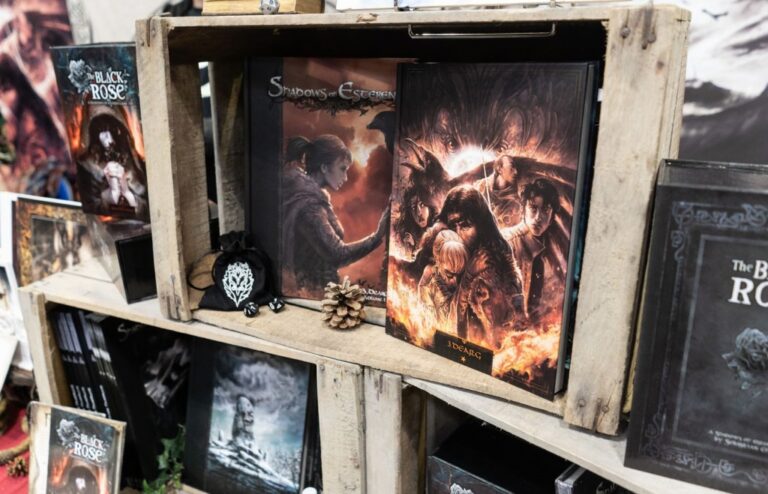
I have always struggled with traditional fantasy settings, especially those that rely on magic. It frequently feels that magic is used as a get-out clause, without consideration for consequences. Enter Shadows of Esteren, a low-fantasy gothic-horror game with distinct Celtic and Lovecraftian influences.
Shadows of Esteren uses an original setting called the Tri-Kazel’s peninsula, with players able to choose from a variety of different human cultures. There are no happy elves or grumpy dwarves in this game. The game feels a lot like a Mediaeval version of Call of Cthulhu, with scenarios based around investigation and survival.
For anyone who fancies playing an original fantasy rules-light game that is focussed on storytelling, then Shadows of Esteren is the one for you.
Prepare for a shock – this is not a roleplaying game! Instead, Gladiatores is a tactical card game, where players take on the role of gladiatorial stables (gladiatorial trainers). Rather than defeating your opponent in the game, success is determined by how exciting the battles are.
As well as the playability and deep tactics that Gladiatores offers, what stood out was the amount of research in creating the game. Each of the eight core gladiators are based on genuine Roman gladiators.
For those looking for something that is a little bit different, and fancy learning a little history at the same time, could do far worse than play Gladiatores.
This is not the first time that the Aliens franchise has been adapted into a roleplaying game (Aliens by Leading Edge Games in 1991), but it is definitely the better. Whilst the previous version was rules-heavy and focused on gung-ho marines, this new Alien RPG is much more in keeping with the series’ core themes: horror and survival.
That said, Alien: The Roleplaying Game is not dedicated to playing space truckers. Instead, it incorporates elements from the first three films. The game also expands upon the world of Aliens, examining the consequences that the first three films would have upon the galaxy.
The game’s system is based on the Year Zero engine, used in Tales from the Loop, and incorporates two modes of play. Cinematic play uses pre-made scenarios that emulate the Alien films and are designed to be played in a single session. Campaign play is designed for ongoing campaigns with the same cast of characters over many game sessions.
It is a roleplaying game based on the Aliens films. Need I say more?
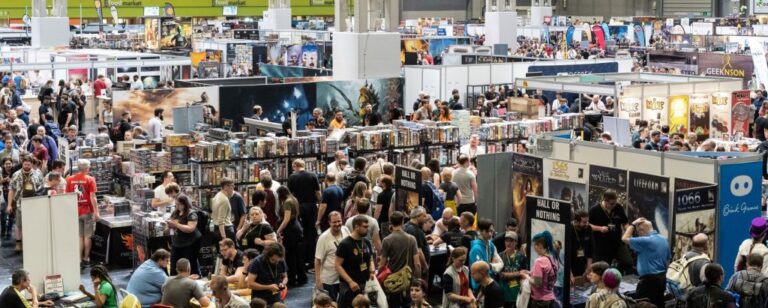
Last weekend witnessed the seventh international tabletop day, an annual celebration of tabletop gaming. Thus, it was only proper to join tens of thousands people at the UK Games Expo (UKGE), the largest gaming event in the UK.
The first thing that would hit people when they enter was not the size of the UKGE, with it filling two halls and the Hilton, or the incalculable number of people, but the roar. This was not from the cheering crowds at one of the many sanctioned tournaments or the undulating rattle of rolling dice, but the air conditioning systems working flat out to keep the temperature at sub-tropical levels, rather than the blast furnace levels it could easily have been.
One thing that cannot be denied about the UKGE is that it has grown year on year since its inception in a single room of a Masonic Lodge twelve years ago. This time, it had not grown in size but scale, as there were countless events taking place throughout the weekend. The sheer diversity of these events was incredible, from designer talks and workshops through to live-action games and live performances. The highlight of these were Starship Bridge Simulator and The Dark Room, both of which were swiftly sold out.
Naturally, as one would expect at a tabletop gaming convention, there were thousands of games that attendees were able to join, from roleplaying games and board games through to wargames and collectible card games. There was literally something for everyone
However, it was the trading halls that took up the most space, filling two of the convention halls of the NEC. It was refreshing to see that traders were in the minority and the UKGE was instead dominated by creators and publishers, with many of the line developers, such as Matthew Dawkins – the “gentleman gamer”, who more than lives up to his moniker – on hand to discuss their latest games.
This is one (of many) reasons that makes the UKGE so popular, as attendees often get the chance to learn about and try new games, sometimes before they are available for general release. Onyx Path Publishing had the highly anticipated second edition of their Scion roleplaying game. SLA Industries by Nightfall Games was making a return. Grange Live Gaming were promoting their planned Cyberpunk 2020 New Year’s Eve experience in Birmingham, which if sufficiently successful will have the Cyberpunk RPG creator Mike Pondsmith attending for the night.
Despite traders being in the minority, there remained countless opportunities for buying new games. So much so, that many attendees give themselves a strict budget. It could be very easy to max out a credit card, as there were dozens of fantastic deals, such as the last chance to buy the Big Trouble in Little China boardgame (as no further copies will be printed due to the license expiring).
Previously it had been possible to comfortably see everything in a day, but that is no longer possible. Attendees can very easily spend a day exploring the show halls without ever actually joining any of the other events taking place. In order to fully appreciate UKGE, it is far better to attend UKGE for the whole weekend, thereby giving time for the ancillary activities that combine to make a more rounded experience.
Despite the crowds, which did make it challenging for the less able-bodied people to move around, the show was well laid out. Maps were available in the brochures and stands in Halls 1 and 2 were laid in a logical grid pattern with footways clearly named, allowing for ease of navigation.
Unfortunately, the event was not without a controversy. A games master was ejected for running a game that involved subject matter unsuitable for a public convention. That said, this was a one-off incident, amongst hundreds, if not thousands, of roleplaying games that were being played that day.
Due to the captured market, food and drink prices were extortionate, and in many cases some of the smaller stands were running out. However, it was great to see the neighbouring Film and Comic Con offered free entry to anyone with tickets from the UKGE.
If nothing else, UKGE is a welcoming and community-focused event, with people coming from all over the county, and in some cases beyond its borders, to attend. There is always something going on, people to meet up with, and lots of games available to play.
All photos are by Peter Gatehouse and are used with permission.
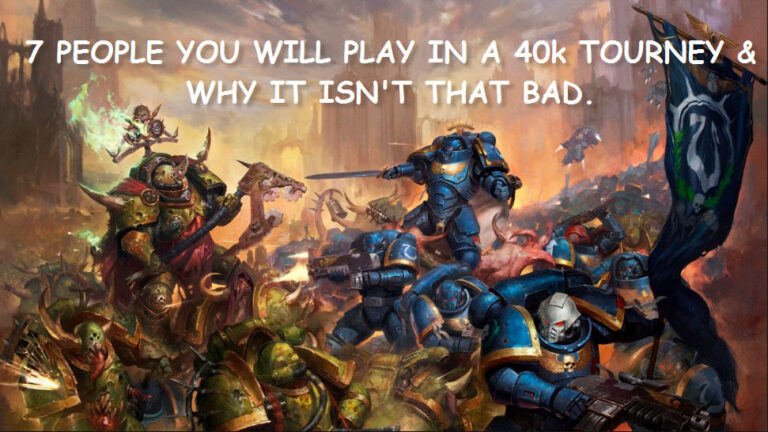
Playing 40k tourneys is a daunting undertaking, one marred by rumours of WAACS, Neckbeards and people who get no joy out of the game other than winning. In the end you play a game for the fun, for the challenge and obviously the win is a nice bonus but you don’t want to have a bad experience do you? It is a ‘Game’ after all.
With so much bad press and rumour its therefore understandable that people are a bit reticent to play in them. I was one of the many who always said they’d never play a tournament and well, 3 years on a lot of mid table results, a few sportsman awards, a painting award ( obviously the quality was low that day) surprisingly a second on a 1 day event and a lot of new friends, I can say I am glad I took the leap and it isn’t as bad as it is made out to be.
Why did I do it though?
Well, with it becoming somewhat harder to get my general group of friends to play, for one reason or another, (cat herding comes to mind) I was running out of options on what to do If I wanted to play a game.. random people at Element was an alternative but I couldn’t always get someone on the day I was free, on top of this, as I wasn’t playing much my pile of grey plastic shame was growing with no painting being done; I had to think outside the box and tourneys seemed to offer an incentive to paint, along with a weekend of gaming.
But you still had to enter the proverbial lions den and deal with all the Neckbeards right? Well yes and no and here is why:
First up I’m going to give you a list of 7 types of people (though you do get hybrids) you will find at tournaments:
The WAAC – Also commonly known as the neck beard, this is the guy you read about, the reason you probably don’t want to play tournaments and just a horrible person. Winning is all that matters and he/she will cheat, rules lawyer, intimidate, time waste and bully their way to victory. If they aren’t winning they’ll challenge everything, strop, moan and generally make you feel uncomfortable; nobody likes this guy. Luckily these people are the minority and in a tournament of 100 people you’ll be lucky (unlucky as it is) to find 2 or 3 of them; so you odds of playing one are slim.
The Competitive player – Most people who enter tournaments are competitive in some way shape or form but the archetypal competitive player takes things a bit more seriously. Like any sport, the win is important, a good list is important and knowing the rules thoroughly is important. In the end a lot of tournaments are ranked (ITC & ETC) so there are league table positions at stake.If you rock up to a tourney and expect not to play someone who takes the game seriously then you are going to be disappointed but there is something very important to note, despite being called /mistaken as WAAC by some, they generally aren’t.Granted, If you have a middling or fluffy list, you will get annihilated, and very little mercy will be given to you.. to the Moaner (see below) this may epitomise what is wrong with the game / scene and why you should throw your toys out of the pram and stop playing, but they won’t cheat you, they won’t bully you or rush you, they will just play the game to the best of their ability, based on the list they feel is effective and, depending on the list you have, enjoyable games to play and something to learn from.
The Rules Lawyer – Rules lawyers are generally competitive players as well but whereas a pure competitive player will optimise a list and go for the most effective meta going the rules lawyer will have more varied lists and will focus on how rules are interpreted, how they can be used to their advantage and how to use them to set traps for unsuspecting noobs ( I have been that noob, many times). Their proverbial ace in the hole is a nasty trick they have found, with some poorly written rules.A frustrating player to play, if on the receiving end of a bubble wrapped flyer that can disembark its units or a charge that seems to be able to lock down all of your units at once, but, to be honest, a good player to know and learn from if you want to make it from mid table results to top tier. Also without people knowing the rules inside out and how to exploit them, then GW wouldn’t be able to fix meta mistakes as quick as they do these days.
The Moaner – He / she rocks up to a competitive tournament with a list that has no chance of succeeding against current meta or they have a mono list they like but everyone is running flyers or knights…and boy do they moan about it. They moan to you, to their gaming club, to the blog they have with 25 followers and have pretty much quit before the first dice are cast. A vocal minority who give others and the tournaments a bad name. In the end, if you want a fluffy game, then play with your mates, if you want to play a fluffy tourney then play one, don’t rock up to ITC / ETC , knowing the rules and the list restrictions and expect everyone to have nice balanced monochrome armies; it isn’t going to happen.
The “Is what it is guy” – This guy is a pleasure to play, his/her lists go from fluffy fun lists, with no chance of success competitively, to moderately competitive. He doesn’t care though and he / she is their because they just want to field a nicely painted army, they have some cool new units they want to try out or WAAAAAAGHHHHH! They know they aren’t going to win but are happy to play similarly ranked players in the second half of the tournament after a drubbing from the guys at the top.Generally upbeat, happy to let you take back moves, do things out of sequence, if you’ve forgotten and just a good sport all round. Don’t be a WAAC, Be the “is what it is” guy.
The Painter – The painter is here for one reason, and one reason only, to show off how awesome their paint scheme is and how beautifully he / she can base and pose units. Getting 1st place in the painting competition is the goal but if the list is competitive as well, bonus. You will seldom meet a well painted army where the player is a knob, why? Painting / converting units takes a high level of patience and dedication, they therefore are patient people in general and a lot easier to get along with.. as well as the fact that when you play them, the games look super thematic…. Only let down by your hastily sprayed and washed guardsman blob.
The fluff lover – Sometimes coupled with the moaner but for the most part just an “is what it is guy.” They will rock up with a pure mono faction list, no real thought will go into how it works, just they like it and they want to see if it works or not. Sometimes it works and they do quite well, other times they get absolutely smashed and end up with the wooden spoon but all in all they are just happy to have played, been able to try out their list and give other players a fun thematic game.
Still sound somewhat intimidating? Like its something you don’t want to do? Well let me give you a view from a guy, who never played a tourney to a guy who now plays in 1 every few months.
Pick your tournament wisely – There are loads of tournaments out there, with all kinds of different restrictions, rules and prizes, pick the one that suits you. Don’t just pick one, turn up, get beaten and smoulder with rage for the rest of your gaming life. In the end its your decision and your choice on what type event you attend.
Generally the ones I attend at Element, ran by them or Caledonian are great. You have prizes for best painted (some times top 3) you have best sportsman award, best army in faction, 1st 2nd and 3rd for the tournament and, of course, the wooden spoon. So there is always a good chance of you getting something. It also helps that they are really well run!
If you want a less competitive tourney, they are out there. Some are dedicated to mono lists and good paint jobs, others are for lower point limits; there is a lot of choice.
Don’t be put off by rumour or assumption – Tournaments are not hives of scum and villainy, WAACs are not rampant and you can have a good set of games. Sure, if you aren’t overly bothered about optimisation, or maybe you just cant afford the new big meta toys then you will struggle to reach the top table BUT if your just there to enjoy the games, then granted you may get obliterated in a game or two, depending on the size of the event, but rankings will find you your niche and by the 3rd game at least you will be facing more manageable lists.
If you are new, play to learn and enjoy, don’t play to win- If you turn up to a tourney with the wrong sort of mindset, especially if you are new, you will leave disappointed. A lot of people you will playing will understand the rules very well, will understand their armies very well, and, will also know your army too, so will challenge if you make a mistake.
Just turn up and play the game as best you can, learn how the meta is moving and learn how different armies work. It may mean you lose all your games, or most of them but if you have come into it with the right mindset, you’ll come away understanding the rules more, understanding how your army works more and understanding how other armies work / are played too. This will then give you an idea on what to change for next time, if you care or if that sort of tournament is for you or not.
Trust in the Emperor and GW– Meta lists are a thing and can be frustrating but what I have found is that Games Workshop are being very proactive with neutering meta creep with restrictions on matched play, points increases and rules changes.
There are very hard lists out there, and some players will know their rules inside and out, but, as has been shown around the globe and in different Tournaments, just because you have knights doesn’t mean you’ll win, and just because you have flyer spam, doesn’t mean you will win. Its very much about playing the mission and having something that will be able to score points. you can lose your entire army but as long as you are ahead in points, being tabled doesn’t matter anymore; so don’t live in fear.
There we have it, hopefully this article will have given you an insight into the competitive world of WH40K tournaments and maybe, hopefully, encourage you to give one a try. In the end it is just a game and if you want to play and have something to aim for, be it painting minis or aiming to be the best; the tournament circuit is the best way to do this. it can be a cruel mistress to someone unprepared but once you find your niche, it becomes a great weekend of gaming.
Had a good experience? Had a bad one? Thinking of getting into the tournament scene? Let us know in the comments below.
This year we have witnessed the conclusion of numerous sci-fi and fantasy epics, from Game of Thrones to the Marvel cinematic universe. However, one has gone largely unremarked, despite being one of the most original pieces of television in recent years. This was Into the Badlands.
Into the Badlands is best described as a post-apocalyptic martial-arts drama, which in itself is unique. The series followed the adventures of Sunny, a regent for the barons, as he began to question their authority and strived to leave his violent past behind him.
The setting was never specified, although we see long-ruined cities and the detritus of our former society can be seen. The society has since become a form of feudalism, where workers – called “cogs” – are owned and nominally protected by Barons, who have their laws enforced by “clippers”.
Unlike many other post-apocalyptic shows, this society has outlawed all firearms (although they use crossbows and bow and arrows), meaning that people now use swords and daggers. Yet, despite this technological restriction on weapons, people still use the precious few remaining cars and motorbikes for transport, as well as electricity.
It could be said that Into the Badlands draws parallels with the Warring States period of China, due to the various Barons vying for dominance. The barons each had their own distinctive style. The Widow, for example, frequently used clippers who wielded throwing stars in the shape of butterflies, whilst the clippers of Jacobee used pick axes instead of swords to indicate their Baron’s control of the mines.
These are similarities with historical plantations in deep-south America, where the first season was first filmed. Plantation owners had slaves do their work, with their own enforcers to ensure none escaped.
Underpinning the society of Into The Badlands the mythical city of Azra, rumoured to be a paradise on Earth, and a mystical “gift”, the bearers of which become unstoppable engines of destruction. This gift allowed the series to narratively justify the amazing wire-work in the series, that harkened back to classic wuxia films. As the series continued, the writers began to explore what the gift was and its links to Azra, as well as what it symbolised.
It should come as no surprise that the creators of Into the Badlands have admitted that they were inspired by the classic Chinese tale Journey to the West, which tells of the adventures of the Monkey King. Indeed, some of the principal characters from Into the Badlands share names with those in Journey to the West.
Sunny was played by Daniel Wu, who, as well as being an accomplished actor, is also an experienced martial artist. It is for this reason that the choreography simply shines. Whilst other shows need to rely on stunt-doubles (something the Marvel-Netflix shows were particularly guilty of), Into the Badlands used a trained cast. This allowed them to be more creative and ingenious with their choreography, and created some truly amazing fight scenes.
Into the Badlands was frequently compared with the Marvel/Netflix series Iron Fist, as both were embedded within the fantasy/martial arts genre, but that is where the similarities end. As well as the different settings, whilst Ironfist used snap-cuts, hoods and dim lighting to hide the stunt doubles, Into the Badlands was able to rely on Wushu-trained actors and a highly trained stunt team for their fight scenes. This reliance on trained martial artists meant that the fight choreography and stunts were clearer and frequently relied on practical effects rather than digital manipulation.
Whilst Sunny was the lead role, it was The Widow – played by Emily Beecham – who was the undeniable star. The Widow sought to usurp the Barons’ tyranny from within. The fact that she was female was inconsequential when it came to fighting, with one of the greatest scenes of first season was where Sunny and The Widow finally confront each other.
Most of all, Into the Badlands was unique. In a time where shows are frequently generic, Into the Badlands was gloriously original and strove to be unlike any other, and in this it undeniably succeeded.
Into the Badlands proved that not every series needs to be derivative of what has gone before, and that there is room for shows that wish to be experimental and to break new ground. If that is the legacy that Into the Badlands leaves us with, and it inspires new shows to do the same, then it is one that we can at least live with.
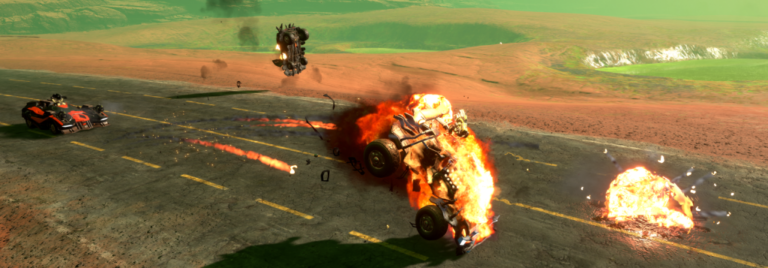
One of the first things players will realise when playing Dark Future: Blood Red States is that, despite the countless beweaponed vehicles they will undoubtedly face, is that this is not a driving game. Instead, Dark Future: Blood Red States is best described as a tactical car combat simulation, where the game’s focus is more on force projection and positioning than on actually driving the car. It is for this reason that the game is so unique.
Based on the Games Workshop boardgame of the same name, Auroch Digital have resurrected this classic game of vehicular combat as video game. Unlike many of the other offerings from Games Workshop, Dark Future is not set in their Warhammer universe, but a dystopian vision of America, where sanctioned operatives – militarised police forces – take on crazed gang-cults across the blighted highways of this new America.
Rather than recreating the board game experience by having a turn-based system, Auroch Digital have distilled the essence of the original board game into their adaptation. Dark Future: Blood Red States offers a real-time simulation of tactical car combat.
This real-time element allows Dark Future: Blood Red States to become a far more dynamic experience, as each car’s relative position to each other are a constantly changing variable, forcing players to constantly revise their strategies. That said, movement is constrained by the cars remaining within the four lanes of highway, barring the occasional moments when a car is forced off-road. This narrowing of focus makes for a tighter gameplay experience, and whilst it limits some tactical options it does force players to think more creatively.
Due to the speed of the cars, orders can be given in a command mode, allowing players to slow the game down to a tenth of the original speed in order for them to issue commands. This slowing, rather than pausing, of the game adds a frisson of tension as players can find themselves frantically ordering manoeuvres before the moment passes.
The game can be broken down into two halves, with the first being the core tactical car combat and the other being resource management, between each mission. This latter element allows players to invest in upgrades, refuel the car and hire operatives to join you on missions, as well as choosing missions.
However, it is these missions that form the bulk of the game, which has the player’s interceptor cruising through the blighted landscape of America. These landscapes are refreshingly varied, from bridge-mounted motorways to routes through narrow canyons. Along with this are a variety of weather effects that affect visibility.
The types of missions on offer are limited by the scope of the game, but vary from objective-based missions, such as escort and blockade runs, to pure combat missions. Each of these missions form part of an ongoing career for a variety of sanction operatives, which the players can choose from. The overall narrative progresses through a series of z-mails (email to you and I), which is where the humour shines through.
As much as Dark Future: Blood Red States is dystopian, it is a vision is based on eighties paranoia. This retro-futuristic feel permeates the entire game, with the menus and loading screens rendered in the style of 80’s 8-bit graphics.
Dark Future: Blood Red States is not a game that players could continuously play, as there is a danger that the tight focus of the gameplay can become monotonous. That said, what Dark Future: Blood Red States does, namely tactical car combat, it does really well. The game’s playability is extended with the introduction of new perks and equipment as the players progress, as well as some missions having so-called “mutators”, where specific attacks can do more damage.
Dark Future: Blood Red States is ideally played as a game that players dip in and out of, or as a short break. With each mission lasting no longer than ten minutes, this makes them a compact experience that does not overstay its welcome.
We use cookies on our website to give you the most relevant experience by remembering your preferences and repeat visits. By clicking “Accept All”, you consent to the use of ALL the cookies. However, you may visit "Cookie Settings" to provide a controlled consent.
This website uses cookies to improve your experience while you navigate through the website. Out of these, the cookies that are categorized as necessary are stored on your browser as they are essential for the working of basic functionalities of the website. We also use third-party cookies that help us analyze and understand how you use this website. These cookies will be stored in your browser only with your consent. You also have the option to opt-out of these cookies. But opting out of some of these cookies may affect your browsing experience.
Necessary cookies are absolutely essential for the website to function properly. These cookies ensure basic functionalities and security features of the website, anonymously.
Cookie
Duration
Description
cookielawinfo-checkbox-analytics
11 months
This cookie is set by GDPR Cookie Consent plugin. The cookie is used to store the user consent for the cookies in the category "Analytics".
cookielawinfo-checkbox-functional
11 months
The cookie is set by GDPR cookie consent to record the user consent for the cookies in the category "Functional".
cookielawinfo-checkbox-necessary
11 months
This cookie is set by GDPR Cookie Consent plugin. The cookies is used to store the user consent for the cookies in the category "Necessary".
cookielawinfo-checkbox-others
11 months
This cookie is set by GDPR Cookie Consent plugin. The cookie is used to store the user consent for the cookies in the category "Other.
cookielawinfo-checkbox-performance
11 months
This cookie is set by GDPR Cookie Consent plugin. The cookie is used to store the user consent for the cookies in the category "Performance".
viewed_cookie_policy
11 months
The cookie is set by the GDPR Cookie Consent plugin and is used to store whether or not user has consented to the use of cookies. It does not store any personal data.
Functional cookies help to perform certain functionalities like sharing the content of the website on social media platforms, collect feedbacks, and other third-party features.
Performance cookies are used to understand and analyze the key performance indexes of the website which helps in delivering a better user experience for the visitors.
Analytical cookies are used to understand how visitors interact with the website. These cookies help provide information on metrics the number of visitors, bounce rate, traffic source, etc.
Advertisement cookies are used to provide visitors with relevant ads and marketing campaigns. These cookies track visitors across websites and collect information to provide customized ads.




 When is the game set within the Aliens universe?


 How many Sam Spallucci books do think there will be?
 As the series has expanded, has setting it in Lancaster presented any challenges?


 Why has there been a massive uptake of Vampire: The Masquerade recently?
 One of the things that Onyx Path does really well is communication. Why does Onyx Path make such a point of being transparent?



 Last weekend witnessed the seventh
 This is one (of many) reasons that makes the UKGE so popular, as attendees often get the chance to learn about and try new games, sometimes before they are available for general release.