Home Blog Page 18

Walker – the reboot

Do you guys remember Walker, Texas ranger played by Chuck Norris? Because I do. He used to kick ass and take names for 8 seasons, starting in 1993.

And it was Chuck Norris, right? I for one absolutely loved it and to be honest I never felt like  reboot was needed. It was narmy at times, it was silly, but it was perfect for when you needed a happy ending.

However, the powers that be of The CW decided that the world needed a new Texas Ranger, this time played by Jared Padalecki (Supernatural, Gilmore Girls). Of course, much darker, because a show with a well balanced lead would not appeal to people. Where is that sarcasm font when you need it?

This Walker has a dead wife (seems like Jared Padaleki is cursed to only have unseen or dead spouses in the shows he stars in) and it seems to weigh heavily on him. Genevieve Cortese, his real life wife will appear in flashbacks as his on screen wife.

Somehow I expect very little smiles and humour in this show, but maybe I am wrong and it will be filled with rainbows and puppies.

The show drops on January 21, 2021 so it won’t be long for us to see if this will be worth our time or not. At least it features a cowboy hat, though I doubt it will help fill the Justified shaped hole in my heart.

Until then, have a look at the trailer and let us know if you will be watching or not.

Rest in peace – John le Carré

The sad news of John le Carré’s (David Cornwell) death has shaken the literary world yesterday. The 89 year old writer passed away of pneumonia at Royal Cornwall Hospital.

He has been known for his spy mystery books that have fascinated readers since the very start. His focus on the world of spies and what such a life would entail stemmed from his own past as an intelligence officer, that came to an abrupt end following Kim Philby’s betrayal.

This particular event actually inspired Tinker Tailor Soldier Spy, one of his most admired works, brought to both the small and the big screen. It depicts George Smiley’s efforts to identify a Soviet mole within the British SIS. The worlds that John le Carré has built within his novels are the exact opposite of what the most famous British spy is. While James Bond novels are flashy and eye catching, le Carré has mostly focused on the less glamorous sides of spying. The long hours of waiting for something to change, for someone to leave their house or cross the border.

It was spying as spying is. With flawed characters who do not look like they rolled out of bed and straight into a make-up chair. He portrayed a world that was gray and drab, but still made the readers compelled to keep on going. After all, someone that is morally ambiguous and generally more down to earth is more relatable than the opposite.

He will surely be missed and, Stephen King said it best:

John Geller, who represented the author has said of his passing:

“John le Carré was an undisputed giant of English literature. He defined the Cold War era and fearlessly spoke truth to power in the decades that followed. I represented [le Carré] for almost 15 years. I have lost a mentor, an inspiration and most importantly a friend. We will not see his like again.”

And he might be right. What we do have are his works, his books that he loved into being and the legacy he left behind, too rich to be easily forgotten.

Rest in peace!

Loki – The Trailer

Loki has been a fan favourite, despite him being labeled a villain, since his very first appearence in Thor. Since the announcement of his series came out, people have been waiting for the smallest crumbs, such as the logo (which I still find ridiculous) or the trailer.

Recently the newest trailer came out and to be honest, I am not quite convinced. Maybe because it feels much more comedic than I expected? Maybe because having seen Endgame I know the character is dead, so whatever happens will feel a little empty? It seems that Tom Hiddleston is having fun, but maybe he is just that good at faking it. He did seem disappointed of the direction his character took in recent films.

I will hold my judgement, however, until May 2021 when the show is projected to premiere on Disney+

What did you think of the trailer? Yay or nay?

Do not be afraid to let us know.

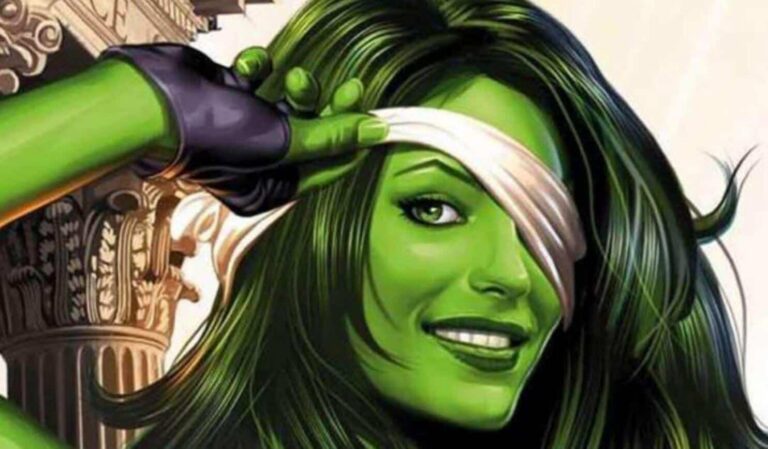
She-Hulk has a face!

The rumour mill has been going on for a while concerning who will portray She-Hulk in the upcoming Disney+ series. As far back as September there were articles claiming that Tatiana Maslany will portray Jennifer Walters/She-Hulk, however she denied the rumous.

Turns out the joke was on us. It was confirmed by Marvel Studios that she will play the titular role, after all. She has also posted on her instagram that she will be playing Jennifer Walters and I for one could not be happier.

Who is Tatiana Maslany?

Mostly known for her role in Orphan Black, Tatiana has been a constant presence on both the big and the small screen. Most recently she starred in HBOs Perry Mason adaptation as Sister Alice, a spiritual leader with a mysteryous past. Born in Regina, Saskatchewan, she also holds the honour of being the first Canadian to win a Primetime Emmy in a major dramatic category for acting in a Canadian series.

Given the variety of characters she played in Orphan Black, I cannot say I am surprised.

The show is currently available on Netflix and can be streamed to your heart’s content.

Will a She-Hulk live action adaptation work?

I asked the question and I will asnwer it as well. Definitely. The character has appeared in comic books since the ’80s, a cousin of Bruce Banner, who following a blood transfusion from him ends up with similar powers, yet she never appeared in any live adaptation.

The fact that the world is crying out for more female superheroes is not a new thing and She-Hulk seems to be the answer (one of many, I hope).

It was already confirmed that Mark Ruffalo will appear in the show, as well as Tim Roth, who will both reprise their roles as The Hulk and the Abomination, respectively. The extent of their roles is currently unknown, however attaching some star power to the show cannot hurt.

She-Hulk is a lawyer and while we all know this joke: “What do you call 10,000 lawyers at the bottom of the ocean?
A good start.”, she is definitely one of the good ones. Speaking of that rumour mill I mentioned before, Tatiana has apparently liked some fan art of a potential crossover between Daredevil and She-Hulk, after Kevin Feige teased a possible appearence of the devil of Hell’s Kitchen. One can only hope.

The release date for the show has not been announced yet, but given it is December and the filming has not started yet, 2021 is most likely a tall order. 2022 is much more likely.

I for one cannot wait and hopefully this news gets you all as excited as I am.

5G – Should we? Shouldn’t we?

Why is this even a question, you might ask? The answer to that is quite simple. While there are countless articles and studies about what 5G is and what 5G does, there are still people expecting it to turn them into slaves to some obscure force, eager to take over. Oh, yeah…and the coronavirus is involved. Of course.

But what is 5G?

To put it simple 5G is the fifth generation of cellular wireless. It promises speeds up to 100 times faster than 4G, what with it reaching 10 gigabits per second, diminishing download times to mere minutes, from what could have taken hours before, in the case of large files. My phone currently has 5G connectivity in some areas of the city and it works like a charm. This makes going into areas with only 4G coverage all the more jarring.

At first sight the difference between the two should not be that significant, and if used to download a picture of a cute kitten it might not be noticeable, however when testing the two with the download of a larger file, it is obvious why 5G is the superior choice. Why? Let’s see:

It uses broad channels in under-utilised parts of the radio frequency spectrum to transmit data, with little chance of overload at peak times.

The time lag in processing data (known as latency) is far lower than with 4G. In effect, this means virtually instantaneous connection to, and communication within, the network. Low latency has obvious value in applications like self-driving vehicles, remote robotics and traffic collision avoidance…and many more yet to be developed.

The capacity to connect a lot more devices and applications to each other will increase vastly.

Source: 5G: How it works and what it does

Why 5G?

Using 5G networks to send and receive information quickly will help develop new services and devices, particularly connected cars and vehicle-to-vehicle information, virtual-reality gaming, remote surgical operations, and translation software.

Source:5G VS 4G: WHAT’S THE DIFFERENCE?

Is the above important? Given the desire to transform Europe in a carbon-free continent in the next 30 years, the importance of digitalization and implicity of the speed at which things are moving in the virtual environment becomes all the more obvious. You cannot transform the world at a snail pace, especially given that everyone else seems to be ahead in the game, with The US, South Korea and China already leading the charge.

5G can lead to changes that could improve virtually everything, however the change is slow due to high costs and the lack of a coherent policy across Europe. The constant squabbles with groups that believe 5G is somehow the mark of the Apocalypse are also a barrier against the quick implementation of a technology that provides superior speeds, lower latency rates and improved security and regulations.

Does it work?

The answer to that is a resounding ‘Yes!’

The speeds are definitely supperior, with and without the use of a VPN service, on mobile. However it is noticeable that when the VPN is disconnected the speeds increase and the latency period decreases significantly. I tested the difference between 4G and 5G with Speedcheck to see if I was just falling under the spell of the novelity and publicity. Turns out I wasn’t:

On a laptop connected to the network the difference is even more dramatic:


By comparison the 4G network on mobile only provides half of the speeds a 5G network offers, for both download and upload, at least on mobile. Given the proven differences between the capabilities of the two, the differences would not be in favour of 4G on a laptop either.

Would it really improve life for users that are in the market for entertainment only?

Even if the sole purpose of your phone or laptop is to download a movie or watch youtube videos, the answer would still be yes. Why? Because everyone deserves a better experience, regardless of what they are doing.

In our era of instant gratification, 5G will make augmented reality and virtual reality experiences in real time so whether we are gaming, exploring or shopping, everything will feel more dynamic and instantaneous. The speed of 5G will eliminate lag in these AR and VR devices, which will eliminate the motion sickness that high latencies on VR and AR devices occasionally cause. 5G will create a realistic and immersive experience uninterrupted by delays and make users feel as if they have been truly transported elsewhere.

Source: 5G will fundamentally change our lives for the better

Currently the coverage is still spotty, however as this infographic shows, we are heading in the right direction, hopefully sooner rather than later.


Falcon and The Winter Soldier trailer

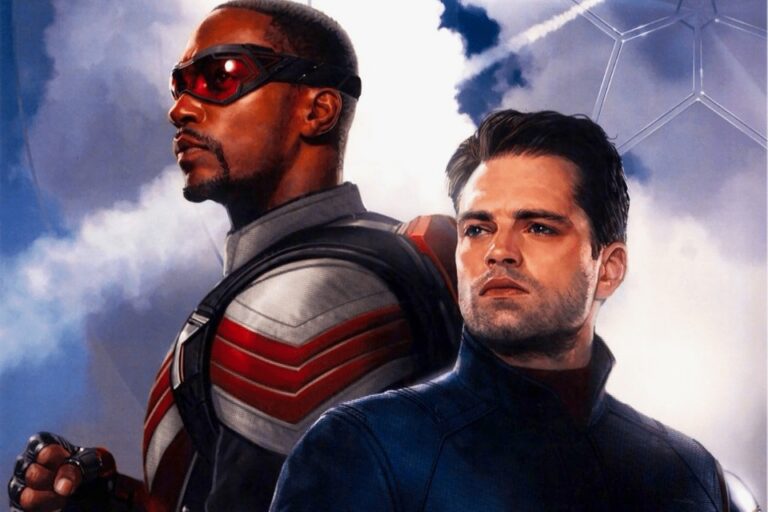
Two days ago Disney went on a rampage of trailers, dropping both Loki and The Falcon and The Winter Soldier for the world to see. I have to admit, I am more intrigued by this one. Why? Because it seems more coherent and it offers something that MCU fans have been clamouring for forever. Found family trope? Check. Friends after being bitter enemies?

Oh and it also has two of my favourites Sebastian Stan and Anthony Mackie as the titular characters.

After a rather disappointing ending to the Phase 3 Infintiy Saga, the Marvel universe definitely needs a breath of fresh air and this just might be it.

With only a few months to go until its premiere on Disney+, I can only hope we will get more tidbits of what is to come. 2020 makes me cringe when I think of March, but hey…maybe next year it will be better.

And well, if we are stuck inside, we have these two to look at. Bucky Barnes and Sam Wilson getting proper screentime together? Sign me up! And if you are not patient enough until then, you can always check out the comics.

Rivers of London – The Fey and the Furious

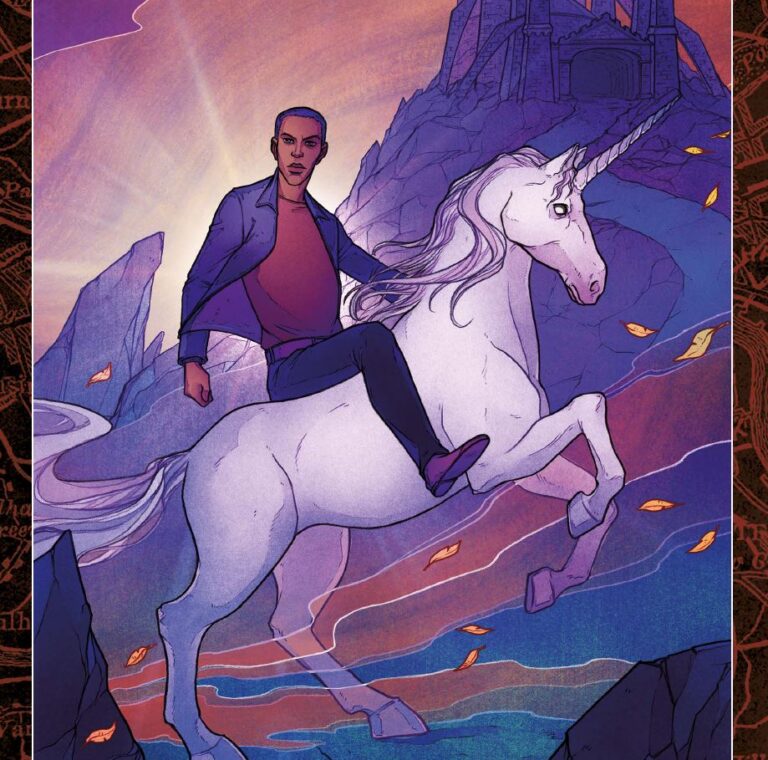
The Fey and the Furious is the 8th installment in the comic book series Rivers of London, brought to us by Ben Aaronovitch and Andrew Cartmel.

The book follows the misadventures of detective Peter Grant, that readers will recognized both from previous issues of the comic book series and from the books that brought new life to the fantasy genre. In this particular instance Peter ends up undercover as a street racer, which is a nice nod to the series that made Vin Diesel famous, and a lot of kids dream about driving at insane speeds through the city.

Unlike Vin Diesel, however, Peter has to rely on magic and all of the allies he has. Why? Because Peter Grant is definitely not a natural behind the wheel of a sports car, despite all of his posturing. Still, he definitely enjoys going the extra mile in order to win the race that would help him solve the puzzling appearance of a British car, filled with unicorn horns, and its driver on the shores of the Netherlands. They had 0 business being there, together or otherwise, after all.

What you should know?

If you are one of those still unfamiliar with this world, the 8th volume offers a quick recap of the main events that Peter Grant was involved with, as well as a handy profile page to bring you up to speed with the most important characters. You get to see what their abilities are and the relationship between them. I still recommend reading the previous comics, even if this book works as a standalone too. While it does help to know more about the mythology of this universe, picking The Fey and the Furious up will not make you feel like you are excluded from the cool kids’ table.

One of the things that I like about Rivers of London in general and The Fey and The Furious in particular is that the saying ‘Modern problems require modern solutions’ definitely applies to it. While the fact that the fair folk is involved in illegal street racing is something that might raise eyebrows, for those that are familiar with more classic views of the fantasy and magic, I think that any self-respecting magical creature would learn to adapt to the new world and, if they can get their fingers in a particularly juicy pie, they just might.

A definite point in favour of this book is the realism of the fact that Peter is absolutely down to solve things using his wit when magic fails and he is not afraid to run when he knows he has no chances of winning. Like fighting with an extremely angry Fairy Queen, whose clutches he already escaped once, courtesy of Beverley Brook an incredibly smart and beautiful godess who just happens to love Peter.

Is the book worth a read?

That being said, I absolutely loved this book. I found myself thinking that it would be maybe a bit too much Fast and Furious to my liking, but I ended up devouring the pages, needing to know NOW what comes next. It is witty, it is funny and it manages to keep itself from becoming pretentious, at the same time. The side characters, while given little time to shine still manage to feel real and the book does make a point to illustrate just what makes people get involved in car racing, even if it might mean certain death for some, or losing everything else that is important. Addiction is not only drugs and alcohol, kids.

What else is there?

At the volume’s end a history of car racing is also available, mostly detailing how and why the phenomenon appeared. If you think it’s a particularly novel invention, you could not be further from the truth, but I will let you discover that for yourselves. Aside from that, the additional material also provides details about the Fairies and their history in Britain, as well as a brief history of unicorns. All elements that appear in the book and that might have piqued the interest of readers. It definitely taught me things I had little to no idea about.

You also get to enjoy some ‘Tales from …’; one page comics about 4 characters that do not appear in The Fey and the Furious :

  • Tales from the Folly — At your Bark and Call (starring Toby)
  • Tales from the Nick — Under the Hood (starring Hoodette)
  • Tales from London — Wrap it up (starring Beverley Brook)
  • Tales from the Folly — Cold Comfort (starring Molly)

These are incredibly funny and offer a nice behind the scenes view of the characters that we all know and love.

Who is behind it all?

A comic is more than the words of its author and that is not different for The Fey and the Furious. The book would not have been the same (or at all) without the amazing artwork of Lee Sullivan and Mariano Laclaustra who have outdone themselves. Paulina Vassileva, Color-Ice (colours) and Rob Steen (letttering) have also contributed to the final product. Each little element fits perfectly to bring you a story of magic and mundane, all rolled into one.

In conclusion:

While it has been a while since I picked up Rivers of London, this has definitely re-awakened my appetite for the stories of Peter Grant, Thomas Nightingale and everyone else at the Folly. After all, where else would I find gems like this?

All in all, this is a definite read for fans of the series, who will be happy that they waited for all the issues to be compiled in a nice volume. To  be honest, having to wait to see the resolution issue by issue would have driven me up the wall. And if you are a beginner when it comes to this universe, fret not, this will be a nice introduction that will definitely make you want to know more about it. If you would like to learn more about this world, you can check out Ben Aaronovitch’s oficial page.

Coriolis: The Third Horizon – Emissary Lost
Emissary Lost is the first in the three-part Mercy of the Icons campaign for the Coriolis: The Third Horizon roleplaying game by Free League Publishing (reviewed here).  The Last Voyage of the Ghazali, a separate scenario for Coriolis: The Third Horizon, acts as the campaign’s prologue.

The Mercy of the Icons campaign is epic, in every sense of the word.  The first volume in this trilogy includes two three-act scenarios and is over 230 pages long.  The first scenario is focussed on a hunt for kidnappers throughout the Coriolis station, whilst the second descends onto the planet that it orbits and finds characters pitted against a special force’s hit squad.  The ramifications of these scenarios will have colossal repercussions for the third horizon.

One of the reasons that Emissary Lost is so huge, is that it includes everything a games master (GM) will need to run the campaign. It makes no assumptions of how experienced the GM may be or any prior knowledge of the game.  Essentially, Emissary Lost could be run by a GM as their very first storyline in the Coriolis universe.

However, although Emissary Lost acts as a perfect introduction to the Coriolis station and the planet of Kua, the events of the campaign will have a much greater impact after the players have become familiar with the setting and realise what is at stake.

The Mercy of the Icons campaign begins properly with the Last Voyage of the Ghazali.  In this scenario, the characters find themselves in a race onboard a dying ship as it plummets towards a star.  Whilst Emissary Lost, and the rest of the campaign, can be easily played without first playing this prelude, the Final Voyage of the Ghazali adds context to the campaign.  Furthermore, the events that the player characters will find themselves in directly lead into the Mercy of the Icons campaign.

One of the greatest things about Emissary Lost is that it is not just a series of combat encounters, but requires significant investigative work and social interaction by the player characters.  These can vary from conversing with the social elite of Coriolis, to navigating the criminal underbelly of the station.  Each of the characters they meet comes with their accompanying statistics and a portrait.

Like the Destroyer of Worlds cinematic scenario (reviewed here) for Alien: The Roleplaying Game (reviewed here), also by Free League Publishing, Emissary Lost is a complete story for Coriolis: The Third Horizon.  However, unlike the Destroyer of the Worlds, it does not have any handouts (be it physical or as PDF), despite several instances of players getting access to new information as a map, email or tablet.

This lack of maps and print outs means that GMs will be forced to photocopy, or print from the PDF, each of the pages that includes player information.  However, these images are often squeezed onto a page containing GM information and will require cutting out and resizing to a more easily viewable scale.

A side-effect of catering for all GM levels is that the more experienced GM will find some material to be unnecessary.  In creating an investigative-led series of scenarios for an inexperienced GM, from covering possible avenues of enquiry, the consequences of each possible outcome and suggested encounters during each investigation, there is almost a surplus of material.  That said, much of this excess material could be incorporated into scenarios created by the GM.

In assuming a novice GM would run this campaign, it seems to indicate that Emissary Lost is designed for equally novice players experiencing Coriolis: The Third Horizon for the first time. However, this campaign would work best with players that have become familiar with the setting and have characters that are building a reputation.  In this way, players will be accustomed with the setting and the subsequent revelations become that much more impactful.


At the Mountains of Madness – Volume 1

A new, illustrated, version of H.P. Lovecraft’s At the Mountains of Madness has been released.  At the Mountains of Madness is a classic piece of nineteenth century literature, set deep within the Antarctic circle it combines elements of horror and science fiction to create an iconic tale.

The story details the events of a disastrous expedition to the Antarctic continent in September 1930, and what was found there by a group of explorers led by the narrator, Dr. William Dyer of Miskatonic University. Throughout the story, Dyer details a series of previously untold events in the hope of deterring another group of explorers who wish to return to the continent.

In this new edition of Lovecraft’s classic novella, François Baranger has provided a series of illustrations to accompany the story.  However, make no mistake, this is a full-sized artbook and not simply a graphic novel.

Here, the art takes centre stage, with Baranger bringing Philip’s work to life.  The accompanying text comes second and is solely there to act as a structure.  In many ways, the story is so well known, that the text is dispensable.  Explorers go to the Antarctic, find an ancient city and things go horribly wrong, with tentacles.

The text is from Lovecraft’s original story, without any revisions or omissions for Lovecraft’s racism.  This not excused, but there is an afterword that explains the publisher’s reasons of wishing to preserve such a classic tale.

The book is huge, coming in at 262mm x 350mm.  The size of the book is justifiable, as the attention to detail is exquisite.  If this book were to be any smaller, then there would a significant loss of details, which would be to its detriment.

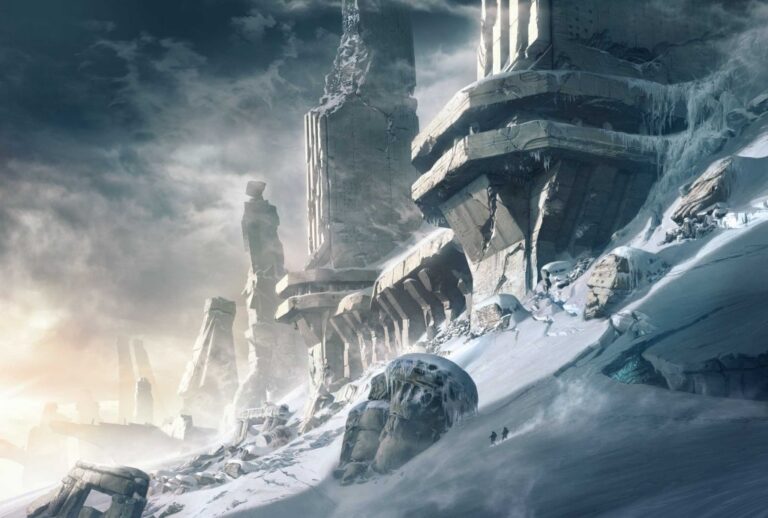
What stands out here, more than anything else, is Baranger’s clear expression of the sheer scale of the vistas at the Mountains of Madness.  Diminutive people, almost mere specks, are contrasted with the colossal structures, whilst mountains seem like hillocks compared to the vast alien cities.  This scale and lack of human perspective express the sheer alienation of the setting and architecture.

This focus shifts when we are inside with people from the story.  Here, people dominate the perspective, when we are viewing at the same level as the people, they are more relatable than when shown in the inhuman vistas.

There is also a fantastic use of colour in Baranger’s paintings.  The cold exteriors are predominantly the white and blue of snow flurries and icicles, evoking a subconscious chill.  This is balanced by the warm yellows and browns of the human interiors – usually libraries and cabins – that feel safe.

These shifts in perspectives and colour are combined to reinforce the underlying theme of Lovecraft’s work; that we do not belong in such an alien and inhospitable environment.

Baranger does not shy away the body horror found in At the Mountains of Madness and such images are profoundly detailed and yet obfuscated just enough to never fully show the grotesquery and descend into being gratuitous.

It should be pointed out this is not the complete story, but only the first of two volumes.  Volume 1 concludes just as the expedition encounters the entrance to the alien city, acting as the perfect cliff-hanger to conclude the first volume.

Finally, accompany this artbook is a foreword by French novelist Maxime Chattam exploring the enduring fascination with Lovecraft and At the Mountains of Madness.

Hiro Arikawa – The Travelling Cat Chronicles…

…or how I ended up weeping over a book about a sassy cat, travelling in a silver van with her human.

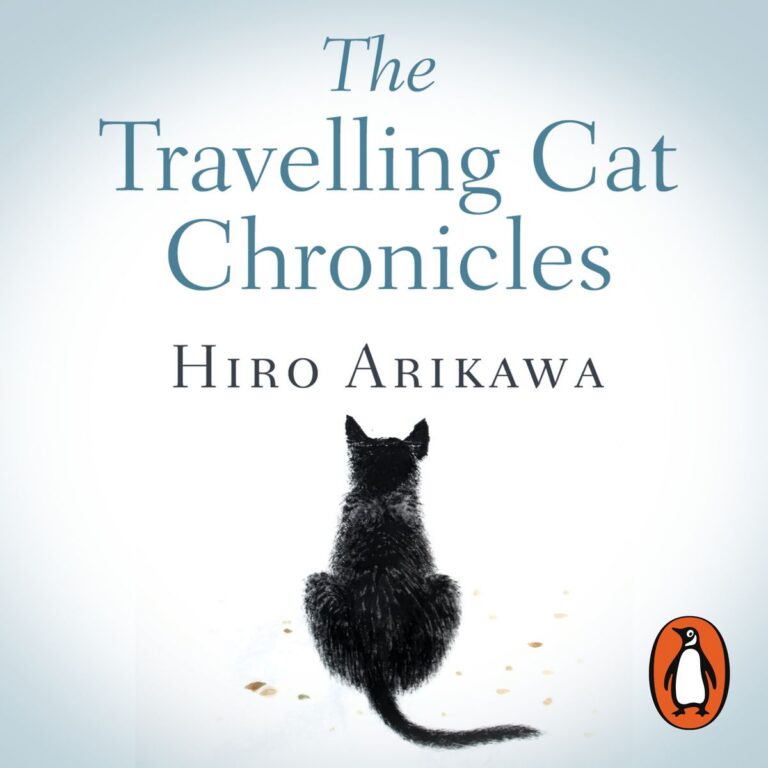
Hiro Arikawa is mostly know for her light novels – an all encompassing term for novels aimed at young children and teenagers – but The Travelling Cat Chronicles is not something I would necessarily put in that category. I think regardless of age, it will touch people’s hearts and definitely pull at the strings it finds there.

The book focuses on Nana (because his tail twists like a lucky 7), a five year old cat who has been living with Satoru, his human, for a longer time than he had lived on the street. Still, he sees himself as a great fighter and teacher of the young, as well as an astute judge of character. Human or otherwise.

He is the narrator of the book and tends to sometimes look down on the logic humans employ in their day to day life. Satoru is spared, for the most part, however cats will be cats and Nana does get in a jibe or two about the man that rescued him from the street, following a car accident.

At first I admit I was not convinced by the synopsis of the book, however as I slowly delved into the story, I found myself absolutely loving the characters, especially the ones that were flawed. Of course, in Nana’s eyes only humans and other creatures had flaws, he was perfect (as most cats are).

“At that moment, we were without doubt the greatest travellers in the world. And I was the world’s greatest travelling cat.”
― Hiro Arikawa, The Travelling Cat Chronicles

As I neared the final pages of the book it became more and more clear that it was never really about a cat chronicling a trip around Japan, meeting old friends and gathering up smiles, but about the deep love between a human and his feline companion. I think there are hundreds of book chronicling stories of humans and their dogs, the deep bond that exists between them, but cats are often overlooked.

Maybe because people who don’t like them think they are incapable of loving their people, but this book proves in spades that cat love is there, if different. Nana is loyal to a fault, knowing what Satoru needs or what he thinks, even before the thought is put into words and it goes out into the world.

The book chronicles Satoru’s encounters with his old friends, while in the search for a new owner for Nana. The true reason behind his desire to find a new home for his cat is not disclosed until late in the book, but his need to know his cat is cared for and loved as he had loved him is the driving force behind all reunions – with childhood friends, with highschool or college ones. The story of Satoru’s life is revealed through the eyes of each person he meets and then it’s filtered through Nana’s understanding of each story.

Without giving too much away, I will say that this is one book that deserves to be read, that carries a lot of love and it might leave you in tears, but in a good way.