Home Blog Page 6

MCM Comic Con returns to Birmingham for three days of pop culture extravaganza

The anticipation is building as MCM Comic Con gears up for its grand return to the NEC Birmingham from Friday 1st to Sunday 3rd December. Brace yourselves for the ultimate celebration of pop culture, promising an unforgettable long weekend filled with exciting experiences, exclusive panels, and the chance to meet your favourite stars.

As the 60th anniversary of Doctor Who approaches, MCM Birmingham Comic Con is pulling out all the stops to make this event truly special. The iconic series will be celebrated with a fantastic lineup of activities, including the Doctor Who Timey Winey pub quiz, where fans can test their knowledge of The Doctor. Attendees will also have the chance to witness the Daleks Through The Decades Christmas Beauty Parade and even learn the language of the Dalek—a once-in-a-lifetime opportunity. The Project Dalek prop display is back in all its glory, ensuring fans won’t want to miss out on this nostalgic experience.

The festive magic continues beyond Doctor Who; attendees can explore the inspiring world of Artist Alley to find the perfect Christmas gifts for pop-culture lovers. Original artwork, comics, prints, and unique merchandise from independent artists and creators await discovery.

One of the highlights of the event is the presence of the incredible Mike Quinn, renowned for bringing Nien Nunb from the Star Wars franchise to life. Fans of the popular game Baldur’s Gate 3 will also have the chance to meet Neil Newbon, best known for his role as Astarion. Autograph and photo op sessions with these talents will be available throughout the event, providing fans with memorable interactions.

The event boasts an incredible lineup of guests across all three days, including Patricia Summersett and Sean Chiplock, the voices behind The Legend of Zelda: Breath of the Wild characters. Voice actors from animated sensations like RWBY and Genshin Impact will also be present, alongside Roger Clark and Troy Baker from Fort Solis, offering fans a chance to meet and greet their favourite talents.

The event caters to various interests, offering augmented reality sports with HADO UK, live full-contact thrills with Quadball UK for sports enthusiasts, and Elite Wrestling Entertainment for wrestling fans. Gaming enthusiasts can explore the Side Quest area, featuring a Multi-Player Lounge, Retro Zone, and the latest consoles in the Gaming Bus. Tabletop gaming aficionados can indulge in an extensive library and life-sized TTRPG games in the Life Size Tabletop Experience.

For families, the award-winning Treehouse provides a world of creativity and imagination, featuring face-painting, comic creation, mask making, and magical story time sessions with Santa and the Elf. Kids under 10 even get free entry with an adult ticket holder.

Cosplay Central promises a realm where creativity knows no limits. Attendees can witness the remarkable skill of cosplayers, learn from experts, and enjoy the Cosplay Masquerades showcasing exceptional craftsmanship. The Artist Alley invites visitors to explore independent artists and creators, offering a perfect opportunity to find unique Christmas gifts.

Pop Asia awaits with an Origami workshop, K-pop dance performances, and Manga drawing sessions to unleash your creativity. Teresa Heitor, Event Director at MCM Comic Con, expressed excitement about bringing the event back to Birmingham.

Get ready for a weekend of immersive experiences, entertainment, and a celebration of all things pop culture at MCM Comic Con—where the excitement knows no bounds!

Geek Pride will be attending and will report back soon on how the event turns out! Check out the official show guides here to help you navigate the event.

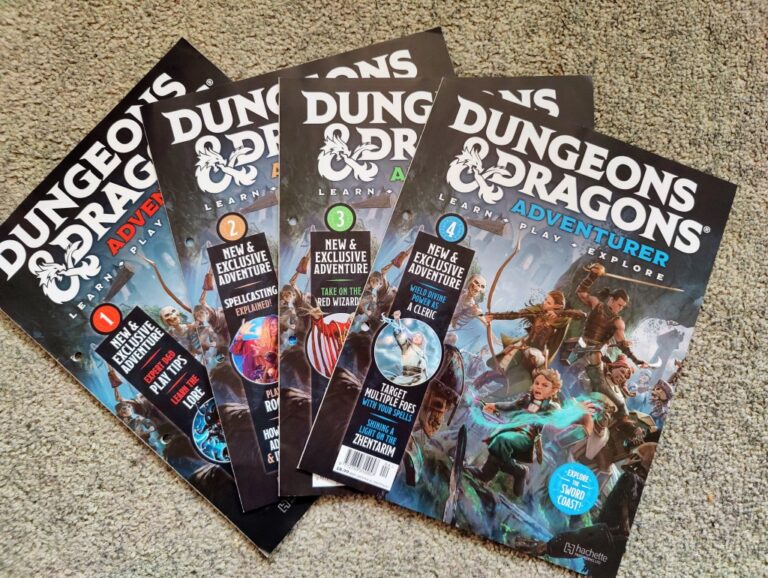
Dungeons & Dragons Adventurer

Dungeons & Dragons Adventurer is a partwork that introduces the concepts and rules of Dungeons & Dragons (D&D) over eighty issues.

Each issue is dedicated to a particular facet of the game, is approximately 25-30 pages long and is broadly split into the following four parts:

  • Sage Advice discusses different aspects of the D&D rules.  There is no assumption of any existing knowledge of the game, so it is ideal for anyone interested in playing D&D.
  • Character Creation examines how player characters are made, what the various classes are and how their different abilities can be used.
  • Lore examines the standard D&D setting, by explaining the locations and factions within the Forgotten Realms.  It would be interesting if they also considered other D&D settings such as Dragonlance or Ravenloft.
  • The final part is an encounter.  Each scenario forms part of a larger adventure, but they could be slotted into an existing campaign as a small side quest. The encounters are reminiscent of an hour-or-so games for running during lunchtime breaks.

The magazine is engagingly written and encourages experimentation; D&D – like all of roleplaying – rewards player imagination.  Likewise, each of the scenarios are inventive and sufficiently different that they do not always rely on combat to solve, ensuring that no particular character or class is essential for their completion.

Location maps accompany each scenario and are clearly presented for the GM. However, the best ones are those that are presented as in-game handouts, as they are drawn as if on parchment.

The sample character sheets (and their accompanying tokens) with the second issue are designed with these initial scenarios in mind.  However, the scenarios could be run using the players’ own characters or the sample characters used as supporting characters in another game.

The first few issues come with free dice and accessories, but the highlight has to be the map of Sword Coast that comes with the second issue.  The map is especially useful and will make an excellent focus for players to gather around.  Its large size means there are a lot of details, whilst the heavy-duty paper quality means it is possibly tough enough to withstand being used as a playmat.

Dungeons & Dragons Adventurer contains everything needed to understand how to play D&D.  However, it does not replace the Players Handbook, Dungeon Master’s Guide or Monster Manual.

The elephant in the room is the price tag.  The first issues are cheaper, but later issues cost £8.99 each (premium subscribers pay an extra £1.25), with four issues released each month.  When buying just for one person the price does seem steep, especially compared to the price of a D&D Essentials boxset.  However, if the subscription were to be shared, then it could be justified.  As D&D is a group activity, a group subscribing to the magazine collectively makes sense.

Overall, Dungeons & Dragons Adventurer is an excellent, if expensive, partwork magazine that introduces the world of D&D – and the wider hobby of roleplaying – in a clear and fun way to a potential new audience.  And more roleplayers is never a bad thing.

Hunter: The Reckoning – 5th Edition

It would be fair to say that there was some surprise when Hunter: The Reckoning was announced as the next World of Darkness game to be developed after Vampire: The Masquerade – 5th edition (V5 – reviewed here).  Many had expected that Werewolf: The Apocalypse (W5) would be the next game developed (it actually came after this and is reviewed here), whilst some hoped for Mage: The Ascension.

However, a fifth edition of Hunter: The Reckoning (H5) was a logical choice to follow V5.  After all, vampires are, amongst others, the natural quarry of the hunters.  That said, the hunters of H5 do not just hunt vampires; they hunt anything that threatens innocents within the World of Darkness.

It is worth noting that there were previously two hunter games in the World of Darkness.  There was the original Hunters Hunted, a sourcebook for playing people hunting vampires using Vampire: The Masquerade.  A few years later Hunter: The Reckoning was released, for playing supernaturally-imbued hunters.  H5 removes the imbued abilities and retains the core character concepts of Hunters Hunted to create a new version of the game.

In H5, players take on the role of people that have glimpsed the horrors of the night.  Rather than having the powers of the imbued, hunters rely on their innate skills and abilities.  There are some mystical powers available for hunters, but the emphasis – like the rest of the 5th edition – is on a more grounded approach to the World of Darkness.

There are a variety of different types of hunter, based on their creed (their background and how they approach hunting) and their drive (why they hunt).

Another defining aspect of the hunter is their edge.  An edge is an exceptional talent or ability they have, such as ‘arsenal’ or ‘drone jockey’.  Most of the edges are relatively grounded, but a couple are supernaturally endowed, such as ‘repel the unnatural’ for example.  Edges can be further enhanced with perks, giving additional benefits above the standard.  During character creation, players have the choice of selecting an edge with two perks or two edges and a perk.

A core concept of H5 is the theme of collaborating and working as group.  Mechanically, this is represented by the group, known as a ‘cell’ in the game, having a desperation and danger rating.  These ratings are 1 to 5 and they change throughout the game due to the actions of the player characters.

Danger usually starts at 1 and rises throughout the game as the quarry becomes aware of the cell’s actions against them.  As the danger level increases, the cell’s quarry takes additional protection, such as bodyguards.  The danger level can decrease if the cell chooses to stop actively pursuing the quarry, but this can cost the lives of innocent victims.  Desperation meanwhile represents the stress the cell is under, which can increase through the danger to which they are exposed, or decrease due to their successes in the field.

Skill checks are made by combining the skill and attribute (such as wits and alertness).  In cases relating to their drive, a character can add a number of equal to the desperation rating of their cell.  This is akin to the hunger mechanics in V5 or the rage mechanic in W5.

The results of a skill check are interpreted by the number of successes on a dice (6 or over).  Rolling a 1 on a despair dice, but still succeeding, means that the character over-reaches, alerting the quarry and thereby increasing the danger level for the cell.  Failing a skill check when using desperation dice leads to despair for the character, where they succumb to the overwhelming odds facing them and need to redeem themselves in accordance with their drive.

This is where the touchstones come into play.  A touchstone acts as a reason for the hunters to continue pursuing their vendetta against the supernatural and can help restore their willpower.  A hunter without any touchstones permanently descends into despair.  However, a touchstone can also become a potential liability, especially if a touchstone is threatened by the very forces the hunters are pursuing.

The system for H5 is very similar to that in V5 and W5, offering lots of crossover potential.  Hunters are probably the characters that have the most potential for interacting with the game lines, as they hunt anything.  Anyone familiar with V5 or W5 will have an understanding of how to play H5.

Although H5 is a game about hunting monsters, the threat posed by them is such that any physical confrontation should be kept to a minimum.  Instead, the focus of the game is on the investigation and coordination.  The players will need to investigate the monster, find its lair and learn its vulnerabilities, before setting an ambush to eliminate it.  Facing a monster should be an epic grande finale and it should be hard – hunting monsters is a dangerous occupation and the unprepared will not survive.

Standing alongside the vigilante-style cells in H5 are the larger government or privately-funded organised groups, otherwise known as ‘orgs’.  There is a disconnect between the hunter cells that are out to hunt monsters and the orgs that hunt monsters, but have other reasons for doing so.  The government-level orgs, like Special Affairs Division and the Information Awareness Office, are covered in greater detail within the Second Light sourcebook for V5.

The background on the orgs is very good. The Order of the Rose is absolutely terrifying, as it like a cross between the Stepford Wives and a fundamentalist cult.  Re:Venge is a fun org, riffing on the gig economy, but feels out of place in the World of Darkness, as it implies there is a wide knowledge of the monsters within the setting than has previously been established.

The list of antagonists facing the hunters is amazing.  There are some fantastic ideas; more than just another vampire or a werewolf, as the writing added lots of texture to them. The background material embraces the focus on the research and investigation, rather than just the extermination. It could be argued that H5 is worth getting for the antagonist section alone, as they would make excellent storyteller characters for V5 or W5.

Due to the mature nature of H5, the core rulebook concludes with a discussion about storyteller tools for dealing with sensitive subject matter, such as lines and veils, and a ‘session zero’ for character creation and setting the tone and subject of the games.

H5 ultimately abandons the superpowers of the original Hunter: The Reckoning for a more grounded approach to hunting monsters that fits well within this new World of Darkness.  By incorporating the danger and despair mechanics into the game, H5 explores the psychological toll that being a hunter has on the characters and how they need to maintain their humanity when fighting monsters.

Werewolf: The Apocalypse – 5th Edition

Werewolf: The Apocalypse – 5th Edition (W5) is the latest edition of the World of Darkness games about werewolves.  Unlike the previous editions of Werewolf, which continued the metaplot and expanded the world, W5 is a reboot of the series, returning to the core of the game and redefining how it is played.

W5 is focused on the Garou; warlike shapeshifters torn between wolf and man, and the champions of Gaia, the spiritual representation of the Earth and nature.  However, Gaia is dying, and the apocalypse has begun.  Each player takes on the role of a Garou, calling upon their rage to confront the forces of destruction and wrest Gaia from the brink of death if they can, or follow her enemies to the grave.

W5 is very much a game about the horror of an environmental apocalypse and what impact this might have on those fighting it.  Rage is a core theme within the game, as that is what powers the Garou’s ability to change shape, as well as fuelling their strength and capacity to withstand injury.  However, it can also lead to harano (despair) and hauglosk (fanaticism).

These themes are embedded within the mechanics of the game.  Skill checks are made by combining the skill and attribute (such as wits and alertness).  A number of 10-sided dice from the pool are replaced with rage dice equal to the amount of rage a character has.  In many ways this is akin to the Hunger mechanics in the fifth edition of Vampire: The Masquerade (V5 – reviewed here).

These results of a skill check are interpreted by the number of successes on a dice (6 or over).  Two successes are needed to pass a standard skill check, but some checks may be more difficult than others and require a greater number of successes.  More successes on rage dice than normal dice can lead to a bestial success, where the rage-filled nature of the character comes to the fore.  Likewise, critical failures (rolling a 1) not only fail a skill check but cause something detrimental to happen, such as an item breaking.  Furthermore, when performing a violent task, such as fighting, the rage dice is added to the skill check, rather than substituting existing dice.

One of the things that stands out most is how W5 removes the previous cultural associations of each tribe.  The concept of tribes, in that each Garou is a member of particular group, remains, but they are no longer tied to a particular region or ethnicity.  Some tribes have been renamed to reconcile with the culturally agnostic approach.  As a consequence of these changes, W5 feels truly global for the first time.

This is a Werewolf game for a new generation.

Some existing fans may be disappointed with certain changes, such as the Cult of Fenris and the Stargazers leaving the Garou nation.  However, their expulsion is used to exemplify the extreme fallouts of rage.  In the case of the Cult of Fenris, their departure is used to explore the extremes of absolute fanaticism.

Another of the major change is that some Garou believe that Gaia is dead, rather than dying.  There was always a fatalistic element to Werewolf: The Apocalypse, conveying how this was the end times of the Garou.  Now, with Gaia believed to be dead by some, this fatalism is brought to the fore and adds much needed gritty element to the game.

The umbra, the realm of spirit that overlays the physical realm, has also evolved, and it is no longer safe for the Garou.  Although Garou may be able to crossover into the umbra, they are only partly creatures of spirit and this is not their natural habitat.  As such, Garou are no longer able to pass between the umbra and the physical world with impunity.  This provides a new element of risk and reinforces that nowhere is truly safe for the Garou.

All of these new elements combine to make the power levels of the Garou lower than what they once were in previous editions.  Garou are still a (literal) force of nature and more powerful than a vampire, but they are no longer unstoppable killing machines.  This decrease in power feels in keeping with the overall themes of the game and the grounded approach to this new World of Darkness.

There are also much more varied enemies in the core rulebook.  The wyrm, the spiritual representation of decay and entropy, remains a core protagonist, as well as the wyrm-tainted corporation Pentex (imagine Umbrella Corporation from Resident Evil but without H&S and an ethics committee).

However, we are presented a far more nuanced portrayal of the antagonists. The wyrm has become evil not because of what it is, but because of the imbalance within the triat; the celestial trinity of wyrm, weaver (stasis) and wyld (creation).

It is interesting to note that vampires are not now considered wyrm-tainted, and thus natural enemies of the Garou.  However, a vampire remains worthy of a Garou’s loathing, as both consider themselves apex predators.  As such, do not expect any team-ups any time soon.

We are also introduced to more enemies.  These include the fomori, humans and animals possessed by banes (wyrm spirits), and skin-stealers, humans that performed foul rituals to gain the power of shape-shifters.

The core rulebook concludes with an excellent scenario, which introduces the main concepts of the game to new players.  It should only take a session or two to run, and each of the scenes are explained with how they should be run.  The core rulebook also offers guidance on how to run Werewolf: The Apocalypse.  There are a rich collection of antagonists and allies to inspire many new storylines.

W5 uses the same system as the fifth editions of Vampire: The Masquerade and Hunter: The Reckoning.  Making the rules system compatible with the other World of Darkness game offers intriguing crossover potential and presents a far more cohesive setting.

W5 contains everything needed to run a game of environmental apocalypse.  It is easy to understand, with key rules highlighted in standouts.  The fantastic artwork throughout the book, along with the evocative quotes and atmospheric stories, makes this a joy to read.

W5 is a long-awaited reboot of Werewolf: The Apocalypse, which introduces the game of environmental horror to a new generation and asks them; “When will you rage?”

Undaunted: Battle of Britain

Undaunted: Battle of Britain is a two-player deck-building wargame played over a hexagonal map based around the Battle of Britain that took place during the Second World War.  One player controls the RAF, whilst the other manages the Luftwaffe.

Undaunted: Battle of Britain has a setup time of approximately 10-20 minutes.  Laying hex-tiles into the set pattern, as well as sorting the cards and counters that players will need for each mission, can be time consuming.

Anyone who has previously played any of the other Undaunted games will be instantly familiar with the format.  Each player has a deck of cards, from which they draw at the beginning of each turn to form a hand of five cards.

Initiative is determined by players bidding using a card from their hand; the player who plays a card with the highest initiative number goes first.  The initiative bidding is an elegantly effective mechanic (the more powerful the card, the higher the initiative number), but it also means the card is then unavailable during the player’s turn.

During each player’s turn, they will play the cards in their hand until all have been played.  The player’s units are moved across the map by playing the appropriate card.  However, maintaining squadron cohesion is a must.  The units in each squadron need to remain within a set distance of each other, otherwise they need to regroup.

There is an escalating complexity to the rules as the campaign is played through.  These additional rules introduce new elements to the game that the players need to consider in their tactics, hence ensuring the game does not become repetitive.

The rulebook is concise and well laid out, but the rules can be unclear at times.  This is especially true in regard to the movement and actions of units. Watching how-to-play videos can alleviate this, but it can be frustrating when wanting to just start playing the game.  The artwork is wonderfully atmospheric throughout and offers a faithful representation of the time.

The campaign also has a neat touch in how it mirrors the Battle of Britain.  It is not as historically accurate as it could be (this is not The Campaign for North Africa), but it does make for an interesting story based on historical events.  The modular aspect of the game, using different units, tiles and cards for each mission, means that there is the potential for new missions to be created.

With so many board games being playable with four or more players, Undaunted: Battle of Britain feels restrictive with being limited to two people.  However, this is true of most wargames, and it would be fair to say that Undaunted: Battle of Britain feels like the combination of a wargame and board game.  It would have been interesting if there were possibilities for more than two players.

Overall, Undaunted: Battle of Britain is a satisfying tactical boardgame that recreates an iconic moment in history.  However, watching how-to-play videos is recommended as the rulebook is not as clear as it could be at times.

Aliens: We’re in the Pipe, Five by Five

We’re in the Pipe, Five by Five is an expansion for Aliens: Another Glorious Day in the Corps (an interview with the developer Phil Yates can be found here).  It is important to note that We’re in the Pipe, Five by Five needs the Get Away From Her You B*tch expansion in addition to the base game.

The Aliens: We’re in the Pipe, Five by Fiveexpansion brings the dropship pilot Ferro and the quartermaster Spunkmeyer to the game, expanding the strategic options available to the colonial marine player.  Meanwhile, the xenomorph hive player can now field four new variants of xenomorphs; brute, guard, scout and skulker, which similarly expands the potential strategies for the hive.

Alongside this is an A5 rulebook including seven pages of expanded rules for fire teams of colonial marines, new xenomorph variants and updated missions incorporating the dropship and air ducts.

The accompanying miniatures are incredibly detailed and look amazing.  Unfortunately, like the rest of the game, each miniature is in five or more pieces and takes a long time to assemble.  This can be frustrating for people with limited free time, as the amount of additional setup time is extensive.

Despite this minor quibble, Aliens: We’re in the Pipe, Five by Five (even if it really should have been called ‘Bug Stomper’, the name of the dropship in Aliens) is an excellent addition to Aliens: Another Glorious Day in the Corps, bringing a key element of the dropship crew to the game as well as some new xenomorph variants to counter them.

Village Rails

Village Rails is a neat tableau creating card game for two to four players.  Each player takes on the role of a railway network manager wanting to usher in the age of steam trains by connecting villages together whilst meeting the demands of local residents.

This thematic game is surprisingly challenging.  Each player chooses a track card and gradually builds a 3 x 4 cards tableau in front of them.  Although the players can essentially place the cards in any order, careful planning is needed in order to maximise the returns of the cards by their placement.

Completing train lines allows players to plan a trip and play a terminus card.  These, in turn, generate income, which can be used to choose other cards and purchase extra trips, thus earning points.  Balancing income and points necessitates agonisingly careful decision-making: income offers more options within the game, but it is the player with the most points at the end who wins the game.  However, points have little impact during play.

There is wonderfully evocative art style throughout Village Rails that portrays the rustic quaintness of rural England at the time the game is set, as well as the exacting traditions of local planning authorities.  The themes of the game are baked into the mechanics.  As the tagline proclaims, this is a game of locomotives and local motives.

The rulebook is quite small, coming in at only eight pages of A6, but the writing is small and densely packed.  The setup is clearly explained, however some of the rules and terminology are not as clear as they should be.  Some players may therefore find it helpful to look up tutorial videos in order to fully understand the rules of the game.

One of the big bonuses of Village Rails is that it is small and compact, making it an easy game to take on holiday.  Although it would not be suitable for playing whilst traveling, due to the amount of tablespace required to play, its small size means it would be easy to pack.

Overall, Village Rails is a neat little card laying and management game that would be ideal for when shelf or suitcase is limited.  However, watching actual-plays or tutorial videos could be worthwhile in advance of playing to ensure a full understanding of the rules.

Stray Gods: The Roleplaying Musical

To know the story of Stray Gods, we must first know the story of David Gaider and how he came to co-found Summerfall Studios in Melbourne, Australia in 2019. Gaiter. Coming from a lengthy career in the video game industry with BioWare, including handing the quill for Baldur’s Gate 2: Shadows of Amn, he was already responsible for writing a number of BioWare’s success stories, such as Star Wars: Knights of the Old Republic to The Dragon Age series. He departed the company in January 2016, moving to work as Creative Director at Beamdog, which he would then leave in February 2018.

Why the preamble? Well, Stray Gods: The Roleplaying Musical is Summerfall Studio’s first project, funded by Creative Victoria – a state government body dedicated to supporting Victoria’s Creative industries – and a largely successful crowdfunding campaign on the platform Fig (reaching 115% of its $600,000 goal). Originally named Chorus: An Adventure Musical, the project set out its inspirations from the start, citing musicals like Buffy: Once More With Feeling, Dear Evan Hansen, Hadestown and Wicked, as well as videogames like the Dragon Age series, Life is Strange, and Dream Daddy. Whilst it never quite managed to smash through its stretch goals, the stage was set for Stray Gods to take the spotlight.

Stray Gods sets out to work as a part interactive musical and part illustrated adventure game, with a dash of character-driven narrative and a dusting of romance. Initially aiming for a PC release, the project managed to successfully launch across a range of platforms including Xbox, Playstation and Nintendo.

The game places you in the shoes of Grace, who must navigate through a treacherous new world with the power of music. Assuming the role of the Muse upon the death of her new friend Calliope, Grace finds herself charged with murder by The Chorus – a group of Greek Gods who still operate beneath the world as we know it as it emerges that perhaps those myths and legends about Greek Gods and monsters might not be so farfetched after all. Driven to discover the truth, Grace gains a stay of execution and a week to uncover the true tale that lies beneath – and so, armed with her newfound ability to draw others into you might just be able to draw characters in just enough to change their mind, perhaps let slip a confession, or even fall in love. It is up to you, and the direction you decide to take.

Meeting the Olympians

But before the plot goes down, the game starts off like your typical visual novel – conversations pause in order to present you with an array of dialogue choices, each allowing you to take the conversation in a particular direction…such as gaining insight into colleague, pressing forwards with the story, or even flirt a little to kickstart a possible romance. However, unlike the dialogue trees of Telltale visual novels or the branching choices of BioWare games, the game also doesn’t hide that music lies at its very heart.

The story starts with auditions for Grace’s band, and once her bandmates leave Grace takes to the stage to sing a personal ballad about feeling adrift – and it is Grace’s heart, laid bare in music, that draws in Calliope and from there we follow Grace’s story. A musical game is a bold direction to take, and the game boasts an impressive cast list who have been known to carry a tune or two to make it work, such as Laura Bailey and Ashley Johnson – our Grace and Calliope – might be known for their work in film and video game voiceover work, but have also carried the tune in ‘Your Turn To Roll’ for the webseries Critical Role.

The versatile cast of Stray Gods…who do you recognise?

The musical numbers which emerge through the course of the game help you steer the flow of the narrative, as time-sensitive choices often emerge during the course of these moments – you can choose to be Charming, Kickass or Clever. In addition to providing some direction to the narrative through conversations, each Trait can also have an impact on the direction of the song too, changing up the tone to be either more delicate or perhaps more rock’n’roll with a distinctly notable beat and lyric change. These can make for some fascinating experimentation with songs as you switch tones, coaxing out different aspects of other characters in which they might let slip or lose themselves to the rhythm.

These natures come with pros and cons, and ultimately some of the responses in the game are limited to certain natures – in order to make that option available to you, you might have to undertake different playthroughs in order to satiate your curiosity. Certain outcomes are not necessarily locked, but are easier to achieve with certain natures, so it’s not as expressly linear as you might expect from a visual novel.

How do you want to do this?

It should also be noted that all this takes place in a gorgeous comic book art style, reminiscent of The Wicked + The Divine which allows for some fantastic hand-drawn visualisations of various icons and recognisable deities. In particular, Grace has an excellent design with a variety of illustrations to convey expressions and emotions that lean on the superb writing that encapsulates her story. This can be notable against some other characters, but for the most part each character is given their own personal style and are decked out in personal accessories that suit the characterisation. Locations are similarly given love and attention to detail, from the opening audition room to best pal Freddy’s apartment to the Olympus office.

God, I could read a comic series based solely on this art style…

If I have one complaint, it’s that the art style makes a choice to stick to the comic book art style by removing a majority of lip animations. This is not uncommon, and is fairly standard for visual novel games – old ‘Ace Attorney’ games stand as a testament to this fact – however, it feels off when songs are the beating heart of what makes your games unique. When you have music and lyrics take the centre stage for your game, there’s an odd, disjointed feeling when you listen to the audio coming from the closed mouths of characters.

Music, as with art, is also a beauty held in the eye of the beholder, and so it is worth noting that this game is a joy to play if you enjoy visual novels and musicals. The two are seamlessly interwoven into one another, and are at the core of this game – its heart beats to a melody of your choosing, but that melody can strike up and take control of the narrative.

Ready to rock?

Despite my minor quibble, I found myself thoroughly invested in the music, the story and gameplay, which I also found to be thoroughly accessible. All these aspects are wrapped around a narrative which drove me not just to uncover the murderer in my own unique way, but to consider how a different playthrough with distinct choices that would still make me feel the weight of some narrative-swaying moments.

Dragonbane

The classic roleplaying game Dragonbane, also known as Drakar och Demoner (Dragons & Demons), is to Sweden what Dungeons & Dragons (D&D) is to the UK and USA.  It has been over forty years since Dragonbane was first released, but it has now been reimagined with a new edition.

Although Dragonbane relies upon classic high-fantasy tropes in a stereotypical medieval-fantasy setting, it has been sufficiently invested with neat twists to make it fresh and interesting.  There are the usual fantasy races of elves and dwarves, but there are also wolfkin (humanoid wolves) and mallards (humanoid ducks). Each race possesses a unique characteristic, such as halflings being hard to catch.  This mechanic adds a different facet to the each of races, without influencing the choice of character classes, which some character background mechanics – such as racial bonuses – can inadvertently cause.

Dragonbane utilises a simple D20-based system, with any skill/combat test requiring players to roll under a target number on a twenty-sided dice (D20).  The system incorporates critical successes (called ‘dragons’ on a 1) and failures (‘demons’ on a 20), as well as the mechanics for benefits and boons, which is similar to the mechanics for advantages and disadvantages in D&D.

Rather than relying on automatic successes for spells, magic is refreshingly skill-based.  Just as a fighter needs to successfully hit with their weapon skill, so does a spell caster need to successfully cast their spells.  Making the magic skill-based balances the game out wonderfully and introduces a different perspective to character creation within the game.

One thing that soon becomes apparent in Dragonbane is that this is a wonderfully stripped-down rulebook, clocking in at just over 100-pages.  When compared to some epic 250-page tomes (Vaesen for example), Dragonbane feels distinctly lightweight.

The rulebook’s comparatively small size makes Dragonbane less time-consuming and overwhelming to read and easier to for players to become familiar with the streamlined rules system.  However, there is a feeling that the game is not as well-rounded or as deep as it could be.

The list of magic spells is also comparatively limited, with them being broken down into only three different magic schools (animism/elementalism/mentalism), as well as a few generic spells for all schools of magic.  However, this could be easily fixed with a sourcebook expanding the magic rules, as the core mechanics work very well.  In the interim, any sufficiently experienced games master should be able to create their own spells and magic schools.

There is a limited amount of information regarding Dragonbane’s setting of Misty Vale within the core rulebook.  This can be liberating, as game masters are not beholden to running games that fit within the established background lore.  However, those that rely on setting information for developing ideas for running games may be disappointed.

Dragonbane concludes with a GM section that describes the basic structure of a Dragonbane adventure and how a series of adventures form a campaign.  An accompanying 120-page adventure book includes over a dozen scenarios, which form the Secret of the Dragon Emperor campaign when played consecutively.  Each adventure is increasingly complex and includes everything a GM will need to run the scenario.

The box set includes a series of glorious maps for each of the adventures, as well as a huge full-colour map of the Misty Vale setting of Dragonbane.  These add some much-needed texture to the limited background information and serves to orientate the players regarding where their characters are within the world.

There is also the Alone in Deepfall Breach booklet, which offers alternative rules for playing Dragonbane as a solo-experience, using the hex-based maps and monster charts.  Whilst solo gaming remains popular, as proven by Fighting Fantasy still going strong, Dragonbane as a solo-experience seems incongruous.

Although the refreshingly compact size of Dragonbane makes it an ideal roleplaying game for newer players, the lack of depth or complexity might not hold the interest of more experienced players. That said, Dragonbane would be an ideal choice for anyone wanting to run a short campaign or looking for a fantasy roleplaying game that is a little bit different.

The Art and Making of Dungeons & Dragons: Honor Among Thieves by Eleni Roussos

This isn’t as big as some Art/Making of books, especially when doing double duty, as this one does. This is an enjoyable read, however, and not just for Dungeons & Dragons fans. With a foreword by the filmmakers, John Francis Daley and Jonathan Goldstein, and an afterword by Jeremy Latcham, one of the producers, it splits the rest of its 197 pages into 4 sections:

  1. Creating the characters
  2. Bestiary
  3. Forgotten Realms
  4. The Magic of Filmmaking

The book is full of colourful illustrations from the concept art and storyboards for the film, as well as behind-the-scenes pictures and production art, doing an excellent job of using that art to illustrate the written content.

Each of the main characters, and a few others, get sections talking about their reason for being in the film, both from the film perspective and a D&D party perspective, and there are comments from the actors. The wizards at Legacy Effects get a lot of acknowledgement for their stunning work on producing practical effects for a number of the characters and creatures, so that the actors could act against them, rather than tennis balls on sticks, and both in the film and the behind the scenes images, their work is very impressive.

There is a lot of love for practical effects where possible in the movie that I think paid off very well, and that’s shown here. They also talk through the tricks and the work they used to make those members of the film’s cast that were intended to be different sizes film with the rest of the cast and then have the scenes updated to fit the ‘reality’ of D&D, which made the performances of the actors better. There are several warnings about the impracticality of Xenk Yendar’s costume in combat as an uncomfortable reality – Especially the cloak, as we have often been warned in a number of films!

Edgin Darvis

The Bestiary doesn’t just talk about the creatures they included in the film, and why, but also how they included a number that are included in tapestries, or paintings, for example, to make the setting feel more real. There is also some discussion about a few of the beasts they didn’t include in the film, often because it would have been gratuitous and taken away from the story. When some are iconic Dungeons & Dragons monsters, this may have been a brave move, but maybe in a sequel? We can only wait and see.

In the Forgotten Realms section, they talk about the world of Faerun, and why they chose the areas for the film to take place they did. They also discuss how the film created some locations that would in turn be put into the D&D books by Wizards of the Coast once they agreed to them…. There are now opportunities for our own parties to cross over with the journeys of Edgin, Holda and even Forge! It’s also interesting to see the level of detail they put in, not just in terms of painting and furniture, but also making sure that markets had stalls selling classic adventurer gear like ropes, alchemy ingredients, tools, etc.

Emerald Tavern

They finish the book by talking about the actual making of the film in more detail. They cover the logistics of making some of the scenes work without injuring people, and if possible being able to recreate them for filming at different angles or reshoots. This includes a lot of storyboards to help you to track the thinking and the hard work behind these, sometimes very quick scenes you might just take for granted.

Throughout the book, they make an effort to relate the making of the film to the playing of Dungeons & Dragons itself – The party creating their characters, choosing the setting, the DM interacting with the players to make things happen and even the emergent nature of the storytelling, wherein some parts of the film were better for things NOT working as planned and forcing them to adapt – At one point all hands on deck meant even the producers helped to carry a village 200 yards to shoot a scene from a different direction. If the characters rode uphill, it required the camera dolly’s engine to be running, which drowned out the actors, but letting it roll downhill with them not only allowed us to hear them, and the background noise of the setting, but even made for a better look to the scene they hadn’t considered.

Overall it was an enjoyable and informative read, and the quality throughout is good (Not always the case). If you’re a fan of these books, and the film, it’s a good addition. If you enjoyed the film, and like D&D, it’s interesting to see how they considered and worked with the ties between the game and the film, which was much better than some other efforts. I’d recommend this book.