Elven Throne is an upcoming fantasy board game for three to six players, based around influence and negotiation in a high-fantasy setting. Each player takes on the role of a House within the Elven courts, as they vie to gain control.
From the outset, Elven Throne looks amazing. The cover artwork sets the high-fantasy themes and each of the world tiles has some fantastic pen-and-ink character drawings that reflect their impact on the game.
The boards and components are all solidly made and are utterly in keeping with the theme and mood of the game. Although there are only a few boards – the elven court and other areas – the randomised nature of setup, using the world tiles, ensures that there will be a lot of variation between games. Likewise, each of the Houses are quite varied and require different strategies in order to be effective. Some are also easier to play than others, but offer a rich diversity in gameplay possibilities.
The game is relatively easy to set up, provided that the components have been sorted into their own bags. The boards are laid out, each player chooses a House, then the world tiles are laid out. The randomised nature of the board game can lead to humorous instances, such as the chaotic-evil human bar tender being on an elven throne.
Unfortunately, problems start following the set-up, when we tried to actually play the game. The rules, as they currently stand in the English language edition, are incredibly hard to follow. There are rules that contradict each other, as well as several spelling mistakes and repeated sentences. The rule books also use game symbols, rather than game terms, which results in a lot of flicking between pages to decipher what is meant.
One of the main problems was understanding the mechanics of counteractions. It was unclear how many iterations of counteractions could be played, and there was conflicting guidance on how to use the counteraction tokens.
Despite having three experienced gamers around the table, with many decades of gaming experience between us, we were unable to understand how the game is meant to be played. This is a massive shame, as the premise of Elven Throne and design of the components is sound, it is just the poorly written nature of the rulebook that lets it down.
Elven Throne has the potential to be an amazing game; it looks great and has some fantastic ideas. However, that is providing the rulebook is completely rewritten.
Note: Elven Throne is still in development and was played using a February 2024 version of the rules.
Dragons of Fate continues the adventure of Destina, as she attempts to go back in time to save her father. However, her plans go awry when she goes further back in time than she intended, to the time of the third dragon war. Joining Destina are Raistlin Majere and Sturm Brightblade. Readers of previous Dragonlance novels will naturally recognise these names.
In the process of going back in time, Destina unintentionally brought with her Raistlin and Sturm. This was the doing of Chaos, trapped in the Graygem of Gargath, which Destina carries with her. Also, along for the journey, is Tasslehof Burrfoot, the original bearer of the time journeying device.
Whilst Destina is the core protagonist of the Dragons of Fate, Raistlin and Sturm are very much the principal characters here. Although it was initially disconcerting having these two characters return after their storylines had concluded, it actually makes a lot of sense. Raistlin and Sturm are complete opposites and their relationship was never explored as much as it should have been in previous Dragonlance novels. It is also interesting to see how they relate to the legendary Huma and his war mage friend Magius.
The story is set mostly in and around the High Clerist’s Tower, just before the attack by the armies of Takhisis. This is a pivotal moment for the setting of Krynn, as Huma confronting Takhisis is the turning point in the war. But with the Chaos now in this time, none of this is guaranteed, so it is up to Destina, Raistlin, Sturm and Tasslehoff to return to their own time without disrupting history.
It would be fair to say that things do not go to plan, especially when Tasslehoff is involved, and part of the fun of Dragons of Fate is watching Tasslehoff interacting with the various characters. Tasslehoff has always been a marmite character, but he is used well, adding a touch of light to moments of darkness.
Raistlin remains as fascinating as always. He is a deliciously complicated character that is continuing to evolve. His complex portrayal is often at odds with the seemingly more simplistic representations of the other characters. For example, all goblins are evil. This could be due to the time when Dragonlance was first developed, but it was disconcerting when these moments arose in the narrative.
One confusing point of Dragons of Fate is that Raistlin and Sturm have memories up to the point of their death, but their skills and bodies from the start of the first Dragonlance book. It could be argued this was necessary for Raistlin, as he was an incredibly powerful mage by the end, but may be confusing for some readers.
Keeping the narrative fixed around the tower adds a claustrophobic element to the story, as the characters attempt to survive the coming battle. In many ways it is akin to David Gemmel’s Legend, which has a similar premise. Including a map of the tower and its surroundings would have been a great addition.
Dragons of Fate was a thrilling read with some excellent characterisation. This was a book that sang when focusing on Raistlin and Sturm. The story builds to a fantastic conclusion, which ends on a cliff-hanger twist leading into the final book in the Dragons of Destiny trilogy. Anyone who read Dragonlance novels back in the day will find a lot to like in this latest novel from Weis and Hickman.
Megacon Live, the latest offering from Malo Events, promised an amalgamation of modern pop culture, spanning film, TV, gaming, anime, social media, and retail, all packed into one epic weekend at the renowned London Excel. With over 30 years of event industry expertise, Malo Events aimed to deliver an unforgettable experience, encouraging attendees not only to participate but also to share their adventures online.
This year marked a significant shift as Megacon Live debuted at the Excel centre, a venue previously monopolised by MCM Comic Con for many years. Excitement brewed among convention veterans curious to see if this new event could fill the void left by MCM’s perceived shortcomings of being overpriced, overcrowded, and underwhelming.
Pros:
Disability in Cosplay Panel (on a TokFEST stage?)
The Excel centre as always proved to be a worthy venue, offering ample space and amenities that attendees appreciated. The event felt less crowded compared to its predecessors, allowing for a more comfortable and enjoyable experience. Furthermore, the presence of more artist alley stalls and independent traders added diversity and excitement to the shopping experience. Attendees also praised the inventive use of photo backdrop areas, adding an extra layer of fun to the event.
In addition, Megacon Live demonstrated a commendable commitment to the cosplay community. The designated cosplay zone, while a common feature at many events, stood out for its spacious layout. Attendees praised the provision of changing areas, convenient bag storage, and a dedicated space for costume repairs. The inclusion of friendly and helpful advice for cosplayers added a welcoming touch, enhancing the overall experience. The volunteers involved in managing the cosplay zone should be applauded for their efforts in creating a supportive and enjoyable environment for cosplay enthusiasts.
Cons:
However, Megacon Live faced its fair share of challenges. The decision to host the event in early January was met with mixed feelings. The cold weather, coupled with open venue doors, made for an uncomfortable experience, deterring some attendees from fully enjoying the event. Moreover, the timing of the event posed difficulties for those who struggled to take time off work or had limited funds post-festive season.
Security measures at the event also came under scrutiny. The premature closure of the venue doors 30 minutes before the advertised closing time left many attendees distressed, unable to retrieve purchased items or belongings from the baggage drop. Additionally, photographers faced restrictions on capturing moments throughout the venue, leading to frustration among cosplayers and photography enthusiasts.
In addition to the challenges mentioned, Megacon Live faced criticism regarding accessibility. Numerous attendees reported issues with accessible toilets, with several being closed off throughout the event. This posed a significant inconvenience and discomfort for individuals who required these facilities. The lack of clear signage further exacerbated the problem, making it difficult for attendees to locate the available accessible toilets. Improving accessibility and providing clearer signage should be prioritised in future events to ensure an inclusive and positive experience for all attendees.
Furthermore, the integration of other events, such as “tokfest,” within Megacon Live’s space created confusion and diluted the overall brand experience. Vendors reported issues with communication and logistics, with some items not arriving on time for setup, highlighting a broader issue with organisation and management.
In conclusion, Megacon Live at London Excel showcased the potential to be a new beacon in the pop culture event landscape, capitalising on the strengths of its venue and diverse offerings. However, certain logistical and organisational challenges need to be addressed to ensure a seamless and enjoyable experience for attendees in future iterations.
One of many backdrops, somewhat confusing in theme, we can’t help but feel a postcard from a fantasy/gaming location would be been more thematic…
As the name implies, Building Better Worlds focuses on terraforming alien worlds. This is a mammoth book; coming in at nearly three hundred pages.
The source book is split into two sections; the first section, containing the first five chapters, is focused on general information that characters will know and will be useful for players to read. These chapters cover life in the colonies, creating colonist characters and the equipment necessary for colonising alien planets.
The second, much larger section is purely for games masters. This section is dedicated to the running of games based around colonisation and alien planets. Building Better Worlds delves deeply into the outer colonies of the Alien universe, as well as providing an ‘extrasolar species catalogue’, which is exactly what it sounds like – different types of alien life for characters to encounter.
There are also rules for creating new colonies, including an appendix for an expanded system on generating planets for players to explore. Many of these are presented as a series of charts, where games masters can choose the different planetary conditions and geography either by choice or by rolling a series of six-sided dice (as a D66).
The final two chapters of Building Better Worlds is The Lost Worlds campaign. This campaign is quite different to previous published scenarios for the Alien roleplaying game. These have been ‘cinematic scenarios’ that recreate the mood – and lethality – of an Alien film, but The Lost Worlds campaign offers a different experience.
The Lost Worlds campaign is seven interconnected adventures with sandbox play style, in that the pacing is informed by player decisions. The campaign could be dropped into an existing ongoing campaign, but the excellent background campaign offers fantastic storytelling opportunities.
The campaign overview provides all the necessary guidance for running an extended sandbox campaign, including session zeroes for initial character creation and downtime – the time between sessions for players to pursue minor storylines. There is a lot of information to be absorbed, but it is well worth a read for even the most experienced games master.
The scale and scope of The Lost Worlds campaign is designed for experienced games masters, due the sheer breadth of the storyline. Novice games master who are new to Alien: The Roleplaying Game, would be advised to develop their familiarity with the game using cinematic scenarios and shorter campaigns before attempting to run this game.
As this is by Freeleague, Building Better Worlds looks amazing and has an aesthetic that is utterly in keeping with the Alien setting – it just oozes atmosphere and much of the background material will inspire storylines that could be run. The artwork is crisp and evocative, with much of the equipment having their own images, which is incredibly useful when describing vehicles and items to players for the first time.
Overall, Building Better Worlds is a fantastic addition to Alien: The Roleplaying Game and an essential component for anyone wanting to run games in the exploratory style of the more recent Alien films.
Royal Punks is an anarchic strategy game for two to four players. Each player takes on the role of a member of royalty as they vie with each other to seize the crown following the death of the king.
There are three ways to win the game. The first, and most brutal, method is to eliminate the other players. Alternatively, if a player’s Royal Punk is upgraded to level 7, then they have achieved recognition and won the game. Finally, seizing control of all the cities ensures the general populous is under their control and they have won the game. These victory conditions involve mastering different sets of strategies.
The game is played across hexagonal tiles that are laid in a series of concentric hexagons. The closer to the centre, the more powerful the map tiles, but the more exposed they are to other players. Each map tile has a purpose and the randomised nature of their deployment ensures variety.
The starting player is the one determined to be the most beautiful, which is guaranteed to provide a source of amusement and lively debate before beginning the game. They are followed by the person sitting next to them in a clockwise direction. Each player takes a turn to lay their base tile anywhere along the edge of the map that has been formed, with the only caveat being they cannot start immediately next to another player. Naturally, the first – and most beautiful – player has the advantage, in that they get to choose a prime starting location for their base.
Each player begins the game with their royal punk, a commander, a cannon, a mansion and some troops. Each of the units have a function and none of them feel superfluous. The punk is the most powerful piece and can move other units with them, but each player only has one. Commanders are tactically useful as they also enable mass movement. Cannons can support troops in battle from adjacent tiles. Troops are the core element and are essential for fighting battles.
There is also the mob, which act as another faction with the game. This group represents the rampaging mob following the king’s death and their presence counters the effects of any tile they are on. Their movement can be controlled by the players under certain conditions and they provide an additional tactical element that needs to be considered.
At the start of a player’s turn, they gain income and troops, based on tiles they have under their control. Control is determined by production facilities that have been built (or taken over). Only a limited number of production facilities can be under a player’s control at any one time, hence having production facilities near the centre becomes desirable. Players are also able to purchase power cards, which offer additional benefits.
Construction of units and production facilities requires the careful expenditure of gold. Gold is also used for the movement of troops. It can become a delicate balancing act between generating gold, moving troops and prioritising what needs to be spent.
As the players’ forces move across the board, they will come into contact with each other. When this happens, a battle takes place. The first round involves rolling the unique dice for cannons, before the main battle takes place. There is a reason why the troops are also called ‘cannon fodder’. Battles are then conducted by rolling a series of dice based on troops on the tile. Every player has three core dice; the dice rolls can be augmented with punk dice if their punk is present, a defender dice if they are defending a city, and other variables. Each dice role determines how many troops and commanders the other player loses and any damage (expressed as levels) to the punk.
There can be some ambiguity when it comes to interpreting dice rolls. For example, if troop losses are rolled on the dice, but all the troops are killed, what happens to this damage? Does the troop damage equate to lost cannons or commanders? Greater clarity in this area, or examples of a battle, would have been greatly appreciated.
Also, other than the artwork, it is unclear how the game relates to punks. Anyone hoping for a game reflecting punk culture and values might be disappointed.
Despite these minor quibbles, Royal Punks is a brilliantly designed strategy game, with just the right amount of complexity to ensure that there are a variety of potential strategies. The core concepts are easy to understand and act as a solid foundation for the gameplay.
The game estimates that it can take 45-90 minutes to play, but from experience we have found that games can take at least 90 minutes. The map that the tiles form is perfect for three to four players, but may seem overly large for just two players.
Overall; Royal Punks is a fun but deep strategy game offering multiple ways to win and has lots of re-playability due to the random nature of the map generation.
Note: Royal Punks is still in development and was played using a November 2023 version of the rules.
It would be fair to say that The Walking Dead is the series about zombies (referred to as walkers in the series); a tale of survival in the aftermath of a zombie apocalypse. It is interesting to note that Robert Kirkman, the creator of The Walking Dead, once described the series as a ‘soap opera with zombies’. In the TV series, Rick Grimes says; “We’re the ones who live.” It is this focus on human interaction in the face of the apocalypse that makes The Walking Dead an ideal setting for a roleplaying game.
It is worth noting that The Walking Dead Universe roleplaying game is an adaptation of the TV series and not of the original comic series. Although the core premise of the comics remains the same, there are some tonal differences and the TV series deviates from certain plot points. The roleplaying game also expands on the setting, but – like the original series – never explains the cause of the zombie outbreak. There are references to a virus, but nothing definite is given.
In the game, players take on the role of survivors eking out an existence following the zombie outbreak. Much like the TV series, the focus of the roleplaying game is on scavenging, building a home base and negotiating with other communities.
The Walking Dead Universe uses Free League’s Year Zero engine. Most skill tests and conflicts are resolved by adding the relevant attribute and skill together, then rolling that number of six-sided dice. Every six that is rolled denotes a success. If the test fails, the player can reroll the test, but at the cost of gaining stress.
A key element to The Walking Dead Universe is the stress mechanic. Stress points allow players to roll extra dice equal to the number of stress points their character has, reflecting their character’s ability to focus in stressful situations. However, if a 1 is rolled on a stress dice, then a critical failure will occur, whereby the situation worsens.
Too much stress can cause characters to become overwhelmed as the mental toll becomes too much. Although the game recommends resolving the consequences of becoming overwhelmed after the game session, doing so loses the sense immediacy. Instead, resolving the consequences at the end of the scene feels more impactful, with any details being discussed after the session.
To avoid becoming overwhelmed, stress can be alleviated by characters spending time with one of their anchors. Each character has two anchors; one is another character that they have a connection with, whilst the other is an NPC within their group of survivors. These are defined during character creation, but can change throughout the game. This is a roleplaying game that is focused on player interactions.
Another element in The Walking Dead Universe is the threat rating. Zombies are treated as an environmental hazard: the higher the threat rating, the greater the danger they pose. The rating usually starts at 1 and can be raised throughout the game, usually by the actions of characters, such as by causing loud noises. As it is difficult to lower the threat rating, this adds a sense of ratcheting tension throughout the stories.
The Walking Dead Universe portrays the harshness of surviving in a post-apocalyptic environment. Players not only have to deal with zombies, but also disease and brutal communities. At one point the core rulebook states that any wound caused by a zombie will become fatal unless the area is amputated (tricky if their chest or head is wounded).
Base-building forms part of The Walking Dead Universe, as players need to maintain their base in order to protect the group. Each of the bases can be defined by their defence rating and capacity, along with weaknesses that need to be fixed. However, for such an important aspect of the game, it feels excessively streamlined. There are only a few rules on improving the base, other than moving to somewhere else (which is admittedly what they do in the TV series). Hopefully later releases will build upon this aspect of the game by expanding the possibilities for developing communities.
The starter set provides a stripped-down version of The Walking Dead Universe, but with sufficient structure to run the first few scenarios using pre-generated characters. The plethora of maps, dice, threat rating dial and character sheets makes the starter set a useful addition, even for those who already have the core rulebook.
The core rulebook includes everything needed to run the game, as well as lots of advice on running a continuing series of stories within the game. Although the rulebook suggests running scenarios at different points within the zombie apocalypse, there is little information on how this portrayed mechanically within the game. As the decaying infrastructure fails and supplies dwindle, survivors will need to become self-sufficient, rather than scavenging. Likewise, a person born after the apocalypse will have a far different background and skillset than one born before.
In many ways, The Walking Dead Universe works best when set in the immediate aftermath, as the characters struggle to deal with the harsh realities and contrasting this with their lives before. Many of the character concepts in the rulebook are presented in this format, so it feels a natural fit. The number of players would ideally be four to six people, including the games master.
Despite a few minor quibbles, The Walking Dead Universe roleplaying game is a fantastic system for running zombie horror games. The stress points and threat level mechanics add nail-biting tension to the scenes and treating the zombies as an environmental hazard keeps the story running smoothly and maintains focus on the characters.
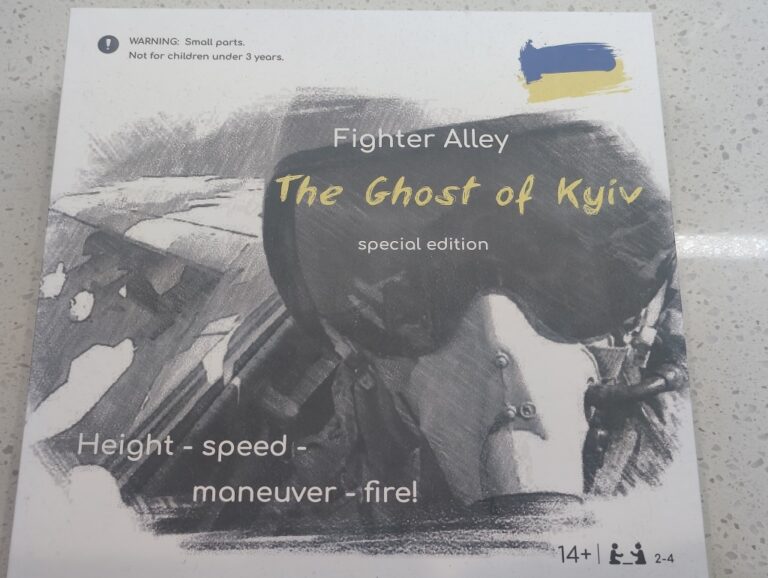
Fighter Alley: The Ghost of Kyiv is a tactical board game for two to four players, simulating the frantic nature of air-combat. Each player controls a jet fighter (or two) as they try to eliminate their opponents’ jet fighters, whilst protecting their own aircraft from attack.
Players also need to protect their bases, which can be attacked and destroyed. Although Fighter Alley can be only won through eliminating the opponents’ jet fighters, as each jet fighter has a limited supply of fuel and the bases are used for refuelling, they form an essential part of any strategy.
Fighter Alley is played over a board divided into hexagons. In each corner are the players’ bases, from which they start and refuel. Every turn uses fuel, and games will often involve needing to fly back to refuel. The board is just the right size. If it were too big it would slow the game, but if it were too small then it wouldn’t have the space for strategising.
The distance moved is randomly generated at the start of each player’s turn by rolling two six-sided dice (2D6). These air points are for advancing forward a hex whilst maintaining or lowering altitude (1 point), or advancing whilst gaining altitude (2 points for every level of altitude gained).
A successful attack can only be executed when attacking another jet fighter from a higher altitude. As such, maintaining a low altitude will allow the jet fighter to travel further, but gaining altitude can protect them from attack. It is interesting that attacks against jet fighters are automatically successful, rolling a six-sided dice (D6) for damage, with a second D6 if the first dice roll was a 6 – possibly eliminating the enemy jet fighter instantly if two 6s are rolled.
There is also a tableau-laying element to Fighter Alley, as the flight path of each jet fighter is determined by laying a series of aircards. These are randomised, with players taking them sequentially from the pile.
The core principles of Fighter Alley are solid. It is an elegantly simple but tactical game that requires players to balance attacking enemy fighters and bases, whilst protecting their own bases and not running out of fuel. It soon becomes a fun, fast and frantic experience, especially with four players.
The game is evenly balanced: everyone starts an equal distance apart and there are no unique upgrades offering unfair advantages. As such, success comes down to strategy and the random element of dice rolling.
Unfortunately, the current iteration of the English language section within the rulebook is not well written. It would have benefitted from an editorial review and a check of the clarity and comprehensiveness of the rules. For example, Fighter Alley is described as being for two to four players, but it is unclear how the game works with three players.
Likewise, it is unclear whether aircards are discarded after use. There is also the question of whether you could fly under enemy aircraft (or if this would enable them to attack the other player?) More than anything else, the rulebook would have benefited from a series of examples to demonstrate a typical turn within the game.
The fuel gauge of each jet fighter is tracked using a cardboard dial, but there is nothing to keep track of jet fighter hitpoints, other than pen and paper or using your own 12-sided dice (D12). Consolidating this information, along with the jet fighter’s altitude, onto a single dial feels like a missed opportunity.
Some have queried if making a board game with direct references to the current war in Ukraine is appropriate. The designers’ response is shown here.
If the issues surrounding the rule clarity are resolved and an improved method of tracking information is introduced, then Fighter Alley: The Ghost of Kyiv has the potential to be a great game that is rarely away from the gaming table.
Note: Fighter Alley: The Ghost of Kyiv is still in development and was played using a Q4 2023 version of the rules.
2023 has been an amazing year to be a geek. So much so, that it is almost impossible to identify the “best of the best”.
However, we at Geek Pride say nothing is impossible (amongst other things…) We have each endeavoured to highlight what we each considered to be particularly meritorious, in what has been a packed year of incredible science-fiction, fantasy and horror.
So, Matt Geary, Peter Ray Allison, Laura Benson, Mark Canty, Bevan Clatworthy and Jonjo Cosgrove compiled their favourites, whilst somehow managing to remain friends.
It’s a bit like the Oscars, but without the lovies…
Best film
Matt: John Wick 4 I love the John Wick series and John Wick 4 was as intense and actioned-filled as any of its predecessors. The fight choreography is superb (I love the stair scene), its humour never dampens the severity of the situation and the film didn’t suffer from plot-rot; the staleness you can find in a long-running film series. A suitable end to an amazing tetralogy.
Pete: Totally Killer A cross between Halloween and Back to the Future, Totally Killer was a surprisingly fun slasher-thriller with a time-travel twist. The script has a wry tone, that played with the horror tropes and highlights the cultural differences between 1987 and 2023.
Laura: Dungeons & Dragons This was a total surprise for me, as I don’t feel games transition well into film and D&D has so much lore that it could have become inaccessible. Yet, its blend of practical and digital effects, paired with a story about love more powerful than romance, and finished with a sense of humour made this a fantastic movie. I will riot if they don’t do a sequel.
Mark: The Marvels lman Veilani shines in this film, which also features a more sympathetic and emotional performance from Brie Larson and some enjoyable set pieces. Unfortunately, it suffers from franchise fatigue on the MCU, and some people not prepared for female leads.
Jonjo: Mission Impossible: Dead Reckoning – Part One The seventh entry in the series and possibly its best. Tom Cruise gets to bring Ethan Hunt out for possibly his greatest mission yet. A huge all-star cast and some of the best ever action sequences cement MI:7 as one of the greatest cinematic experiences in recent memory. Every shot is spectacular and the line between visual and practical effects has never been more indistinguishable.
Bevan: Elemental I went in with low expectations but loved the world building and the charming characters featured in Elemental. The story is little predictable (it’s by Disney, so it needs to have a happy ending), but I had a good time, and a little escapism can be good for the soul.
Best series
Matt: Loki season 2 There has been a lot of great television this year, but the new season of Loki, which I honestly didn’t have huge hopes for, was amazing. It has great writing, great acting and an incredible ending. I thought the Marvel boat had sailed, but this really impressed me.
Pete: Gen V Gen V especially impressed me because I was not expecting that much from it. It is an original story within the setting of The Boys, and all the better for it. Using the premise of superheroes as celebrities, Gen V explores contemporary themes with some fantastic writing and incredible acting.
Laura: Foundation Foundation’s real strength lies with its actors. Every single one gives an engaging performance with special mention to Lee Pace – he is so charismatic that it’s hard to hate his character, despite proving time and time again to be irredeemable.
Mark: Picard I have too many choices here; Season 4 of For All Mankind is simply fabulous, Ahsoka had a few issues with pacing but some wonderful performances, not least the late Ray Stevenson, and season 2 of Loki had interesting storytelling. I couldn’t not pick Series 3 of Picard, which gave us the finale for the Next Generation we didn’t get with Nemesis, and some wonderful performances by old and new cast.
Jonjo: The Power Based on the book by Naomi Alderman, the series follows various women who develop electric powers. Dealing with worldwide implications and personal stories, the show feels like it has come out at just the right time. We get a show that brings out fear, wonder and suspense with its superstar acting.
Bevan: Gen V As a fan of The Boys, this step back into the ‘origin stories’ formula was refreshing. With some great acting, an intriguing story line and some gruesome action, this was a winner for me. If anything happens to Lil’ Cricket, it’s time to riot.
Best game
Matt: Legions Imperialis 2023 has been a busy year for games, but for me has been literally Epic! Epic Space Marine was the first boxed game I ever owned and holds a special place in my heart; I have fond memories of setting up huge battles on my parents’ dining table. Opening the new box set for the first time, seeing all the mini tanks and the titans just made my inner child smile. It’s a literal dream come true.
Pete: Cyberpunk 2077: Phantom Liberty This is a bit of a cheat, as Phantom Liberty is DLC for Cyberpunk 2077, which was released three years ago, but the expansion transforms it into a whole new game. Despite a rough launch, Cyberpunk 2077 has become one of the best video games of this generation and is the perfect combination of writing, immersion, gameplay and atmosphere.
Laura: Baldur’s Gate 3 Baldur’s Gate 3 is my pick for a variety of reasons; the stunning designs, the humour and the sheer volume of content involved. Plus, the cast is an utter delight.
Mark: Cyberpunk 2077 A controversial choice, but with the V2 updates, Cyberpunk 2077 is the game we were all promised when it was first released. Dirty, grimy, violent, loud and fun. Recommended, even if you were bitten the first time around.
Jonjo: Dead Space A remake of the 2008 horror classic, Dead Space made its return earlier this year. For fans old and new, this game is a huge treat. Heading to spaceship the USG Ishimura, Isaac Clarke and his crew are tasked with finding out why it has suddenly gone silent. The game benefits from refined controls, a more balanced story and a not-so-silent protagonist.
Bevan: The Legend of Zelda: Tears of the Kingdom At 227 hours and counting, the mix of new traversal mechanics, the ability to build practically any vehicle you can think of and the vast environment chocked full of things to do, Tears of the Kingdom is an amazing addition to the franchise.
Best book
Matt: Lightbringer by Pierce Brown There have been a few good books released this year, but for me it has to be book 7 of the Red Rising series. The series starts as a sort of Hunger Games, but evolves into a galactic-spanning civil war, with some of the most amazing battle scenes you’ll ever read.
Pete: Quantum of Nightmares by Charles Stross This offshoot from the Laundry Files series is best described as Mary Poppins meets the horrors of corporate efficiency. Although there were no references to the KLF this time, it was is an utterly gripping read.
Laura: Brandon Sanderson I refuse to do one book, but everything Brandon Sanderson has done this year. Sanderson brought out four books and finished a series in one year. He is not only sickeningly prolific, but able to maintain that fantastic quality in his writing.
Mark: Making it So by Patrick Stewart A wonderful book, at times touching, funny, sad and, overall, a really enjoyable insight into someone who has become a pop culture icon.
Jonjo: Making it So by Patrick Stewart It’s amazing that it took Sir Patrick until his early 80s to release his memoirs. But, a gripping read throughout. Any fan of Star Trek or Shakespeare will love this. From a baby born during the war, his journey is almost unlike any other actor. If you can, experience this as read by the man himself in audiobook form. There is something about Patrick Stewart reading his life out that just holds you.
Bevan: Star Wars: From a certain Point of View My favourite book this year actually came out in 2017, as it just happened to be in a holiday home we were staying in over the summer. From a certain Point of View contains a fantastic set of short stories, all from the perspectives of characters around the central plot of Star Wars. Personal highlights were the Jawas that dreamed of going to the stars before her family is slaughtered by the Empire, or the origin story of the eye-stalk monster the heroes encounter in the trash compactor.
Best event
Matt: UK Games Expo There is only one event that does anything for me, and that’s the UKGE; a tabletop gaming convention that never gets boring. I find all other conventions have the same feel, but not so UKGE. Every year there is something new and I have to stop myself buying everything in sight!
Pete: The Forge The Forge was a wonderfully immersive exhibition recreating a Star Wars cantina bar to promote the new season of The Mandalorian. The event was filled with displays and props from the show, with music provided by the fantastic sci-fi band Blues Harvest. Needless to say, I was in my element.
Laura: Thought Bubble Thought Bubble was the busiest I’ve seen it since it moved to Harrogate and is clearly ready for another venue change. The quality of the artwork and volume of artists made it an expensive, but rewarding experience. If you love Artist Alley at conventions, this is the place for you.
Mark: Doctor Who’s 60th Anniversary I know it’s not over yet, but RTD has brought back so much joy and ebullience (not to mention David Tennant and Catherine Tate, and a tear-jerking final appearance for Bernard Cribbins). I’m not ashamed to admit I’ve laughed and cried, and Neil Patrick Harris was fantastic as the Celestial Toymaker. The return of Mel was fabulous and I’m looking forward to Ncuti Gatwa at Christmas.
Jonjo: Barbenheimer Possibly the biggest cinematic event of 2023, Oppenheimer and Barbie helped propel the worldwide box office. Originally seen as an unfortunate clash, the internet actually was used for good to promote both releases. Whereas Margot Robbie led Barbie to the family audience, Cillian Murphy shined as the famed scientist in an Oscar-worthy performance. Will we ever see a more perfectly imperfect pairing? Maybe not, but you cannot deny that this helped cinema a lot more than even the kindest critics could have predicted.
Bevan: UK Games Expo I only attended one event this year, but the UK Games Expo had to be the biggest and best one yet. 2023 saw me and my board game company at our biggest stall yet, plus the spectacle of seeing a massive Space Marine Terminator. It’s also wonderful to see so many indie publishers in one space, all that innovation, enthusiasm and cardboard was heaven.
The halls of NEC Birmingham came alive from 1st to 3rd December as MCM Comic Con returned for an electrifying celebration of pop culture. This year’s event witnessed a record turnout, with fans flocking to experience the magic of their favourite franchises and immerse themselves in the vibrant atmosphere that MCM is renowned for.
One notable highlight was MCM’s nreturn to Halls 3 & 4, reminiscent of the convention’s earlier years when these halls were bustling hubs of activity. The nostalgia was palpable, as attendees rediscovered the charm that had made these halls so popular in the past.
This year marked a different approach, as MCM Birmingham was held later in the year, giving the convention a festive touch. The organisers infused some of the Christmas spirit into the event and the festive vibes were unmistakable.
The inclusion of retro gaming at the heart of the convention hall added a delightful touch. Nostalgic gamers revelled in the classics, creating a lively and enjoyable atmosphere. The overall feeling was one of cheerfulness and camaraderie, a testament to the diverse and welcoming community that MCM Comic Con fosters.
The selection of vendors added to the allure of the event, offering a vast array of pop-culture merchandise. There was everything from unique artwork to comics and prints, giving attendees the opportunity to discover unique Christmas gifts.
Cosplay enthusiasts were out in full force, contributing to the vibrant atmosphere with their meticulously crafted costumes. The strong cosplay presence added an extra layer of excitement to the event, showcasing the dedication and talent of the community.
However, as we reflect on this year’s MCM Comic Con, one suggestion for future events emerges; a desire for curated photo areas. While the convention provided ample opportunities for impromptu snapshots, having a dedicated space with themed backdrops would enhance the overall experience.
Also, considering the time of year, collaborating with prop builders to create geeky, festive sets could be a fun addition, as well as changing annually to keep things fresh.
In conclusion…
MCM Comic Con Birmingham 2023 was a resounding success, capturing the essence of geek culture and providing an unforgettable experience for attendees. As the convention continues to evolve, we are excited of what that future editions of the event will be. Until then, the memories of this year’s festivities will linger, a testament to the enduring magic of MCM Comic Con.
Cosplay spotlight
With so many incredible cosplayers on show, its so difficult to highlight just one person, but this year @nonamecosplayuk left a trail of amazed and delighted fans with her take on the much beloved “Queenie” from the 1986 Blackadder II, played by the incredible Miranda Richardson.
We thoroughly recommend you head over to Instagram and look at the progress and detailed photos of this stunning costume.
Vendor Spotlight
We love to support small businesses at GeekPride, and shopping at conventions is our guilty pleasure! This year we were incredibly impressed by the creations of The Jewellery Patisserie.
Their geeky-themed jewellery are handmade using quality materials but at affordable pricing, and they have something for all fandoms! The designs are forever changing, and once they are gone, they may not get another chance! So make sure to check out their trading dates on the website and head over to her stand to see what nerdy treasure you can find.
For as long as I can remember, the Napoleonic era has been my bag. Growing up reading and watching Sharpe, painting 15mm Napoleonics, watching endless documentaries, reading books on the era and even doing my dissertation on Napoleon for Uni (albeit not the best dissertation in the world); I couldn’t get enough of it. It just captivated me, the pomp, the formations, the tactics the battles, it had everything.
So when I heard that Ridley Scott was making a film about Napoleon I couldn’t help but get my hopes up. How would they do it I wondered to myself, a long film maybe? His rise to power? His last days?
The whole thing, his entire career, wow, ok so I guess it’s going to be a long film then… 2.5 hours… Ah, this could be a problem.
Now Ridley Scott states there is a 3.5 hour Director cut but even at that you are really going to struggle, bearing in mind all the main occurrences, victories and defeats during the period… But I will go into that later.
First the good
I enjoyed how Joaquin phoenix portrayed Napoleon. It was reserved, insecure emotional and gave a more realistic and even flawed look at the man, which I felt, based on what I’ve read/studied at least, was quite close to what he was like. On top of this his obsession with Josephine was well documented and the film showed this really well. Indeed, their pretty emotional and somewhat toxic relationship was one of the triumphs of the film and honestly, it should have been called Napoleon and Josephine.
His letters to her, and her letters to him work well and I found that as much as I wanted certain historical milestones to be hit within the film, having the narration of these letters made me not mind as much and cemented that it was more a film about their relationship than his career.
The hint of humour, which I know people disliked, I quite enjoyed. Again it added to the reality of it all. So much of the time in film we have implacable characters and heroes, seldom showing weakness and so we are used to, especially in war films, them being avatars of the stoic, brooding genius. We didn’t get that with Napoleon, which I think has caused issues for a lot of people because their image of who they think Napoleon was / acted differs greatly from how he was portrayed, which I feel was probably more real.
The Battles (which are also included in the bad) were visceral, bloody and despite the history nerd in me getting wound up by certain things were visually stimulating and somewhat graphic at times. If you’re not a history geek, you’ll love them for the short periods they are on the screen.
The Bad
It kinda felt like a TV film, or a higher-budget episode of Sharpe / one of those historical dramas that the BBC or ITV would do. Which I love, but where I can accept the limitations of a TV film and the abstractions that come with limited budget and manpower. I feel that a 150m dollar film should really be giving me the epic feel, which I’m not sure we got, especially in the battles which seem very limited in size and scope bearing in mind said budget and the battles portrayed.
The battles were historically woeful and needlessly so in my opinion. As much as I’m happy to accept some Hollywood licence when it comes to set pieces. I found myself feeling slightly annoyed in each of the main battles.
Austerlitz was one of Napoleon’s finest moments, louring the enemy onto the pratzen heights and counter-attacking but in the film the only “heights” are where the French guns were and it seemed to be more about the whole, I’m going to shoot cannons at that ice, which wasn’t an overly major part of the battle rather than, showing Napoleon’s tactical ability by outsmarting a combine Russo-Austrian army that outnumbered him.
The Battle of Borodino and the subsequent retreat from Moscow just had no real sense of the scale or cost. 600k + men fought in Russia for la Grande Armee and only 8% returned.
The Battle of Waterloo, the largest set piece in the film just made me kinda angry.
A Rifleman with a scope… The British sitting in field entrenchments then being ordered forward to receive the cavalry charge, why?! One there weren’t entrenched lines like that, the hill itself was used as cover and even they were in existence why would you move out of them and then form a defensive square against a cavalry attack? It makes zero sense. Unless you want to have a great shot of cuirassiers charging round them. Well why not have it as it was, Ney thought the British were retreating, sent the heavy cavalry forward and as they crest the hill the British were in square. The entrenchments weren’t needed and I suspect, were a way to mask numbers so Scott could make the battle look bigger and fill more space.
Finally, the Prussians came in on the wrong flank, It rained the night before not on the day and the advance of the guard to break Wellington’s centre was in line. The attack made by the middle guard were in attack columns, or technically squares, with one being in a mixed formation of a column on both sides and a line in the middle.
Bearing in mind this was an era of massed attack columns and formation fighting, bar the squares at the end of Waterloo little effort was made to reference it in any of the battles and there could have easily been a bit more care made towards how battles were fought at the time.
On top of this, there seemed to be this obsession with the fact Napoleon was an artillery officer and every chance was made to reference it, with each battle having him just waving his hand to fire cannons and that was about it. No other glimpse into his mind or thought process or tactical abilities. His thing was Artillery and that was about it. Which kinda takes away from what I thought the film was getting at, was he a genius or was he a tyrant and you don’t really get a balanced view on either.
The Verdict.
I’d be lying to say I hated it, despite the historic niggles, because I didn’t, it was enjoyable and if you came to watch it with no historical nerd baggage you’d enjoy it as well I think. It’s well shot, as expected, the dynamic between Napoleon and Josephine is great and if you take away the historical inaccuracies the battles look cool.
Sadly, I am a history nerd and as much as it helped with the huge time jumps, as I could fill in the blanks with my own knowledge, I just felt like it didn’t feel like an epic film, it felt rushed in part because it was trying to cram so much into a short period, some of the missed parts I think were vital in depiciting who Napoleon was and the Battles, as much as they were visually nice, were historically lazy.
Honestly, had Apple funded it as a higher-budget series, with more time given to more key periods in his life and his relationship with Josephine I think you would have had a winner. But what we have been given is a somewhat rushed and okish film. Not bad, but not great either. Not a film i’m clambering to go and watch again; which is painful because I love the Napoleonic era.
We use cookies on our website to give you the most relevant experience by remembering your preferences and repeat visits. By clicking “Accept All”, you consent to the use of ALL the cookies. However, you may visit "Cookie Settings" to provide a controlled consent.
This website uses cookies to improve your experience while you navigate through the website. Out of these, the cookies that are categorized as necessary are stored on your browser as they are essential for the working of basic functionalities of the website. We also use third-party cookies that help us analyze and understand how you use this website. These cookies will be stored in your browser only with your consent. You also have the option to opt-out of these cookies. But opting out of some of these cookies may affect your browsing experience.
Necessary cookies are absolutely essential for the website to function properly. These cookies ensure basic functionalities and security features of the website, anonymously.
Cookie
Duration
Description
cookielawinfo-checkbox-analytics
11 months
This cookie is set by GDPR Cookie Consent plugin. The cookie is used to store the user consent for the cookies in the category "Analytics".
cookielawinfo-checkbox-functional
11 months
The cookie is set by GDPR cookie consent to record the user consent for the cookies in the category "Functional".
cookielawinfo-checkbox-necessary
11 months
This cookie is set by GDPR Cookie Consent plugin. The cookies is used to store the user consent for the cookies in the category "Necessary".
cookielawinfo-checkbox-others
11 months
This cookie is set by GDPR Cookie Consent plugin. The cookie is used to store the user consent for the cookies in the category "Other.
cookielawinfo-checkbox-performance
11 months
This cookie is set by GDPR Cookie Consent plugin. The cookie is used to store the user consent for the cookies in the category "Performance".
viewed_cookie_policy
11 months
The cookie is set by the GDPR Cookie Consent plugin and is used to store whether or not user has consented to the use of cookies. It does not store any personal data.
Functional cookies help to perform certain functionalities like sharing the content of the website on social media platforms, collect feedbacks, and other third-party features.
Performance cookies are used to understand and analyze the key performance indexes of the website which helps in delivering a better user experience for the visitors.
Analytical cookies are used to understand how visitors interact with the website. These cookies help provide information on metrics the number of visitors, bounce rate, traffic source, etc.
Advertisement cookies are used to provide visitors with relevant ads and marketing campaigns. These cookies track visitors across websites and collect information to provide customized ads.