The next All-New Marvel NOW! push belongs to a character who Marvel Comics has been trying for the better part of the last decade to find a way to make a star: Moon Knight. With Moon Knight #1 in March 2014, the team of Warren Ellis, Declan Shalvey and Jordie Bellaire will try to bring the character into the spotlight,
“His cape is actually a crescent moon and he goes out only at night and dresses in reflective white so you can see him coming. Now that’s nuts…. I like that,” Ellis told HeroComplexin the announcement interview.
The writer promises that everything that has come before for Moon Knight, and that means several disparate looks at the character, will inform his run on the series. That means there will be story elements dealing with both Marc Spector’s dissociative identity disorder and his association with Khonshu, the Egyptian moon god. But the real focus will be on making this a crime novel in the Marvel Universe.
“The best Moon Knight stories for me were always ground-level but weird crime,” he said. “‘Weird crime’ has kind of been the touchstone for me for this revival.”
The most recent use of Moon Knight was in Secret Avengers – under Ellis himself, and a year-long series by Brian
Michael Bendis and Alex Maleev that saw the character relocate to the West Coast. He’ll be back in New York for this relaunch, something that Ellis says helps Moon Knight stick out more.
The writer also praised the work of the art time, saying there’s a “palpable atmosphere” to the work, and promising “page-wide panels” that provide a cinematic feel.
Moon Knight #1, part of the All-New Marvel NOW! spotlight and relaunch program from Marvel Comics, will debut in March 2014.
Adapting classic critically acclaimed comics for the screen is the in thing apparently as Badassdigest has announced that David Goyer has been in talks with Warner Bros about another long mooted adaptation, Neil Gaiman’s The Sandman.
They also imply Joseph Gordon-Levitt is involved.
MTV reports that Gaiman seems positive about the rumours and is quoted as saying
“What tended to happen a lot in the ’90s was the point where Warner [Bros.] would get relatively close to making a ‘Sandman’ movie, and then somebody would get realistic about the fact that the film would not be PG-13, and that it would be incredibly big and expensive, and it would never really be made or the sequence of films that you would need to make ‘Sandman’ would never get made. I think things like the ‘Dark Knight’ films kind of changed that, just how big and dark you could get.”
“When I used to go for meetings at Warner Bros., the top execs there didn’t know who or what ‘Sandman’ was, and they weren’t really interested, but the nervous juniors who would bring me the bottles of water when I arrived, and would get me to sign their comics on the way out — they knew. They are now running the studios.”
Neil Gaiman’s Sandman has long been held as one of the best examples of what can be achieved in sequential art and artist Dave McKean having previously illustrated Arkham Asylum became synonymous with Sandman after his memorable covers for the series and its collected editions and various spin offs.
With Alan Moore’s ‘unfilmable’ Watchmen now in the rear view mirror and the recently announced Preacher series coming from AMC it begs the question which classic comic property is going to be adapted next?
If you drew a Venn diagram with one circle representing comic book fans, and the other showing infographic lovers, a fair proportion of readers would probably find themselves in the overlap. And for those of you who do find themselves in the middle, here’s a real treat – an infographic guide to comic books, written by Wired digital design director Tim Leong.
The book uses a series of infographic tropes to explore and explain the world of comic book superheroes.
So there’s a political compass showing the ideological positions of comic book characters (the Joker is Liberal Libertarian while Batman is a Conservative Authoritarian), a Walking Dead kill counter and an exploration of Manga murder.
And Leong deals with a broad church of comic books, so beyond the DC/Marvel axis there’s a Scrooge McDuck family tree and (a personal favourite) the Chris Ware sadness chart.
As the book blurb notes, ‘It’s part beautiful, part fascinating, occasionally challenging and sometimes completely useless. In other words, a work of art.’
Super Graphic: a Visual Guide to the Comic Book Universe, by Tim Leong, is published by Abrams and Chronicle priced at £11.99.
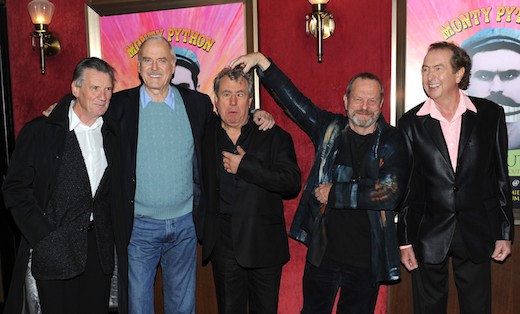
Today in London the five surviving members of Monty Python gave the world all the details on their reunion plans.
The biggest news is that rather than a tour the reunion will consist of a one-off show at the O2 Arena in London on July 1st, though the group has refused to rule out the possibility of further shows later. A press release ahead of the conference promised that the audience of this exclusive show would see “some of Monty Python’s greatest hits, with modern, topical Pythonesque twists”.
John Cleese, though, made sure to point out that there would also be “some new material”.
Other noteworthy revelations about the show were that former Strictly Come Dancing judge Arlene Phillips would be assisting with the choreography of what Eric Idle promised to be a “big show” like a “huge musical”. It was also revealed that the show would be recorded for a future DVD release. Idle also added that the late Graham Chapman, the sixth member of the influential comedy troupe who died in 1989, “won’t be absent” from the show.
The last time Monty Python performed a stage show was at the Hollywood Bowl in 1980.
I’m a man of a few talents that I’ve picked up over the years; I’m a competent drummer, a fairly good writer, a damn fine salesman, and if past dalliances are anything to go by, a dab hand at Cunnilingus.
But the simple fact is this: I can’t draw.I wish I could, but I can’t.
Now here’s the problem. Our glorious leader has far too much on his plate to be dealing with every intricate facet of the Geek Pride machine, so he delegates. I , among many things, have been tasked with the production of a weekly Webcomic starring our wonderful mascot Ralph. Now I can write a webcomic like you read about, drawing however, I suck at. HARD. And not in the good way.
So I have a choice; I either draw them on MSPaint, as I have been doing and call the comic Ralph’s Badly Drawn Paint Adventures. OR (Preferably) One of you guys steps up to the plate, and helps me out. You would join the Geek Pride crew and maybe even get to meet Matt in person!
YOUR TASK:
There are three examples of my terrible work below, pick one of them, and re-draw it for me By DEC 20th. One month to wow me. I will then personally pick one or two of y’all to be a weekly artist, so commitment to the project is a MUST.
In a time when beta testing seems like a thing of the past as a career, EA games has actually come through on a promise to its fans.
We all remember when we dreamed of testing games when we got older, but when it finally came time to start our careers video game companies were no longer hiring from the outside or paying for testers. Did anyone else play the Halo beta? What a great way to get gamers to do a job for you without paying them. It was fun and Bungie actually took our feedback seriously, but we didn’t get paid. A friend and I spent hours playing that thing, and still bought the game when it came out.
While having a conversation that was totally unrelated the other day, this friend of mine was visibly excite to tell me something. He was just waiting for an opening to come out with it. After an even more long winded explanation than I could muster, he shows me a check from Electronic Arts. Apparently they had put a call out asking for testers for the Battlefield 4 game.
Being a pretty determined gamer, this guy went on the website and signed up for the gig. Not expecting anything to ever come of it, he was pleasantly surprised to receive and email from EA with a code to download the 24 hour test version of the game. After playing through as far as he could in 24 hours, he was asked to answer 10 questions regarding the gameplay, graphics and overall experience. Of he did it and then thought nothing else of it. He was satisfied with having been able to play the early release of a new installment in a favorite game series.
Well last week a check showed up in the mail. It wasn’t much but it was something. 24 U.S. Dollars is not even enough to pay for half a game, but it marked an awesome moment in gaming history. Through several conversations with other people who work in the industry, it is very obvious that the companies still beta test but in ways that we didn’t really expect. If you aren’t already involved, chances are you wont be. I have to give Electronic Arts a big high five for following through on something like this. It’s not everyday you see proof that someone in the general public was paid by creators for testing a game. Good guy EA.
“Change my dear. And it seems not a moment too soon.”
The year is 1984. Orwell’s vision is a tiny bit more accurate than Spectrum game designers would admit, Van Halen recorded the best album with a smoking baby on it ever, and humble heart throb Peter Davidson had finally revealed the meaning behind that weird piece of celery on his lapel. The consequences, of course, were fatal and so after one of the most shameless death scenes in the series, Doctor number five became the blond afroed snarky sixth doctor in Nicola Bryant’s arms.
Little did we know how almost fatal that was too.
The Sixth Doctor, thanks to the oddities of the John Nathan Turner regime of the show, budget cuts, policy and management changes at the BBC as well as some other changes led to the Sixth Doctor becoming an immensely controversial and polarising doctor. A lot of people dismiss him immediately, mostly for this.
Our hero, ladies and gentlemen!
However, despite this, or perhaps because of the interestingly tumultuous facets of his time in the TARDIS, Colin Baker and the Sixth Doctor does have a charm past the violence, the dodgy patriarchal morals and some absolutely rubbish serials.
And you of course are coming along for the journey through space and time as well!
By 1984, the John Nathan Turner era had been in full swing, with an emphasis on more science based plots, complex timelines, more question marks than the Riddler and casting people from the TV-AM sofa and to appeal to foreign markets. Like it or not, this was his way. Peter Davidson indeed didn’t like it and so left the series. JNT, in his usual trend of casting a complete opposite doctor from the last, cast Colin Baker, an older actor who had worked on both Doctor Who and Blake’s 7 before. Gone were the cricket jumpers and dapper jackets, and in comes a full on patchwork and rainbow motif. People didn’t like that. Also gone was the Doctor’s very soft heart and sentimental streak, replaced by a doctor that was belligerent at best and outright psychotic at worst. People didn’t like that either.
Part of the problem of course was his debut, the last serial of 1984, The Twin Dilemma, which was far and away the worst Doctor Who serial made in the original run (So other contenders like Dimensions in Time and The Movie don’t count). The plot was sluggish and went nowhere, it looked absolutely cheap even for Doctor Who, took place in about four rooms total and the acting across the board was pretty atrocious. All of these are bad, but what was worse was the Doctor himself, who became psychopathic after the regeneration, and attacked companion Peri Brown in the absolute nadir of the original series. It naturally got complaints and people tuned out in droves, the Doctor being a lead weighted off-taste joke wrapped in kitsch.
The sad thing is this all kind of got worse with the next series in early 1985. The show was rescheduled for about the fourth time in as many years, back to the traditional teatime Saturday slot. The problem was the format had abruptly changed, making the show 45 minutes long. This, like bringing in Nicola Bryant and having her play a scantily clad American tourist was another JNT attempt to get in on the American market. Peri was not popular with the fans, and the fact that a good seven-eighths of the series were devoted to Peri and the Sixth Doctor bickering like an old married couple likely didn’t help matters. This was meant to be funny, but instead came off as either outright insufferable or a little bit patriarchal. (Incidentally, Colin Baker and Nicola Bryant went on to star in a bunch of really cheap BBV straight to video films, including one that gave the pair the dubious honour of being the first Doctor/Companion partnership to star in a love scene together.)
Besides the inordinate time devoted to the Doctor’s mental state and Peri whining about pretty much everything there were the serials themselves, and my word does the classic format not work in 45 minutes. Unlike the modern series, which figured out that the only way to do the American format is to script the show in the same three-act structure that they use, this series films a standard four parter and clumsily edits it to try and create some form of cliff hanger between parts one and two. The result is an absolute pacing nightmare, sagging painfully around the middle more than Baker himself. Attack of the Cybermen, the first serial of the series is hit by this the absolute worst, spoiling what would have ordinarily been a rather good story with pointless meandering and subplots that take too long to get going and don’t have long enough to conclude.
Pretty much every serial had something that managed to get up the nose of fans, staff or people on points of view alike. Vengeance on Varos, probably the strongest serial of the series was absolutely inundated with this, precisely for the same reasons it was good. It was a dark, Orwellian tale of a dystopian totalitaria where torture is entertainment and the viewers get to choose who lives and who dies. Much like I’m a Celebrity then, except it’s not as painful on the viewer. All while this is happening, a disgusting snail-like swindler by the name of Sil is negotiating ore prices while the planet suffers. The result of which is subversive, unnerving, claustrophobic and actually very compelling TV. By the law of Doctor Who of course, this means that it got absolutely lambasted in the popular press for being a tawdry violent spectacle, something it was too clever and too politically minded to be. It reflected a culture where private interests led to the most despicable acts being performed in the name of the people, a people placated by the sight of torture and brutality and numb to the idea of revolution. This would work better if the supposed moral centre of the tale wasn’t killing people with one liners even James Bond would think better of.
That said, in terms of ham fisted as that was, it had nothing on The Two Doctors, a vegetarian screed that ironically enough was so ham-fistedly unsubtle as to be laughable. In this, Patrick Troughton’s Second Doctor is kidnapped and it is up to Peri, Jamie and the Sixth Doctor to go to a Spanish villa (for some reason) and rescue him from the overly-ambitious Dastari, and his Androgum creation Chessene, who seeks to steal the ability to time travel. Flanking them as well are Shockeye, the androgum cook (geddit? It’s an anagram for “gourmand”!) and a strike force of Sontarans who suffer from the worst facial movements since the Junior Christian Science Bible Hour.
Possibly the most action-packed moment of the Two Doctors, as Chessene (Centre) betrays Shockeye (Left) and Dastari (Right)
The simple problem with it was that it was three episodes long, and two of the episodes basically ended up being repeats of each other, with Peri and the Second Doctor getting kidnapped at a rate Princess Peach could only dream of. It wasn’t terrible, but just as you started to enjoy its silliness it whacks you in the face with a spinning leek of lectures.
Still, being interestingly bad was much better than being The Mark of the Rani, which was pretty much entirely composed of bickering and nothing else. If it wasn’t the Doctor and Peri arguing, then it was the Master and new time lady character the Rani bickering about whether her plan is too mundane or not. All this is draped around George Stevenson and the Luddites revolt in a way that looks less like a hearkening back to more historical episodes and more an excuse to use more quarries.
In the middle of this series, we would be remiss not to talk about A Fix with Sontarans, when the Doctor takes on a great nemesis of modern times – Jimmy Saville. Yewtree aside, this was a short little serial at some random unspecified Peri-less point, where the Doctor accidentally enlists the help of both former companion Tegan and future head of Save the Children Gareth Jenkins aged 8 to take on a couple of wily Sontarans. It’s clearly not canon, but it shows the better side of this incarnation, his sly wit mixed with a genuine care and compassion.
All in all the series wasn’t completely without merit, with some great serials here and there, and the ratings, contrary to popular belief, were not actually that terrible. The problem was that the louder parts of the audience, the popular press and the new management at the BBC didn’t quite see it that way. Around the time the series aired a new Director General took office, Michael Grade. Grade is a very controversial figure, not just among Doctor Who fans, but suffice to say he did not like the series, the way it worked, the budget it had and by some accounts Colin Baker himself and so put the show on an 18 month hiatus, all but cancelling it.
And then… this happened…
One Crisis at a Time, Please…
More on that in another article. Apparently daring not to risk a sequel to Doctor in Distress, Grade relented and gave the series 14 more episodes to prove its worth, which led to a series-long epic serial known as The Trial of a Time Lord. It is the longest single serial in the history of the series and is quite possibly one of the best of the original series, right up there with The Deadly Assassin and the Caves of Androzani. It kind of cheats on both counts though, being a frame narrative with four shorter stories within it (titled by fans as “The Mysterious Planet”, “Mindwarp”, “Terror of the Vervoids” and “The Ultimate Foe”) and so manages to create three great standalone serials and a frame narrative that links them all together rather well.
Whoenix Wright: Duel Destinies of the Doctor
The Trial itself is of course echoing the criticisms and sentiments of the series itself, in ways that are probably closer than even the script writers intended, with the primary facets of the Sixth Doctor’s persona that people hated being used as a way to condemn him to death, the violence and callousness getting him indicted for murder and later genocide. To facilitate this, the Doctor himself is also somewhat changed and appears out of the Tardis at the start of the first story as a reformed, more caring and more heroic figure that bantered playfully with Peri rather than abrasively. The initial plan for the Doctor was that since Colin Baker wanted to do it for as long as they wanted him they could have the character be traumatised and psychologically damaged and then slowly build him on the path to becoming a hero but with the series on such thin ice they hadn’t the time for such slow-burning character development. This was likely for the better in any case, and fit the frame narrative’s tale of intrigue and tampered evidence down to a T. Baker’s acting is also superb, the courtroom drama allowing him to ham it up and chew scenery to a level that Phoenix Wright may never reach. It says something about his acting technique that during Mindwarp he almost made Brian Blessed sound subtle, and all tapers to a thrilling, epic conclusion that despite the absolutely chaos behind the scenes still provides a satisfactory conclusion and the potential for future stories.
Of course we would never see those stories. Doctor Who was saved by the skin of its teeth, getting another three years but on the condition that Colin Baker be fired. Given his frosty reception and the ways in which script editor and former right hand man of JNT Eric Saward among others talked about him it wasn’t exactly a surprise he got the axe, but the way in which it fell still seemed to be a bit in bad taste, given how Baker had done his best in the worst of situations and with the worst of creative choices. It looked after the final episode of series 23 that the Sixth Doctor had found his feet and had some potentially interesting adventures ahead, including the loose ends such as the origins of new companion Mel (played as controversially as everything else by Bonnie Langford).
The real Ultimate Foe to Doctor Who
Sadly, it was not to be.
The Sixth Doctor himself is love it or hate it, and for very good reasons. He was John Nathan Turner’s pick to be the Doctor and as such came with a lot of very JNTian quirks, which likely turned off as many people as it appealed to. It also didn’t help that the Sixth was saddled with some of the absolute worst scripts in science fiction, hampered by a very low budget and a Director General with absolute contempt for it. It is an interesting look at just how low a long running institution can go despite the best of intentions. That said, for the uninitiated The Trial of a Time Lord box set is a must have for Doctor Who fans, containing one of the best stories of that era along with a surprisingly candid hour long documentary on exactly what went wrong with Baker’s all too brief tenure. The Twin Dilemma is probably worth it too if you are a masochist, and while I have not heard any of them, the radio dramas Colin Baker did as the Sixth Doctor are apparently brilliant and in that format Baker is apparently at his best.
Colin Baker, after his rather abrupt and cruel sacking was asked to do the regeneration into the next Doctor. Baker refused, given that it made him unemployable for months, unless he could get the entire next series and regenerate at the end. That clearly would never happen, so the last we see of him is portrayed by Sylvester McCoy in a blond wig.
Gordon Robertson had Bowel Cancer, thankfully he doesn’t have it anymore.
The experience inspired him though, he co-created the critically acclaimed webcomic ‘Arsecancer’ along with artist Cuttlefish also the pair came up with Comics Versus Cancer.
The idea was simple; raise money for bowel and breast cancer charities and hold a raffle for awesome prizes. These prizes would be donated by numerous folks from the world of comics using a donations from,
Kate Brown, Laurence Campbell, Stephen Collins, Robert Davis, Rufus Dayglo, Robert Deas,Andy Diggle, Glyn Dillon, Kelly Sue Du Connick, Duncan Fegrado, Neil Gaiman, Tom Gauld, Gary Kelly, Jamie McKelvie, Leah Moore, Olly Moss, Ramon K Perez, John Reppion, Stephen Sutherland, Maris Wicks, Andrew Wildman, Rob Williams and Ben Willsher.
The prizes are still coming in too.
To be in with a chance of winning something all you have to do is buy a ticket or tickets from them either at Thought Bubble Comic Con 23-24 November, where the pair will be at Table 4 in the Royal Armouries Hall or you can buy them via Paypal sending money to [email protected].
For more details visit the Comicsversuscancer site here CLICK ME
The brain child of science fiction writer Terry Nation (Survivor, Blake’s 7) and designed by Raymond Cusick (BBC Staff Designer) the Daleks are the most iconic of the Doctors enemies.
Davros: Creator of the Daleks
Created by Davros during the final years of a thousand-year long war Davros genetically modified the inhabitants of Skaro , known then as Kaleds. He integrated them within a robotic, mechanical shell. To complete the modification Davros finally removed their ability to feel pity, compassion or remorse. Famously known for their catchphrase ‘Exterminate!‘ they are well-recognized in British popular culture. In July 2013, the BBC announced that the Daleks will return in the 50th anniversary special later this year.
William Hartnell and the Daleks
They burst onto the television screen back in 1963 in the second series of the show, coming up against Doctor of the time William Hartnell, his grand-daughter Susan (Carole Ann Ford), and her teachers Ian Chesterton (William Russell) and Barbara Wright (Jacqueline Hill). In the serial the party land in an alien jungle and are captured by the Daleks, mutated creatures, surviving off the radiation that remains in the atmosphere after a nuclear war they waged with their enemies.
Unwanted Teletubby Dalek
Daleks were in danger of becoming too kid friendly when they were re-modeled during the episode ‘Victory of the Daleks’. In this episode five all-new ‘true’ Daleks were created, all coming out in bright Crayola colours leading to the British press to label them ‘Teletubby’ Daleks. Children loved them instead of feared them, wanting to collect the whole set instead of hiding behind the couch. The backlash from Doctor Who fans quickly destroyed any chance of the ‘Teletubbies’ coming back.
As it stands the Daleks are definitely coming back in the 50th Anniversary and hopefully many more times after that.
After last week’s rather tedious episode, I ended my write-up with the hopeful note that the return of The Governor would liven the show up a bit (Get it? Liven? Zombies?). Being the first legitimate human antagonist to the group, and a somewhat iconic character of the Comic books, I hoped that his inclusion would remove some of the navel-gazing that the show likes to indulge in, and get the story moving forward.
And I was wrong: the show’s writers just used this as an opportunity to continue to stare deep into their belly-buttons, hoping to find something of interest. However, this week, they managed to pull a very good episode with some back story.
The episode starts where we last so The Governator, at the scene of his murder spree following the failure of his assault on Rickopolis. Driven away by his freaked-out Lieutenants, and seemingly broken by his failure to avenge his daughter’s second death, he loses the will to live, shown by his willingness to let a FLAMING ZOMBIE get within inches of him. He is saved by one of the Lieutenants, but is then abandoned by both, who leave him to his fate.
His fate being, apparently, a montage. Which is the least he deserves, the scoundrel. It starts with him burning Woodbury, the metaphor for the whole episode. His beard lengthens, he trudges, and he eventually finds a little girl who he can use as a surrogate for his daughter.
Megan lives with her mother, aunt, and grandfather in an apartment complex which no one has attempted to plunder, for some reason. The Governor is allowed to stay the night, but begins to get a little drawn into the family, who are hungry for human contact after somehow managing to avoid everyone around them and almost every Walker. It stretches credulity quite a bit, but I went with it.
As he gets drawn in, he reflects on his own lost family, on particularly his Zombie Daughter (My Zombie Daughter sounds like a kid’s book, by the way). He comes out of his shell a little, which includes going to find a Backgammon set for them. But their willingness to make him a part of the family is at odds with his desire to cling to the past, to the family he lost, and he chooses to leave rather than face that choice.
Image from hollywoodtake.com
Before he gets to go, though, Lilly – who is Megan’s mother – begs him to go to the nearby Retirement Home to get more oxygen for her cancer-ridden father. The Governor agrees, unable to turn down the heartfelt and simple request, which is the beginning step of his oddly-flourishing, or returning, humanity.
He goes to the Retirement Home and he gets what he needed: standard side-quest, really. On his return, Lilly tends to his head wound, and then leaves Megan alone with the Governor whilst she goes to get healing ointment. This is the first time the two have been alone, the abandoned daughter and the grieving father, and they bond almost immediately, with the Governor’s parental instincts kicking in.
This marks a turning point for him, as he burns his old photo of his wife and daughter, leaving the past behind in ashes, where it may belong. We next see him unbearded (he should have trimmed, not eviscerated, those fine whiskers), with his hair shorter, and looking healthy. He has settled in, made himself part of the family.
However, we are also warned that his previous self has not gone altogether with a clever scene of him teaching Megan to play chess, whilst her mother and aunt see to the ailing old man: he talks about the King being the most important piece, that the pawns can all die, but the game won’t be over. Someone on the writing staff thought this was too subtle, though, so they made Megan draw an eye-patch on one of the Kings for THE HARD OF UNDERSTANDING.
Shortly after, Megan is informed that her Grandfather has died. They go into his room to mourn, to say goodbye, but apparently they’ve been so insulated that this is the first death they’ve seen, because they take no precautions with the corpse. The Governor sees the danger and, when the old man inevitably rises, he leaps into action by braining him with an oxygen tank. Lilly and Tara forgive him shortly after, but Megan is terrified of him now, and hides from him.
This rejection by Megan makes the Governor try to leave. But, again, he is stopped by Lilly, who convinces him to allow the three of them to go with him. They are a family now, and that means accepting Megan’s rejection and fear. Something the Governor actually understands.
Out on the road, the Governor helps them travel, and has sex with Lilly. Their vehicle dies, and then they are attacked by a herd. Ridiculously, Tara falls and twists her ankle, which is one of the most stupid tropes in existence, but there you go. Dropping their gear, they go to run, but Megan is frozen by fear. The Governor seems to break her terror with his panic at the danger, his concern for her, and they run, the Governor holding her tight.
Image from ibtimes.com
Sadly, he falls into one of his own traps, his past coming to get him. And there are dangers down there, in the form of three Walkers. With Megan screaming, terrified, the Governor fights the Walkers off with his bare hands, and, covered with blood, promises Megan that he will never let anything happen to her. This metaphor is the excellent finale to the episode, perfectly topped with the cherry of one of his old Lieutenants arriving, shocked at what their trap has caught…
The flourishing / return of the Governor’s humanity is handled quite well in this episode, and shows that revealing character is just as important for a story as action. The problem for most of The Walking Dead since Season 2 has been that the writers haven’t had much more in their tank for the core group, or, at least, not as much as they thought they had: Carl, Rick, Carol, and Daryl have all changed as characters, grown, but the rest have been quite static, particularly in this season. This excellent handling of the Governor’s return to fatherhood, to being within a family, shows that the writers still have the chops for creating interesting characters, so it shows both promise and merely highlights the frustrations many have for the rest of the series. Hopefully, this will be the catalyst for the series to kick on, and reclaim the heights of Seasons 1 and 3.
We use cookies on our website to give you the most relevant experience by remembering your preferences and repeat visits. By clicking “Accept All”, you consent to the use of ALL the cookies. However, you may visit "Cookie Settings" to provide a controlled consent.
This website uses cookies to improve your experience while you navigate through the website. Out of these, the cookies that are categorized as necessary are stored on your browser as they are essential for the working of basic functionalities of the website. We also use third-party cookies that help us analyze and understand how you use this website. These cookies will be stored in your browser only with your consent. You also have the option to opt-out of these cookies. But opting out of some of these cookies may affect your browsing experience.
Necessary cookies are absolutely essential for the website to function properly. These cookies ensure basic functionalities and security features of the website, anonymously.
Cookie
Duration
Description
cookielawinfo-checkbox-analytics
11 months
This cookie is set by GDPR Cookie Consent plugin. The cookie is used to store the user consent for the cookies in the category "Analytics".
cookielawinfo-checkbox-functional
11 months
The cookie is set by GDPR cookie consent to record the user consent for the cookies in the category "Functional".
cookielawinfo-checkbox-necessary
11 months
This cookie is set by GDPR Cookie Consent plugin. The cookies is used to store the user consent for the cookies in the category "Necessary".
cookielawinfo-checkbox-others
11 months
This cookie is set by GDPR Cookie Consent plugin. The cookie is used to store the user consent for the cookies in the category "Other.
cookielawinfo-checkbox-performance
11 months
This cookie is set by GDPR Cookie Consent plugin. The cookie is used to store the user consent for the cookies in the category "Performance".
viewed_cookie_policy
11 months
The cookie is set by the GDPR Cookie Consent plugin and is used to store whether or not user has consented to the use of cookies. It does not store any personal data.
Functional cookies help to perform certain functionalities like sharing the content of the website on social media platforms, collect feedbacks, and other third-party features.
Performance cookies are used to understand and analyze the key performance indexes of the website which helps in delivering a better user experience for the visitors.
Analytical cookies are used to understand how visitors interact with the website. These cookies help provide information on metrics the number of visitors, bounce rate, traffic source, etc.
Advertisement cookies are used to provide visitors with relevant ads and marketing campaigns. These cookies track visitors across websites and collect information to provide customized ads.