Home Blog Page 21

Railway Empire – The Complete Collection Review on PC, by Gaming Minds

£26.99 on Steam, £34.99 on GOG.com

What is Railway Empire?

Let’s be honest here – This is not an FPS, it’s not an MMO, it’s not really an RPG. this is a train set with a management sim attached, and it’s designed to eat your life whole. Once you’re hooked on this, you’ll mislay evenings, if not weekends. and you’ll come back for more. and when you crash and burn? You’ll just pick another scenario and go again. They’re going to claw the keyboard and mouse from your hands with a crowbar if Railway Empire grabs you in the first 30 minutes to an hour that you play it (Which will become 3 or 4 hours at least).

Railway Empire Cover

Why should I buy Railway Empire – The Complete Collection?

While the original game is a couple of years old, the graphics don’t need an update – They are still pretty good and colourful. The main reason to go for this version is that it includes all the add-ons to make it even more of a time sink. Once you have the hang of the original options, you can just pick new countries and new challenges. You didn’t need to sleep, right? That’s one game, 13 free updates and 8 DLCs. 83 authentic locomotives in countries from the UK, France, Germany, Sweden and the US (Including the Great Lakes) to Mexico and even Australia. There are 15 unique scenarios, 4 challenge maps, and Free and Sandbox modes for when you just want to build the biggest train set ever, and not worry about the kids or the cat destroying it.

What is the game about?

So, you might ask before you start (If you waited that long!), “What do you actually do?”

Railway Empire - Bridge

Well, the scenarios start at various times from the start of the industrial revolution, as the train, or steam locomotive becomes a viable method of transport. Depending on the country and challenge you choose, you start in a location, with some money. You pick one of a number of possible kings or queens of industry to ‘be’, each with their own quirks – some good, some bad. The scenarios throw you not just timed challenges (‘Deliver x loads of meat to town a by 1897’, ‘Create x loads of tweed by September 1902’, for example), but also pit you against one or more (up to 3) of the industrial behemoths you chose NOT to be. Time can be run at several speeds depending on how much attention you need to pay, and you’ll start off by building stations (and tracks), buying locomotives and setting routes. Depending on the difficulty level, the computer will take care of signalling and such, so you can choose to just build tracks and cross things over left, right and centre without any major crashes occurring.

As things move forwards, you have to worry about maintenance, hiring staff to man your trains, research and develop new technologies and promote your services. You’ll also have to worry about (and perform) espionage and create negative publicity to sabotage your enemies. More than this though – You can buy into the industries you’re supplying. A farm you serve may ask you to invest if they fall on hard times, or even sell up – The same for meat processing plants, cider breweries and others. Auctions occur for items to advance your R&D faster, and you can even build universities and tourist attractions in the towns and cities you’re serving. these can improve your reputation and passenger numbers.

All of this occurs over an area that slowly grows as you succeed. Initially, you may be limited to a relatively small area with only a couple of small and large towns, but that will grow, as the demands which are placed on you grow. You will need to learn and figure out what does and doesn’t work, whether by reading and Googling, trial and error, or maybe even doing the tutorials (I know, crazy, right?). But I’ll warn you now, the biggest hindrance will be your opponents, who love the sound of their own voices. They pop up to criticise you, nag you, or otherwise annoy and taunt you. they are very good at it. So you might want to prepare a hotkey for ‘mute’ when you hear familiar tones.

Railway Empire - R&D

But as this growth occurs, you’ll get little papers popping up to tell you historical facts as they’re occurring in the world around you. This can be fascinating and helps you to get absorbed further into the game.

Is Railway Empire just a Train Simulator?

So it’s not just a train simulator, it’s a historical educational tycoon simulator which asks you to build LOTS of train tracks (and demolish them, and rebuild them), but also points out that you can’t just talk about the trains on their own. As the owner of a train company, you enable the industries and farms and people of the area(s) you operate in to grow and thrive. More than that, you actively invest in them, buy them, so that you produce goods and employ people that have to travel on your trains. This makes money that you reinvest as villages become towns, towns become cities, and cities become sprawling metropolises.

You can’t just leave things running one way indefinitely and make money forever, either. Cities and towns have a capacity for the things you make and carry. So they may WANT meat, but after a bit they are full, so you need to find a new market while they consume what you already took there. Later, you can provide smaller volumes regularly when they need a top-up. It’s a sneaky game that wakes you up to just how interconnected the world is, by slowly having you build and invest in it, making decisions and wringing your hands at your failure to keep up. Or you might scream in rage as you’re undermined and screwed over by your opponents, who then pop up to gloat at you.

Railway Empire - Sacramento

So, is the game fun?

Yes, if you have the gene that makes you susceptible to such things. It’s unlikely to blow away your CoDheads, or FIFA Fanatics, though they might find that they change their mind if they try it. Look at all the FIFA players that have become addicted to Football Manager and Championship Manager over the years, by telling themself it’s still football. It’s pretty good about pushing you just far enough to fail, but not so far you refuse to go back to prove you can still do it.

But, the paths it suggests for tracks can often be…. less than optimal. To make it possible to actually build them, you need to identify the problems (Whether overlapping on terrain or exceeding the money you have on hand) and take care of them by reducing tunnels, cuts and bridges for the line you need to build. This may require a lot of touchups and experimentation in zoomed mode. And to tweak it almost perfectly and come up $100 is to know the anger of the righteous man…..

At that point you switch modes from building to running, turn the speed up, and wait for the other trains to raise the money you need to build the line, before going back into the build menu, finding the old layout waiting for you, and committing to the track – It’s often at this point you find you have no money for an engine to run on that line. One hint – When you’re building stations that have more than one line, pay attention to which line you connect things to, and where the line is going, to avoid awkward crossovers and issues later.

Being the PC version, it supports high resolutions and, more importantly, it supports playing in a window. This means you can happily play with your trains while Facebooking, sitting on Discord or even working (I didn’t say that, honestly!). So yes, it is even EASIER for this game to latch its claws into your soul and drain you. Sometimes things will go wrong repeatedly at the same point, and it will make no sense to you. That’s fine, you can then either keep going at the same problem and experiment until you finally get taken away by the men in white coats, or you can look for help.

There’s a community on Steam that are happy to talk about the game and share tips videos, but as always, be careful what their solution might trade-off against!

Conclusion

In conclusion, Railway Empire is a fun, but a complex game which offers you the ability to build and run an impressive collection of trains and other industries. The main problem with it is that sometimes it’s hard to keep up when you get past a certain point, even when paused. Because there can be so many things happening AND the trains need you to keep an eye on them too.

Maybe it’s just me, but sometimes you bounce back and forth, think it’s all awesome, only to realise you’re not gonna hit the target because you were in the wrong screen for 5 or 6 minutes and missed a maintenance failure. Little things cause big problems, and they’re all happening at once in different places.

Do you load an older save to have another try, or do you start over? Do you try a different map or challenge, and see how that goes?

It’s a tough game at times, so you might need some air occasionally – Walk it off!! But it also feels pretty good when things go right. For the cost it’s a fabulous game – But only if you’re into it. If you want to buy it as a gift, it’s worth checking the recipient’s Steam list, at least, before getting the gamer in your life this game. It might be the wrong choice for them, but there’s plenty of people out there waiting for it, and who might have missed the original! Just look at all the people recommending it on Steam.

I have a feeling I’ll be coming back to this one again and again – I’ll admit I’ve been at best average at it, but… I keep going back for a little more!


Vampire: The Masquerade – Winter’s Teeth #1

There is always some trepidation when an existing franchise branches out into a new medium.  Questions abound regarding whether the quality will be retained and how it will interact with the established storyline.

The World of Darkness is enjoying a renaissance at the moment.  The fifth edition of Vampire: The Masquerade (V5), has been met with critical acclaim (including us, reviewed here), a fifth edition of Werewolf: The Apocalypse has been announced and it is expected that a fifth edition of Mage: The Ascension will be revealed soon.

There has similarly been a variety of video games revealed, including Werewolf: The Apocalypse – Earthblood and a sequel to Vampire: The Masquerade – Bloodlines, as well as a plethora of boardgames being released, such as Vampire: The Masquerade – Heritage.

Paradox Interactive, the new owners of White Wolf, seem to be taking a shared world approach to the World of Darkness setting.  However, they are carefully curating who has access to the setting, thereby ensuring that the finished product meets their expectations and that of their fans.

A case in point is the new Vampire: The Masquerade comic – Winter’s Teeth.  It would be very easy to write a typical vampire comic with a Masquerade logo added later, but what Tim Seeley and Tini & Blake Howard have done is to create engaging stories indelibly set within the World of Darkness.

The first issue of Winter’s Teeth includes two separate stories.  Winter’s Teeth follows Cecily Bain, as she strives to avoid becoming embroiled in vampire politics whilst maintaining the secrecy of protecting her sister.  Conversely, a group of anarchs – independent vampires not aligned with the Camarilla or the Sabbat – are given a task in exchange for favours, potentially kicking off deadly repercussions in Anarch Tales.

There is a lot to digest in the first issue of Winter’s Teeth, and yet the story introduces the key elements of the setting without hammering the reader with reams info-dumps for those unfamiliar with the setting.  Although Winter’s Teeth remains accessible to new readers, it is still recognisably the World of Darkness.  Existing fans of the setting will find a lot to like, with nods to iconic elements.

Artistically, it is serviceable, evoking the setting with its grungy art style, which is especially suited for the street-level anarch slum of Anarch Tales.  Whilst it seemed out of place in the high-level politics of Winter’s Teeth Camarilla-based storyline, the splashes of red reinforced the themes of the story.

However, what made Winter’s Teeth #1 stand out is that it incorporated material for the roleplaying game it is based on.  In the back were two completed character sheets based on characters from the stories, which can be dropped in to games.  These are both designed for the fifth edition (AKA V5), but can be easily translated into earlier versions of Vampire: The Masquerade with minimal hassle.

Ultimately, Vampire: The Masquerade – Winter’s Teeth embraces the comics medium whilst remaining true to its roots and provides useful material for players of the game.

Breaks volume 1

0

The first volume of Breaks, a comic published by Soaring Penguin Press, compiles the fist 6 issues of the story of Ian Tanner and Cortland Hunt and the slow building romance between them. Penned by Emma Vieceli and Malin Rydén, the story was published initially as a webcomic that is still available for free on https://tapas.io/series/BREAKS/info

I admit that when I started reading volume 1, I found myself trapped in a ‘Oh, it’s just another teen movie‘ state of mind, as the focus on the high-school rivalry between Cortland Hunt and his nemesis Spencer felt so out of touch with my own, current, reality. But as I read more and more I became invested in the story and my curiosity got the best of me. As I tried to put together the characters’ pasts and motivations from flashback panels and little hints here and there, interspersed with the main plot, I started enjoying the story on the page and I did not put the volume down until I was done.

Primarily the story portrays two teenagers, soon to graduate, who are drawn in different directions by their loyalties, their stubbornness and the pull of maturity, at the same time. Ian Tanner is a popular guy, whose most used nickname is ‘arsehole’, but who hides a softer side. Behind his Bad boy mask he can be quite caring, particularly to outcast Cortland Hunt, a boy that transferred to the same school. Cortland comes with a mysterious past that has yet to be revealed in the first volume and with a chip on his shoulder that will probably rival Atlas’s.

The small snippets we get of said past hint at something painful and incredibly dramatic, however based on how long it has been dragged out, I wonder if the reveal won’t fall a little flat.

The story itself it’s slow to pick up, spending a little too much on portraying a rivalry that ends in violence more than once, rather than on the promised love story and its build up. The second volume came out not too long ago, so it is likely that the grand reveals will come, however I admit I felt a little cheated by being left wondering at the end of volume one.

I haven’t been a teenager in a long time, so maybe the whole awkwardness and misunderstandings that lead to some of the more dramatic scenes are failing to touch me in the way it might a highschool aged kid, but more than once I found myself fighting back the urge to try and reach through the screen to knock some heads together.

While Ian and Cortland take center stage, there are a lot of side characters with their own problems and personalities that do not feel like they have been created just to fill out the empty space left on the page. Harvey – Cortland’s equally mysterious brother –  Rennie, Amilah and even the bully Spencer, all come with their own set of issues that more or less help in painting the picture of who they are. Now that I have mentioned them, I should add that while it does cater to the LGBT community, the comic does not shy away from the bad, and that within the world of the comic homophobia and racism, much like in real life are present and accounted for.

Slurs are thrown around by the bullies in charge, there are mentions of racism and the violence I already brought up before, so brace yourself if you expect a cute love story. There might be one, but at least in volume one, the happy ending is not in sight.

That being said, I would still recommend you give this comic a try because while it might not tread in uncharted waters it does benefit from great artwork and a compelling story that promises more to come.


I’m a new DM and I Ran a False Hydra; you should too

First up, if you have read the title of this, are a D&D player and have no idea what a False Hydra is… then great! Stop now, don’t google it and go and ask your DM to run one. If he/ she doesn’t know, then have them look it up; it’s a lot of fun, trust me!

But why the secrecy?

Well, there is a specific mechanic to this home-brew monster that really makes things interesting and allows you to mess with players as well as give them a thoroughly good adventure.  It, therefore, is just better if said creature and mechanic are secret so it can have the full effect.

How a False Hydra works.

There are a fair few articles online, with pictures, describing different ways to run a False Hydra  (below are two I used as reference)  but as long as you know the main traits you can pretty much run with it whatever way you want.

http://goblinpunch.blogspot.com/2014/09/false-hydra.html

https://www.gmbinder.com/share/-LAoJ_bfNWBTTmIV9KQ_

A False Hydra is a Hydra, unsurprisingly, with similar traits. Multiple heads that grow back (unless damaged by fire) multiple attacks depending on how many heads it has and it can be as large or as small as you want. The difference with the False hydra though, is, bar a paler complexion and Humanoid, Skull like heads, it’s kinda invisible; well at least when it sings.

On top of the above, its song alters the reality of the people that are ensnared by its charm. Forgetting others who have been eaten, ignoring the damage it has caused in the town and even, doing its bidding.

The only way to see the hydra, and the damage it has wrought on the said town you are in, is by looking through a mirror or by countering the charm, be this by deafening yourself so you can’t hear the hydra’s song or making enough noise that it counters the charm.

You should note that detect magic and Arcana don’t work, it’s not magic, it’s a charm but there are short windows of time when the hydra eats its victims that the song stops and reality comes back for a short instance.

How your PCs can interact with it.

To run a False Hydra you need to be able to keep your PCs in a certain area or there isn’t really a point. Like cats chasing red dots and shiny things, they will just get distracted, leave the area and all your preparation will be for naught.

You therefore will need to inform them that there may be some slight “guidance” and that this story ark will be more story and investigation driven so just to roll with it.

Once they are aware, and hopefully on board,  then you need to provide a plotline that gets them to said specific town/village. If you’re running a campaign then it could literally just be a random town they are making their way to but if it’s a one-shot or your party are looking to go somewhere else then you’ll need to create a reason.

On top of this, you may have to do some pre game prep, depending on how you want to introduce the concept of your PCs forgetting people, even people they have known very well.

How I ran the FH.

If you would like to watch the sessions we had for greater detail, the link is below:

If you don’t have 10 hours then here a briefer description.

In some examples I’ve seen, the DM does a one-shot for a couple of players, gives them a few fights, wherein they find healing potions just in the nick of time or are just more lucky than usual. Then, while in the infected town he/she starts to drop in hints that players are forgetting things.

In my case, as it was a one-shot. I pre genned characters and made them all soldiers who were on patrol in a place called Belmoor, looking for deserters and bandits in the area. They stumble into an ambush and things get a bit hairy for them. Strangely though, bandits are being killed but the PCs aren’t sure why. They have no healer but find healing potions on the bodies they have no one on the top of the hills but yet bandits are falling from them, dead.

They fight their way through and I give them a round or two of combat before talking about a large force of reinforcements who they defeat but only just, I then give them an option to try and stop some bandits running off and to search the camp. Both of which they do. Finding a mirror ( important later ) and a map with the first seed of our story, showing markings for a potential attack on a town called Waterside.

I then flash them forward, stating that the entire battle was, in fact, a flashback and they were in an inn in Waterside, called the Pig & Harp, and talking to each other and the Inn Keepers wife about the battle (a point I had subtly inferred during some exposition before the battle started ) Where in she starts to ask questions about the attack on Waterside and snatches the map from a PC.

She then proceeds to get angry as the markings on the map do not show waterside at all but In fact a town in another area of Belmoor.  This is where the first seed of doubt and confusion starts to sprout in the party who believe magic has changed the map.

They apologise to the innkeeper’s wife but she’s too upset and the Inn keep asks that the next day they apologise to his wife and puts their rude behaviour down to being drunk and that he “..expected more from the fortunate 5.”

Now the apology to the wife and calling them the fortunate 5 ( despite being four of them) are more plot seeds. Initially, when I talked to them about their background at the start of the session I say they are called the Fortunate 6, again despite there being 4 of them. When challenged I insist it’s because the Dwarf includes his two throwing axes; who he has named.

This is subtle and so the mention of the fortunate 5, instead of the fortunate 6 may go over some of their heads but in our case, it confused the PCs who thought I’d made a mistake. “ you’ve always been the fortunate 5.”

Ramping the confusion up a bit the group goes to bed( the Dwarf staying downstairs to drink with a Bard called Periwinkle. ) the next morning I make them take perception checks, wherein they notice an unmade bed and a bag in the corner of the room that isn’t theirs. This freaks them out a bit and so they search the bag.

Within they find Orders from a commanding officer, who they know of but a Lieutenant who they don’t, Kasar Tral. It mentions a similar mission to the one they were on and the “Fortunate 6” . On top of this they find a diary from said Lieutenant and the 4 entries mirror the experiences they had. The battle,  upsetting the Innkeeper’s wife etc.

The Diary also mentions an NCO, Sgt. Far and how he stumbled across the bandit ambush and killed the sentry, then proceeded to kill more before running off to Waterside in the middle of the night to hunt down a traitor Captain called Byrand; who had killed his brother during the battle of Whispering Shore.

The final entry in the diary states that he ( Lt Tral ) would take the first watch and that he heard a noise so was going to investigate…

The party is suitably on edge and confused now, only to be put more on edge when they go downstairs to apologise to the Inn Keeper’s wife, only to be told by him that he never had a wife and he calls them the Fortunate 4…shit has just gone down.

All kinds of theories come out; magic, parallel universes, are they being manipulated? They start to inspect the mirror and use it to look at the map, but as they are not sure what they are looking for and because the mirror is only facing the Map I just say the Mirror is ornate and nice-looking but you see no changes in the map. Had they looked through the mirror normally and rolled high enough on their perception I may have let them see a crack in their reality ( as occurs later).

In the next few sessions, I provide them with a map of the town and different areas they can go to. Within I have a rough idea of what will happen and the strange goings-on that will help them decipher what has befallen the town. For example, the Militia isn’t being led by anyone and they aren’t sure why despite there being commanding officer documents.

There is mention in the Pig and Harp (after eavesdropping on some punters) that there is a crazy man in the local jail and tails of some bandit activity in the woods. They also ask who is in charge of the town but no one can tell them.

The crazy man they think is one of their missing comrades but it is in fact the renegade Captain Byrand who is deaf and able to see what is happening. This is their first clue that silence will alter their perception. On top of this, randomly I ask them to roll perception and if they roll high enough let them see some cracks. Maybe a glimpse of blood, a destroyed house, a hole in the ceiling or even a look at the head of the hydra. Before disappearing, as if like describing a dream that is slipping away.

The random perception checks are to imply that someone is being eaten by the Hydra, as it can’t sing and eat at the same time. Added to this I play music throughout the game and stop it when the hydra eats; a subtle nuance that some players may pick up on.

As for the Bandit activity, this is a way for them to stumble across a healer I added, a Druid, who was in bear form and couldn’t change back because of the hydras song. It also gave them the opportunity to search the woods and find a tunnel network under the town.

Without a map, they get lost and end up in random parts of the town. Where in they meet people who have strange stories to tell of finding clothes that weren’t theirs in their house or orphan boys running a B&B because that’s how it’s always been.. despite not having parents.

In the tunnels they find evidence of something burrowing but aren’t sure without having a look in the library.

The library will be a big reveal for them as they check different categories for evidence of similar things happening in other towns and what it could be. Within you can start telling them, depending on their rolls, how the False hydra works, what it has done, and how you can see it. You can also start making random PCs make wisdom checks, and if they fail have them start wandering off as if charmed. This means PCs are going to have to stop them or risk being eaten and forgotten.

By this time, they are now aware of the creature in the town, feeding off it and it’s up to them to decide how to deal with this fell beast. In my case I implied, having let them see it through the mirror, that it was a huge 5 headed monstrosity, towering over the town. Unfortunately,PC’s will do what PC’s will do and the Wizard in our group cast fireball straight at it.

This was the biggest test for me as a DM because how I had it in my head was that if the party went against the main Hydra, as was, they would be killed and I didn’t want them dead.. just wouldn’t have been a good stream. So I gave them a chance to tackle the Wizard before he cast it. They succeeded but instead of hitting the hydra they set fire to the Inn and then proceeded to be kicked out of town; forcing them to use the tunnels.

They used the tunnel network to go to the town hall and found a map, they then figured out where the hydra could potentially be based on the tunnels ( though I did add in an additional tunnel that wasn’t on the map and had them roll investigation to find it. )

I threw in some minor minions to kill, in the tunnels, and then let them loose on the Hydra’s secondary heads (which I stated, based on miners first-hand account in the library, defended its heart. ) Unfortunately for me, I didn’t stat it hard enough and they made short work of it. The fire spells prevented the heads growing back and despite me charming some of the PCs who hadn’t covered their ears  they were still able to kill it quite easily.

After it’s defeat I described a scene of destruction as they surfaced and how the reality of the situation they had been in started to kick in. All their memories coming back and the emotion that came along with it.

Initially, I was going to end it with them going back to their Bastion, reporting to their commanding officer, only to be told they don’t know who he is. But I ended it with them realising that the Gnome Bard, Periwinkle, they had been drinking with was in fact a part of their order and had some of the characters link in with the Campaign I was running after… Byrand Escapes!

What I would have done differently.

As it was, I felt the One-shot went well, especially as I had to ad-lib a lot but I would have definitely made the Hydra harder, especially knowing that there was a Wizard with spells that stopped its head regeneration. More hit points at-least, to enable it to weather more attacks and do more damage in return.

I may have even stuck with it being unassailably big by the party and so have them make a decision of either destroying the town or not, in a bid to kill the Hydra.

I would have also made the PCs either have their ears blocked up or covered and if not, made them use the mirror to see the Hydra; something I forgot to do at the end of the stream.

Other than that I got the impression everyone involved really enjoyed it and was told that they were very much engaged in the entire story, which, is the main outcome your want really.

Why running False Hydra is a good starting point for a new DM like me as well as a good insert for a seasoned one.

I haven’t played D&D since the 80s, bar a quick one-shot our usual Rogue Trader DM ( Ben) ran for us a few years back and so when I decided that I was not only going to dip my toe in the water but was also going to try and DM, I needed to think of a way to do it that would not only be engaging for new and old players alike but forgiving for myself as a DM… a Falsie Hydra seemed like the perfect plot devise.

I was able to run this Game in 6, 2-hour sessions with 2 new and 2 seasoned players and not only engage all of them but also help myself and the new players get to grips with specific mechanics/rules. It worked so well in fact that I ran it again for another group of complete noobs, to the same effect.

The great thing about this story ark is that most of it is an investigation, with a little combat, mainly as a plot device, and can be ad-libbed quite easily, without needing a huge grasp on all the intricacies of the rules. You have a general starting point, some main filler points, and an end, the rest you just fill in as, and when, the PCs do things. If they are going off track then nudge them back on track, if they aren’t grasping what’s going on, then drop more hints.

Game rules are secondary to the story itself. Of course, you have to adhere to the main principles but for a new DM like me, if you make a mistake then it’s not a huge issue as long as the story moves forward and to be honest, I made a fair few mistakes but even the seasoned players didn’t have an issue because they were captivated by the tale being told.

It’s a generally forgiving plotline that you can mold as you go along, so for a new DM you can alter things to make it slightly easier for you to manage but likewise if you are a season DM you can add in all kinds of extras to really fill out the story and mechanics. The only major issues you may find is if certain PCs try and prematurely attack the hydra or do something majorly stupid. In these instances you have to make a decision, do you let them die or do you throw them a bone? For me streaming it for Geek Pride, I had to throw them a bone so it made better watching but just because I did, didn’t mean I couldn’t make things harder for them, and you should too.

Have them kicked out of town, or make the number of times they are being charmed increase. Something to at-least show a consequence for their actions and make them think harder on how they will deal with the situation.

Conclusion

All in all the False Hydra plotline is something that, if your players aren’t aware of, can be very rewarding, and even, if (like in my group) one knows of it, you can still run it as long as you make sure they role-play their character and not metagame.

Its an investigation, a horror story if you will, with some combat to help you get to where you need to go and, in our case, help teach new players how to do combat. You could, if you wanted, and I’ve seen examples of this, have it where there is no combat whatsoever, and just have PC’s investigate and then make a decision on how to deal with the hydra in a different way.  It very much up to you and because it is homebrew and has a lot of different ways that the Hydra interacts with the town and your PC’s you can tailor it to suit your play style and experience.

So don’t be afraid to use it, old or new to the game, it is very much something you can mold and shape how you like. For me the story gave had the added bonus of providing an output to create and write stories, it captivated my creative side and because of it, and the response from the players, I started a campaign, based on the maps and story I had already created; all thanks to the False Hydra.

Mythic Odysseys of Theros

To those unfamiliar with Magic the Gathering, Theros is a plane of existence which takes a page from the myths and legends of Roman and Greek Mythology and mixes it up a new pantheon, new map and new monsters. Now Dungeons & Dragons (aka D&D) is no stranger to turning to the realms of Magic for inspiration – two years ago, the Guildmasters’ Guide to Ravnica was released which brought us to the world-sized city filled with ten guilds. Theros echoes the worldbuilding and new content by providing a similar spread of content for players and dungeon masters to enjoy.

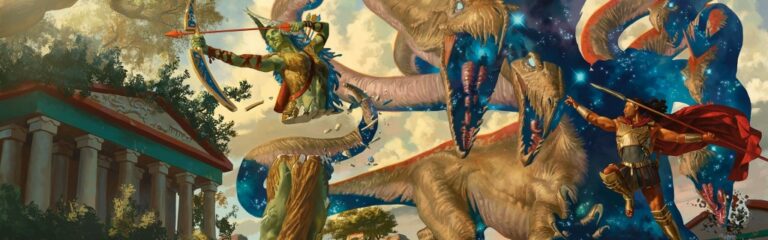
It should also be noted that to help the reader immerse themselves in the setting, the book comes with a plethora of gorgeous illustrations courtesy of some fantastic artists. Depictions of deities, epic struggles, and the world itself…it’s enough to make me want to try and obtain a copy with the alternate cover just so I can marvel as the struggle against the Hydra as captured by Kevin Tong.

Welcome to Theros.

Despite Theros pre-existing in the Magic card game, much like Ravnica you do not need to enter the realm with a complete understanding of information that is already out there. The sourcebook provides you with all the information you could want, laid out to help explain how Theros takes the Greek Pantheon, and forms is own which are full to the brim of personal goals, intricate rivalries, and prone to meddling in the affairs of mortals. The world of Theros itself seems to be taken straight from the pages of the Iliad or the Aeneid, with all the settlements and monster infested caverns and isles you would expect from the myths and legends. In fact, Theros encourages players to make the connection because here ‘hero’ is an actual vocation and synonymous with adventurers.

The key difference between Theros and traditional D&D Forgotten Realms lies in the power behind and of the gods themselves. In Forgotten Realms, the default setting of  5th Edition, gods exist and help heroes – granting power to clerics, and even favour to paladins – but all in all they’ve taken a step back and have no direct action in the realms. In Theros the gods are as involved as any could believe they could be, and this is because “things believed and dreamed here eventually become real”. The gods themselves are a produce of this process, and it is the continued belief and worship that keep them alive – each story told, every sacrifice made, every devotion is nourishment for these impossible beings.

There is also a theme in Theros, that “the power of fate and myth destines every character for legend; all one must do is act and discover their own immortal tale.” Fate, destiny, and the heroic drive then combine to amplify a character’s ideals, bonds and flaws. It’s understandable that this definition is explained so early in Mythic Odysseys of Theros to set the tone and to help players grasp the core concepts of the world. A brief history of Theros is included at the beginning to give an idea of the background, though those familiar with Magic might find such content to be a little light. I find it useful, as the players can briefly catch up on the establishment of the world whilst the Dungeon Master can have artistic freedom on where to go next without having to extensively revise the dense history.

Player options

Drive and Gifts

For players, some of the primary content they will focus on is the new features for character creation. In line with the mythic qualities of the realm, the book treats characters as heroes from the start, as all heroes in Theros begin their tale with a Supernatural Gift. These gifts enable characters to set themselves apart from their first level and can be identifiers for the heroic deeds you will undoubtedly undertake in the future!
Each of these Supernatural Gifts act as feats for your character, providing key abilities which will prove to have a use over the course of your odyssey. Perhaps you are Anvilwrought – where you take on the aspects of the Warforged, and have constructed resilience and operate on a Sentry’s Rest to ‘recharge’ for six hours whilst on watch – or perhaps you are Nyxborn – a fragment of divinity, you personify an idea and were born in the gods’ realm. Given your affinity for the divine, you can adopt a cloak of starlight to make it difficult to attack you and have resistance to necrotic and radiant damage.

One particular gift I look forward to trying is that of the Oracle – the gods can commune through you at their leisure and add a d10 to an ability check roll once per long rest. Additionally, you have a curse bestowed upon you (thanks Cassandra) which allows the Dungeon Master to go nuts in terms of visions of a grim future you must avoid, or as a character hook for the other players to try and solve in a quest somewhere along the line.

There is an optional rule for Dungeon Masters to allow a list of feats to be chosen as a Heroic Feat instead if players so desire.

Races

In Theros, there is an interesting limitation to the playable races which occupy these lands. From the Player’s Handbook, only the Humans are noted to live in these lands. The other races feature familiar faces from Ravnica, as we are provided with breakdowns for Centaurs, Minotaurs and Tritons (with a new errata added to allow for Darkvision) as well as two new races – the Satyr and the Leonin.

Each race is given their own specific attention to explore how their societies fit into Theros. The information is fruitful for new adventurers looking for inspiration for their character and how they will fit into the society as a whole. Some little tidbits are particularly insightful, as they can help personally explore and build stories for characters – an example of this lies in how Triton names can set up for unique and quite personal characterisation, such as Tritons having “a fluid concept of gender and might switch names freely as they shift gender identities”.

Players may be drawn to the two new races, and the possibilities they offer. First of all, we have the Leonin. Whilst from the appearance they could be seen as just an alternative form of Tabaxi, this catlike race is more built around health and strength than agility with an ability to make creatures tremble as you stand tall and let out a majestic roar. Proud, noble creatures, they also play a key part in the mythological ecosphere of Theros as being one of the only races where most of the race outright reject gods. They even have a Supernatural Gift crafted especially for their denial of servitude, the Iconoclast.

We also have the Satyr, embracers of life who embody chaos with their revelry and eccentricities. They see the world as a buffet of pleasures, to sample and relish at their leisure. Creatures of charisma and a little dextrous, fey in origin and capable of resisting spells and other magic effects, they make the perfect candidates for spellcasters.

Unfortunately, the book does not introduce any new subraces to the previously existing races. There is an opportunity to be creative with their Supernatural Gifts and introduce this as a flavoured subrace, but I would have liked to have seen some Deep Sea Tritons.

Subclasses

Mythic Odysseys of Theros provide recommendations about pairing cleric domain  to deities, but the main draw is the official introduction of two new subclasses which were previously Unearthed Arcana – the Bardic College of Eloquence, and the Paladin’s Oath of Glory.

The new bardic college places an emphasis on the spoken word, allowing for characters pursuing this subclass to excel more in support and roleplay outside of combat. An interesting edit to the subclass which is immediately apparent – Calm Emotions spell is replaced with a variation of the Rogue’s Reliable Talent feature specifically for Persuasion and Deception checks, treating all rolls of 9 or lower as 10. Having this at such a low level will ensure that you’ll want this person to talk to everyone you need something from to get the best deal!

The Oath of Glory does seem to be a more reduced version of Oath of Heroism, though the severity of the reduction might catch a few people off guard. I personally like the change of Legendary Strike to Inspiring Smite, where it turns from making critical attacks easier to distributing hit points as a support move. However, the aura which boosts the movements speed of those very near to you (paired with the worst aura range of all official Paladin subclasses) seems a little too reductive in the capabilities of this subclass. I know it can be used to increase allies and your steed to cover more ground, but people might be put off by just a speed boost.

Finally, the book also introduces only one new background, that of the Athlete. This allows you to envision your character as someone renown for their physical prowess, and have some escapades of athletic events which you and the DM could turn into a small tournament arc (though you will have to choose a favoured event). I can see this to be an opportunity to be expanded for an arc of a campaign, where the heroes take a break to participate in the Olympics only for the events to be disturbed by a slighted athlete looking to disrupt the ceremonies.

The World

The Gods

As stated before, the pantheon of fifteen gods guide religious life on Theros. Each divine being represents important aspects of mortal life, and can be seen moving across the night sky and may even be encountered face to face. Though they are powerful beings, they lack omnipotence and omniscience – they are still wise enough, having a perfect recall of everything that has happened to them before. They may speak through oracles and seers, manipulate natural phenomena to create oments, and create Nyx-born creatures to serves as messengers and emissaries.

In this setting adventurers can have intimate relationships with the deities of the pantheon, as Theros introduces a Piety System for the Dungeon Master to increase and decrease depending on the actions of particular players to appease a specific deity. Through this system, the gods can bestow favours on those who prove their devotion – depending on the god you have improved relationships with, you gain a unique benefit in accordance with specific levels of piety – 3, 10, 25 and 50. Remember though, the gods are nothing but observant on those who supposedly represent them in the mortal world. Breaking tenants can lead to losing piety points, which can lead to you losing the benefit if you fall below the specific level.

Mythic Odysseys of Theros provides an in-depth look at each of the 15 deities to allow players the opportunity to get to know the ambitions and core aspects of the gods. These profiles also detail each benefit they can obtain through certain deeds and works, as well as some of the myths attributed to that deity.

Realms

Within Theros, there is the Mortal Realm and the divine realms of the Nyx and Underworld. Most of Theros consists of a long stretch of coastline sandwiched between the Siren Sea and the Oraniad Mountains. Inland, there are three poleis (large cities and surrounding territories). Within Akros, Meletis and Setessa are different political structures which offer their citizens safety and a home. The book provides some much needed context for each poleis, and parralels can be drawn with the legends of ancient Athens, Sparta and Troy. Key features of the world are expanded upon within the book to give players and Dungeon Masters all the ideas of how the places exist on a day-to-day basis and what can be expected (or built upon by Dungeon Masters who might lay about with the material for their campaigns). Attention is also given to the other realms of Theros which players might visit in their adventures. Anyone up for plunging into the depths of the Underworld to retrieve a lost soul wrongly punished?

Monsters & Adventures

Mythic Odysseys of Theros would not be comeplete without some fantastically laid out adventures waiting to be utilised by Dungeon Masters. An entire chapter is dedicated to the deities of the realm and key adventures that players may embark on related to that deity, whether they be the patrons providing these challenges or the ultimate antagonist for the players to foil.

And it wouldn’t be an Odyssey without any monsters to challenge the players along the way! Each creature has been sourced from mythology and the Magic game itself, utilising some of the card artwork to bring creatures to life! Classic monsters such as the Cyclops and Lamia are taken straight from the Monster Manual, but introduces the new Cerberi and Hydras to challenge even the most seasoned adventurers! And, to add an extra layer of challenge to encounters, Theros introduces three Mythic Monsters with Mythic Traits which can change battles into truly legendary climaxes as they refuse to die. For example, Arasta (whose lovely web-covered visage can be seen above) will immediately regain 200 hit points and gains a swarm of baby spiders which provide an additional 100 hit points.

Finally, what adventure wouldn’t be complete without treasures! Magical items – such as the Two-Birds sling which allows ammunition to ricochet to a second target with each attack, or the wonderous Helm of the Gods which provides a different boon depending on which deity you worship. Or perhaps you eventually stumble on one of the five artifacts, godly in origin and carrying some impressive power within.

Final Thoughts

Ever since the inclusion of Ravnica to D&D 5th Edition, I have been curious about what could come next. What new setting and stories could possibly come forth from Magic or elsewhere. Recently, it seems that 5e is looking to explore all possible realms and places from, as Theros is a welcome addition to the settings to play about in, appealing to both those familiar through Magic or completely new and just familiar with the Greek myths and heroes of old. The new Piety System makes for an interesting addition to the mechanics of the game to get players all engaged with the divine cosmos, and the Supernatural Gifts ensure that players start their campaigns off already feeling sure and confident in themselves as they start their journey to embark on Odysseys of their own.

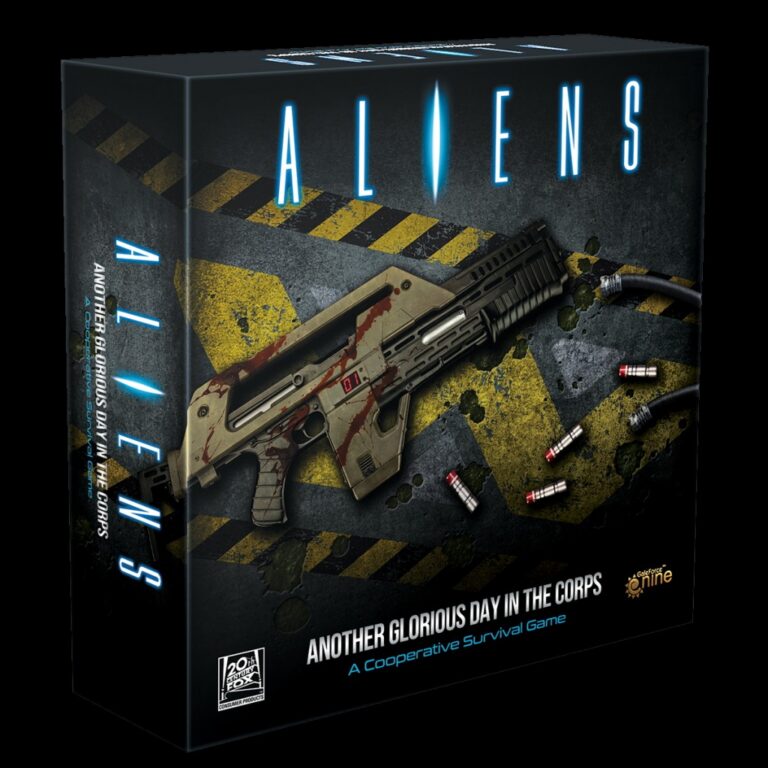
Phil Yates on Aliens: Another Glorious Day in the Corps

Directed by James Cameron, Aliens is a cinematic experience like no other.  Building upon the original, Aliens expanded the universe and setting to create a war movie in space that stayed true to its horror origins.  Whilst many boardgames have replicated the feel of Aliens, there has only been one official boardgame adaptation, and that was released over thirty years ago.

One of the reasons that Aliens is such a classic film are the iconic moments, such as the multi-layered mess hall scene and the nerve-wracking sentry gun sequence.  From the retro-futuristic hardware to the memorable characters, all come together to create a film like no other.

It was therefore understandable that “Let’s rock!” was pretty much the universal reaction when Battlefront announced they were developing Aliens: Another Glorious Day in the Corps.  Best known for developing the World War 2 miniatures game Flames of War, Battlefront brought their twenty years’ worth of experience to create the ultimate Aliens experience.

With ‘Aliens: Another Glorious Day in the Corps’ due to be released later this year, Geek Pride took the opportunity to interviewer the game’s developer Phil Yates.

How did Battlefront become involved in developing Aliens: Another Glorious Day in the Corps?

Aliens has been one of the favourite movies of the boss, since it came out. When the opportunity to do a licensed game for it came up, there was never any doubt that we would do it. As you can imagine, that decision was greeted with cheers from most of the studio.

Aliens has a very specific mood and theme, how have you translated that into the game?

We didn’t really think about it in terms like that, rather we just tried to bring in the feeling of the film itself, a feeling of growing menace, then of being overwhelmed and a desperate struggle, and finally just sheer survival. There are two aspects to that; the first is game play and the second is the campaign.

In each game, you start in a fairly good position. And then the aliens start coming and the ammo starts dropping and marines start dying. By the end of the game, you’re really struggling and just happy to get out of it mostly intact.

The campaign follows the same sort of arc. Whereas in many campaigns characters get better as time passes, such as learning new skills, the arc in Aliens is downward. Your resources slowly run out as the alien threat ramps up. By the end, you are down to just a few characters, barely enough ammo, and even more problems. Just surviving is a victory worthy of a major celebration.

For those wanting a more optimistic arc, the expansions add the option of experience cards, allowing your marines to grow tougher as the fighting progresses. For those who just want a good old bug hunt, there are a bunch of challenging scenarios where the goal is simply to wipe out all of the aliens!

What have been the challenges in adapting such an iconic film and how did you overcome them?

As you suggested, one of the biggest challenges was staying true to the feel of the movie in game play, and the same challenge applied to the miniatures as well. Getting the characters right is a big challenge for any sculptor, considering the faces, poses, and equipment. Likewise, creating aliens that reflect the feeling of a film where they are mostly a hidden threat that flashes onto the screen in their full terrifying glory was an interesting challenge. Even the design and artwork of the gameboards took careful crafting to combine interesting gameplay and the feel of the film.

Will you be incorporating elements from the Director’s Cut and other sources, such as the Colonial Marines Technical Manual, or are you focussing only on the original release?

Definitely the wider story. We have sentry guns in one of the campaign games and several of the bug hunt scenarios, for instance. Likewise, you can drive the APC [Armoured Personnel Carrier], firing its weapons as you go. We tried to give the richest Aliens experience we could.

One of the most memorable aspects in Aliens are the motion trackers, how did you bring them into the game?

The motion trackers are the core mechanism in the game. Until your characters can actually see them, the aliens are just blips. You know that there’s something there. The big question is exactly how many somethings. As the game progresses, each player draws motion tracker cards adding more blips to the game board. These might appear in the expected place, or suddenly burst out of the ceiling or an unexpected maintenance tunnel. You can predict the sort of threat you’ll face, but when it actually comes, it’s never quite what you expect.

The motion tracker also features in the first campaign game where you are trying to find Newt. One of those blips is the one you’re looking for. Simple enough. The problem is that the rest definitely aren’t!

Are xenomorphs the sole enemy in the game, or will other antagonists be involved?

The game follows the story of the movie, with the expansions filling in more gaps. Since the only opposition was the aliens, that’s what the game is about. However, the alien queen expansion definitely makes those aliens a lot more scary – especially if one of the players takes on the role of the hive mind, adding intelligence to their blind instinct. One might consider Burke as an antagonist as well, although he’s on the player’s side.

What characters are available in the game and can players create their own marines?

All of the main characters from Aliens are in the game and the expansions, including Bishop, the synthetic ‘artificial person’ who has some quite unique characteristics. Since the game focuses on the movie, there is no system for creating your own custom marines, although the experience cards mentioned earlier do allow you to adapt them to your taste. This really isn’t a problem: with each character having a different style of gameplay, there’s plenty of options to choose from.

How will campaign rules differ to standalone play?

The campaign is a series of missions that you must complete. Unlike standalone games, some of the resources you use in one mission are no longer available for future missions. That means that you need to keep everyone alive and out of the clutches of the aliens, or undertake rescue missions to get them back, and rather than just getting one or two characters out alive to claim victory.

It’s pretty cool in that you can play the whole movie. You can even watch bits and then play the matching mission, then watch some more and play another mission!

What expansions do you have planned for the game?

There are two expansions: Ultimate Badasses, which adds additional characters and experience cards, and Get Away From Her, You B***h, which extends the story and adds the alien queen, power loader, APC, more game boards, and the ability to play as the hive mind.

Phil Yates, thank you very much.

Aliens: Another Glorious Day in the Corps will be released in October 2020 and can be ordered in advance through your friendly local gaming store or through most online retailers.

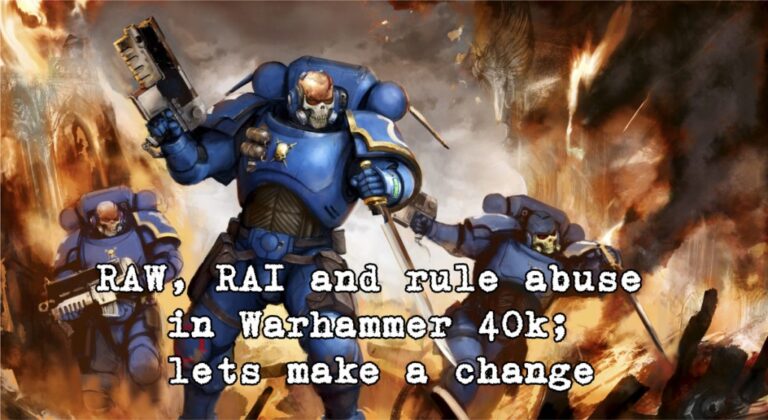
RAW, RAI and rule abuse in Warhammer 40k; lets make a change

I have been playing 40k since the days of the original Rogue Trader book in all it’s strange and weird glory. I took a small break in between 3rd and 5th editions, but within my time in the game, I never played competitively until 8th edition. Why? Well It seemed a bit more streamlined, and I was finding it hard to herd the group of cats that were friends into playing games at all; kids, mortgages and general adulting have a lot to answer for it would seem. So I entered a tournament at Element Games to get a chance to play, and that was it – I haven’t looked back since.

Some of you may be aware of my views on competitive play and how, despite some unsavoury moments, it isn’t as bad as it is made out to be (check out these articles):

https://geek-pride.co.uk/tabletop/7-people-you-will-play-in-a-40k-tourney-and-why-it-isnt-that-bad/

https://geek-pride.co.uk/tabletop/why-ill-never-be-a-top-table-player-in-40k-and-5-ways-you-can-be/

BUT despite this, I do have a couple of remaining bugbears.

  1. The general “the sky is falling, I can’t believe they are betraying me, I’ll never play Warhammer again” rhetoric you get leading up to and before each new edition (this is another article in itself, I think) and
  2. The intentional use of broken rules to gain an advantage by aggressively overruling dissenting views in your favour; this second point is what I want to talk about.

The issue

As someone who played casually for many years with groups of friends, over numerous editions, figuring out rule ambiguity was mostly a simple case of an agreement that the rules as intended had precedent over the rules as written. In a lot of cases, you could see that the rule was broken, how they had made the mistake in explaining it, and you just dealt with it as intended (If there was a bit more ambiguity, then you house ruled it so all parties agreed it was fair for everyone’s armies). I therefore had a massive shock when I entered competitive play and came up against people who actively sought out and aggressively defended broken or badly written rules to gain an advantage.

As it was taken by everyone about me, it was a case of like it or lump it, that’s how the competitive scene worked – If you wanted to be a part of it, you had to learn about the exploits, use them, counter them or try not to fall foul of them.  So that’s what I did, and after a steep learning curve I just accepted it as part of the game. The problem is, it never sat well with me and you’d have moments where common sense would seem to want to prevail – but you always got trapped within the house of mirrors that represents the circular RAW argument; C’est la vie, I guess.

Now, granted,  I fully understand the arguments for using rule exploits – You will find that some of the current top tier players will spend hours, days, weeks or even months looking for and testing out optimised lists based on optimal use of loopholes that they can exploit for maximum advantage. These people are intelligent, fully aware of how the rules are intended to work over how they actually work, and can be a great source of tactical knowledge once you’ve reviewed their matches, or been on the receiving end – they are, in effect, unofficial and unpaid playtesters who are giving GW a nudge to fix something by their success.

The thing is though, with this being accepted as the norm (and with people like me just going with the flow), we end up with an unbalanced and broken game; One that promotes and favours only specific factions and subgroups, depending on what loopholes have been found. This in turn creates a situation whereupon if you want to win, you have to play as a certain army and so punishes those who just want to play the army they have always played… I’m a Space Wolves player, so I know this very well. It also can quickly discourage new players for their very lack of in-depth knowledge and experience, promoting the perception that having so badly misinterpreted the rules, the game may not be for them.

The counter-argument is, of course, that it’s not our fault GW introduces power creep and can’t write rules properly, we are just playing with what we have. I would accept this, if it wasn’t for the fact that in most of the tournaments I have played in, there are house rules and changes from the official line in the ‘Tournament Pack’ or ‘Rules Pack’ you get when entering. What this says to me is that if there are broken rules, or people abusing specific units/tactics, that it CAN be changed by consensus – Therefore the opinion “Well I guess we need to wait until the FAQ comes out to change it” is just a way of saying “I like this rule because it benefits me to the detriment of the game and other players, so I’ll just drag my heels and wait for the FAQ to come out and get as many wins as I can out of it.” This needs to change for the health of the game, and the players.

Of course, the game isn’t fully balanced at any chosen minute – It’s a dynamic system, constantly being rebalanced by new codex releases and expansions (Plus FAQs) – Inevitably some factions are going to be better than others, based on having newer rules/Codexes, but we shouldn’t be encouraging, accepting or looking for broken rules & exploits – That tips us from one side having a slight advantage to creating a completely unfair advantage for certain people with the time and money to switch what they use to frustrate and crush others – And that’s just not fun to play for anyone except those few ‘winners’.

In the end, we are playing a game, it’s not actual war. There are a set of rules and a general consensus that approximate how specific things work in the real world for a specific effect and feel ‘on the table’.

This doesn’t even touch on the fact that winning by using an exploit is just lame and ultimately unsatisfying.

I would rather have a close and well-fought game that I lose by a well-timed choice and a spectacular intervention by Lady Luck on a dice roll than win by exploit. It’s not cheating, it’s in the RAW but it’s just not, well… Honourable – And definitely not in the spirt of how the rules, and the game, are intended.

So how do we fix it?

Well, in my mind it’s simple enough:

  1. Firstly there needs to be an acceptance that Games Workshop are a company who want to make money, therefore it is not in their interest to make everything tight and even all the time; that will take enough time and money they just won’t sell enough models to break even, let alone make a profit.Once you have accepted this, then it’s good to remember that, good intentions aside, GW are pretty much our plastic crack dealers, you can move on to thinking about fixing imbalances –  Or at least fixing the exploits that cause potential game-breaking impacts on the mechanics without waiting for GW to come up with an ‘official’ fix for everything.

    In their defence, they do at least seem to be trying a bit harder these days to fix/balance the meta, and to restrict rules abuse  – But with so many codexes, players and combinations, things will fall through the net  – And there are big delays before fixes come in as they test them and try to not make it worse (Not always entirely successfully).

    We should probably remember it’s often 6 months between them writing and signing off on a Codex or an expansion, and the product being sold – That’s a lot of time for other things to change! This is where the community needs to come together and not just create, but maintain specific standards on rules and how the game is played. Fixing cracks as they appear and keeping them together until GW do eventually FAQ them.

  1. There needs to be an acceptance that RAI wins out over RAW. If the majority of the community accepts that there is a specific intent to a rule or mechanic then that’s how it should be played and used, irrespective of the wording.Bear in mind this already happens to a point. People point out issues, the community agrees, the difference is nothing is done consistently because there is no “official” FAQ. So it is just left to be abused until then.

    This was perfectly understandable, even 10 years ago, but with social media and the fact that many gamers play in more than group between shops, clubs and friends, we all talk to each other, so we can spread ideas, and share links to articles to discuss or use for reference.

  1. With the above in mind there also needs to be an acceptance that just because an official FAQ hasn’t come out, doesn’t mean things can’t or shouldn’t be changed for tournaments, sanctioned or otherwise. Things should be changed and the rules should be changing with the meta constantly; a living ruleset if you will that is designed to make the game overall fun – Not just for a small group, but for everyone at some point. Some will be happier more often than others, but that may be because they are just better players, or the dice liked them that week.Once new rules are out, submissions could be sent to a central post, email or repository (or coordinated and shared from posts or discussions in some of the more common hangouts on social media, reddit etc), where they can be compiled and voted upon on a regular basis (weekly might be harder to arrange than bi-monthly, for example) .

    Eg.  Storm shields give a +1 to your armour save now (9th ed), and a 4+ Invulnerable save. As you are unable to modify a dice roll below a 1, and the rules emphasise the value on the dice when rolled. This would mean Terminators and other 2+ save characters with storm shields would now in theory have, in effect, a 2++ save.  (I appreciate that this new SS rule as seen only relates to the new bladeguard veterans, but it serves as a good example)

    It is believed, however, that this is not the intent and that weapons with an AP value can reduce the effective save (Though not cumulatively, only by +1 or -1), leaving the model with a maximum save of 4++ in effect.

    VOTE Y / N

  1. If the vote carries after a week or other specified and consistent period, then that’s the rule and how it should be implemented until GW say otherwise.
  2. New rulings are applicable to tournaments that occur 2 weeks after the ruling, meaning that there is no messing around with list submissions, and people have time to get used to it.

Granted, this will not be fool-proof, but it’s a start and it’s something that will bring back the power of how this game is played to us. We can then provide a gaming experience that at least feels a bit fairer and competitive, rather than one that you know will be decided by the army your opponent fields – Whether a specific list, or just certain units, rather than what happens when those models are on the table – Why would you play?

You will know that, if an exploit is found by someone else, or if you fall victim to it, that it can and will be fixed soon and you don’t have to give up playing the army that you want to play. GW don’t have to be the only arbiter, or the excuse for things remaining broken. Blood Bowl was managed by the community for 22 years when Games Workshop stepped away. And yet, GW could come back in 2016 and release a new version without breaking all the community teams with their own, because the core of the RAI were still there, and in line with the RAW.

People still loved and played the game, though not as many, and while there are less units and forces, it remains the truth that the community of Blood Bowl players shed those looking for nothing but an easy victory by cheating. We can do something similar in 40k. They have already taken aboard some of the tournament organisers and players that have either used the loopholes or fought them, so it’s hopeful they will be better at avoiding these issues. In the meantime, we want to play, so we can take some responsibility for how the game is seen, played and presented, or we’ll scare our peers and the next generation away.

Let us know what you think in the comments below and a big thanks to Mark Canty for some insightful points in this article.

Not Throwing Away Your Shot with Sidney Harcourt

Written by Daniel Delargy, Matt Geary, and Cristina Bogdan

Sydney James Harcourt is an American singer, musician and actor who – by his own admission, from the woods of Michigan – has had the incredible chance to be a part of the Hamilton Musical since the very beginning, before it genuinely took the world by storm.

Gracious enough to share some of his time with us, we sat down for a chat to talk about the upcoming Hamilton movie which was released today on the Disney+ streaming platform. The first thing we noticed about Sydney is that he is an incredibly down to earth person. You would expect from someone that has had the chance to be a part of something so big, that has ‘rubbed’ shoulders with the Broadway elite and even several celebrities, to be a little less modest, a little less open, but it seems that Sydney has maintained a winning attitude without giving up on his kindness.

Wearing a Black Lives Matter t-shirt, he openly discussed with us, explaining the way systematic racism is working in the US, a hot topic that not many touch on, at least no further than a throwaway black picture on their instagram feed. But Sydney did more than that, painting a very real picture of what it is like being black or non-white, in America, today.

He shared with us a story of an audition for a rap musical – “Holler If Ya Hear Me”, on the music of Tupac Shakur – where he was stopped by a pair of police officers. It was hard to hear how the officers that stopped him just because of his outfit brings out the profiling that he, as many others, found himself subjected to.

Though humorous to us, due in no small part to his casual delivery, he shared the possible thoughts going through those officers heads as they questioned him – of how many drugs he was in possession of, how many children he’s fathered. The process was long, as they didn’t believe him when he told them he had no record – they spent a long time checking just to make sure – and when they asked him where he was going, they acted as though it were an improbable thing for him to have a job.

Being stopped and forced to wait for your criminal record to be checked just for being you, and after insisting that you do not have one, has got to hurt and the fact that the bubble seems to have burst now in the way it has is a sign that it was long overdue.

Still on the topic of Black Lives Matter, he mentioned how this time it feels like the move is more inclusive than before. As an openly gay man, he never felt quite accepted, and he was left out of the discussion, due to the views that the black community holds on homosexuality or anything outside the norm. This time, he says, it feels like it truly is an ‘All black lives matter’ situation – black, brown and everything in between – everyone has a place at the table now. In particular, he made note of the inclusivity of the movement bringing to light the current plight of the Native American population, even to help clarify to modern Americans that Native Americans still exist in a modern context.

Given the kind of history that Hamilton presents, we launched into a discussion on the way history tends to be romanticized and how most people know very little of the reality behind the glamour of the founding fathers. Sydney admitted he knew surprisingly little before the musical, did some research and has plenty of things to say about the particular behaviours that tend to be glossed over in history books and even in the Hamilton musical.

Slave ownership, behaviour towards Native Americans, the suffering spread left and right in the name of a new nation all come to mind. The play has been criticized for skipping over these and, when asked about it, Sydney mentioned how now people behind it are doing their best to educate people more about the ‘real’ history behind it. Students are invited to view the play and they then get to write their own rap songs or do their own sketches to be more familiar with the reality behind the curtain.

As someone who has done many roles in Hamilton, but particularly Aaron Burr – probably the least loved character in the play – Sydney talks about learning more and more about him and according to him, the man was ‘vile’. He was also the character with the most words to learn (over 10,000) and that could not have been an easy feat. There are a lot of ‘How does a…’ tracks that he had to make sure not to mix up, and impressively managed never to mix them up.

It’s not an easy feat, and one which is made even spectacular when discussing the conditions of the first time he stepped up as an understudy. He was one of the first understudies to take up one of the main roles, and the process was rather swift – learning about playing Burr at 12:30 on a Saturday to play the character at the performance later that day. He was given the swiftest of instructions, a brief explanation of his entrances and exits and was provided with a costume that was made for Leslie Odom Jr to wear during the off-Broadway performances.

The process behind a play is much more elaborated than we imagine, with walkthroughs, read throughs, repetitions with and without orchestra, yet he had to make do with a little more than a passing through the stage. However, he made a conscious choice not to panic and take everything as it came, and he got the job done.  After the performance, he met up with René Goldsberry Johnson backstage – who played the role of Angelica Schuyler, and previously performed alongside him as Nala in a Broadway run of The Lion King – and the two hugged each other and let the emotions flow. It was one of the scariest moments in his career, and helped every other performance afterwards as nothing could possibly match the fears and anxiety from that performance.

When asked about any type of ‘bloopers’ he could share from his time with Hamilton, he mentioned that whilst there were no Broadway performances that came to mind there was one early public performance where he appeared as King George’s herald and managing to go the wrong way, straight into the other herald. This was a thing that did tend to happen at the beginning of the play, as there were many changes done on the fly, as the play grew and evolved into what it is today.

We did learn a funny story that has now forever planted the image into Cristina’s head of Sydney James Harcourt as a lion taking a dive in a pool by walking too close to the edge of it. When playing a very dramatic scene in one performance of The Lion King – where Simba realizes his father will forever live within him – he apparently nearly toppled off the stage. He managed to right himself after some severe hand-wheeling, saving the audience from getting too close to the action. Based on his body language, it seems that the first-row people were more than happy to pull away, instead of helping – not the rock concert crowd there, obviously.

Upon mentioning the many roles he played in Hamilton, which is undoubtedly a scary thing, having to change your ‘skin’ so many times and embody so many people – at times during the same show –  Sydney described it in a quite different way. Given the amount of shows they would do in a week, the change to a different character brought some reprieve from the Groundhog Day situation where everything became routine. Being someone else for a while allowed for something else. Maybe even some rest for his body.

We might see only the glamourous side of theatre, but with the 8, sometimes 9 shows a week, the whole thing took a toll on his body. He mentioned Epson salt baths, acupuncture, going to see a chiropractor and getting massages just because the high-heeled shoes were a nightmare. Going up and down stairs, dropping to your knees and handling a rotating stage added some more pain into the mix. It’s something those who have seen Hamilton live barely get to see, or consider.

And in the glimpses of performances that are available so far online, all that shines is the talent and dedication of everyone involved. And Sydney has both in spades.

Discussing the difference between doing a movie and a play, he mentions how easy movie/series actors have it, with chairs between takes, hour long rests and even the Kale smoothie, if needed. Such reprieves are not a thing in theatre, but he was still quick to advise Hillary Duff to go for her idea of staring in a stage musical during their time filming for a television series Younger – at a time when he was still performing in Hamilton too. (Maybe he is a little cheeky too).

As we were all still isolating due to the global pandemic, the conversation turned towards what an artist does when he is cooped up inside and away from the stage. It seems that for Sydney this was a blessed break, that allowed his own projects to take center stage.

Maybe not his knitting passion – which he mentions as he describes it as something he used to do during his Hamilton days that yielded quite a few scarves – but his music projects including an amazing collaboration with Nina West. The wonder of digitalization came to play and while apart, they felt that they truly were in the same place recording.

He spoke about his relationship with her as something that inspired and helped him through the years, as they had been friends for quite a lengthy amount of time. Even now, or at least when it was possible, she braved the pandemic to see new plays, to go meet new and old friends, despite the apprehension from Sydney who chose his home state of Michigan to retreat to, during the lock down.

This collaboration – a video cover of “A Safe Place to Land” for the #blacktranslivesmatter movement, which was Nina’s suggestion for the digital Pride event SHE’S A RIOT – was just one of the projects he’d had the pleasure of taking part of during this time of ours. He mentioned more musical numbers were on the way – a mash up of Rise Up” and “My Shot” with René Goldsberry Johnson and the cast, and even an a capella collaboration with Six Appeal of “History Has Its Eyes on You” in honor of the protests in Minnesota and around the country.

Whilst our time with Sydney was brought to a swift close, it was clear to see that he had thrived during this time, and it was great to see that his spirits were high. He encouraged us to read the Hamilton book to continue extending our knowledge of America and the narrative provided through the musical. It was an absolute pleasure to talk to him, and we at Geek pride wish him all the very best going forwards.

After all, when history has its eyes on you it’s a real shame to throw away your shot.

Hamilton is available now on the streaming service Disney +.

Justin Achilli rejoins World of Darkness

White Wolf veteran Justin Achilli, the developer of countless rulebooks and supplements, is returning to the World of Darkness, the iconic setting for Vampire: The Masquerade and Werewolf: The Apocalypse.

From 1997 to 2011, Achilli prolifically designed and authored a manifold range of World of Darkness materials.  With his unparalleled breadth of knowledge regarding the World of Darkness, Achilli will lead creative development for the setting.

“I’ve loved the World of Darkness since my then-girlfriend convinced me to get into it back in the 1990s,” says Justin Achilli. “I’m excited to help deliver the future of WoD, as Paradox has the ability to realise games, and other media, that we simply didn’t have the means to accomplish in years prior.”

Achilli will be joining Martyna Zych, also known as Outstar, who was recently announced as brand community developer for World of Darkness.  To watch the latest season of LA By Night, visit the World of Darkness Twitch channel.

Highlights from D&D Live 2020

The largest D&D celebration of the year, D&D Live 2020: Roll w/ Advantage, occurred last week, celebrating the first and largest roleplaying game in the world.  Amongst the many reveals that weekend, one of the most eagerly anticipated was an exclusive look at the gameplay of the forthcoming Baldur’s Gate III.

Highlights of the weekend included, Deborah Ann Woll led a group of actors including Amy Acker, Jay Ellis, Janina Gavankar, Matthew Lillard and Sam Richardson, in improvising a way to help people in a fantasy world not that different from ours.

Meanwhile, Kate Welch DMed a wild and hilarious bunch of comedians as they experienced D&D’s upcoming setting Icewind Dale for the first time.  Participants are Sue Perkins, Kevin Sussman, Thomas Middleditch, Reggie Watts and Melissa Villasenor.

Finally, D&D’s Cast of Thrones game reunited Game of Thrones stars Kristian Nairn (Hodor), Daniel Portman (Podrick), Iwan Rheon (Ramsay Bolton), Natalia Tena (Osha) and Gemma Whelan (Yara Greyjoy) in an epic adventure.  (Not written by George R R Martin, otherwise everyone would have died…)