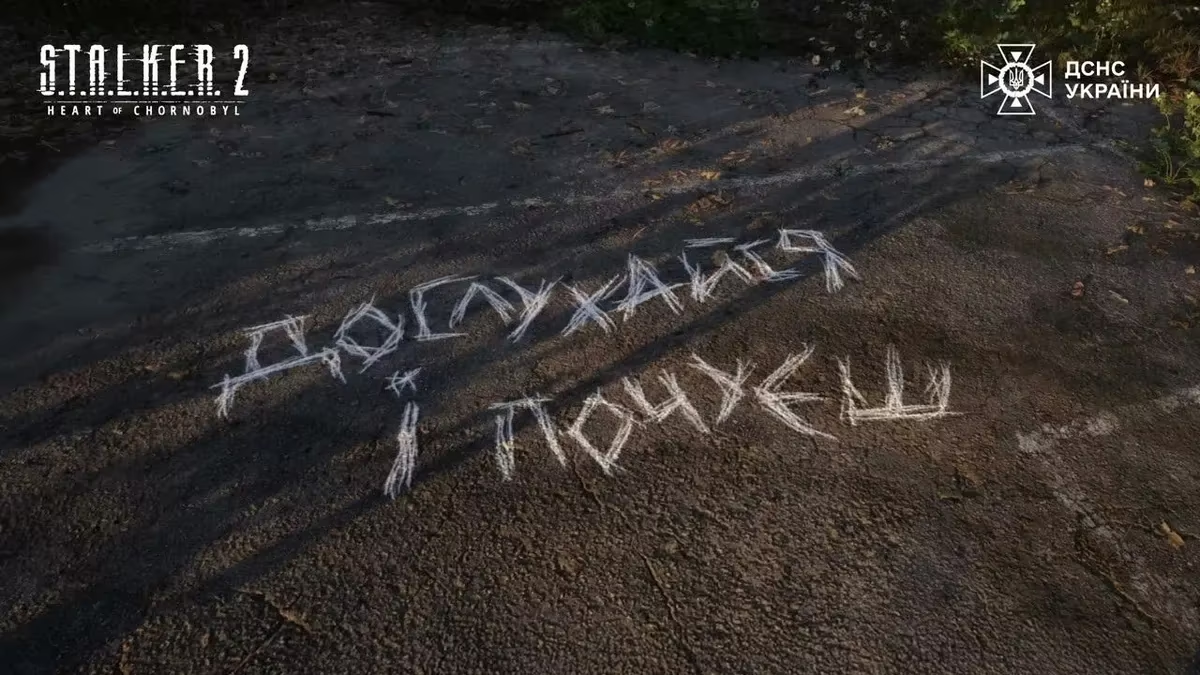
In Ukraine, nearly a quarter of the country is potentially dangerous due to landmines, making it one of the most mined countries in the world. The most demographic most vulnerable to this danger is teenage boys, who spend more time outdoors.
In order to raise awareness of mine safety, the State Emergency Service of Ukraine (SES) worked in partnership with Rockets Growth R&D and GSC Game World to create S.T.A.L.K.E.R. 2: The Hidden Threat.
Instead of presenting a traditional public service announcement, S.T.A.L.K.E.R. 2: The Hidden Threat is styled like a PDA message in the S.T.A.L.K.E.R. universe, where attentiveness and caution determine survival. This approach allows teenagers to absorb safety rules without moralising, fear-based messaging or official rhetoric.
Skif, the main character of S.T.A.L.K.E.R. 2 became the project’s safety ambassador, voiced by actor Dima Havrylov. The character lives in the Exclusion Zone – an area that was temporarily occupied and heavily mined, making it relatable. The creative team reconstructed the story inside the game, so the message is naturally embedded: mine danger is everywhere, and the Chornobyl area itself was evacuated for a reason.
To learn more about the project, Geek Pride spoke to Taras Mokhonko, strategy lead at Rockets Growth R&D.
At what point did you choose to use video games as a medium for this public safety campaign?
The idea emerged organically when two realities overlapped: the rising popularity of S.T.A.L.K.E.R. 2 and ongoing incidents involving teenagers injured by explosive remnants of war.
We realised that traditional safety messages were not cutting through, especially for teenagers. The atmosphere of S.T.A.L.K.E.R. 2, where attentiveness determines whether you lose a virtual life, [is close to] the reality for Ukrainians, where inattentiveness can mean losing a real one.
That was the moment when a simple phrase was said, which became the starting point: “Skif would say this better than any of us.”
This became the turning point, shifting from explaining safety rules about reality to embedding them inside a familiar gaming world.
Did you ever consider using conventional media for the campaign?
We did consider conventional media – and, in fact, it had already been heavily used in the first years of the full-scale war. The communication around mine safety was very intense across TV, outdoor, radio and other channels. But over time, those formats started to lose effectiveness, especially with younger audiences. Teenagers, in particular, had learned to tune them out – they simply stopped noticing them.
That’s why we chose a non-standard route. Instead of trying to compete for attention in oversaturated spaces, we decided to meet the audience in environments where they are still genuinely engaged.
In addition to the core video, we developed a series of audio safety messages to extend the campaign’s reach. Importantly, these were not traditional radio placements. We did not run a paid radio campaign – although the project was organically mentioned in a broadcast, which we consider earned media rather than planned distribution.
We created two distinct audio spots, each tailored to a specific audience and context. One was designed for a mainstream audience and distributed through the in-store audio network of the Avrora retail chain – a highly accessible, everyday environment with consistent foot traffic. The second was aimed at teenagers and young people, and placed on YouTube Music, where it could naturally integrate into their listening habits.
The concept behind both was the same: to function as interruptive media within familiar audio environments. During music playback, the main character of the game, Skif, suddenly addresses the listener directly – breaking the fourth wall and delivering mine safety guidance in a voice that feels recognisable and relevant.
This approach allowed us to avoid the fatigue associated with traditional formats and instead reintroduce the message in a way that felt unexpected, contextual and much harder to ignore.

S.T.A.L.K.E.R. 2 is developed in Ukraine, but why did you choose that particular game?
The idea actually came at a very specific moment – when S.T.A.L.K.E.R. 2 was about to be released. The game had a massive marketing push behind it, and the hype around the launch was huge. Naturally, a lot of attention – especially from younger audiences — was already focused there.
We saw an opportunity to use that momentum. If people were already emotionally and visually engaged with the game, why not meet them exactly in that space and redirect part of that attention to something that matters?
The hypothesis was straightforward: if official videos fail to capture teenagers’ attention, maybe they would stop for something that looks and sounds like their favourite game.
The idea was developed in the format of a PDA – the in-game interface through which players receive messages, warnings and quests. The mission logic remained purely S.T.A.L.K.E.R. 2-like, without moralising: If you see something suspicious – don’t approach it, don’t touch it, go back the way you came, and call 101.
At the same time, S.T.A.L.K.E.R. 2 has a very distinct atmosphere and a strong fan culture, where excessive “officialdom” simply doesn’t work. Make it too entertaining – and it feels frivolous. Make it too official – and the audience rejects it. Everything depended on how precisely we could balance form, tone and message:
Form: an actual in-game format – a PDA message that truly exists in the S.T.A.L.K.E.R. universe. No invented mechanics.
Tone: no lectures, no preaching. Short, calm, and direct, exactly how advice sounds in the Zone.
Message: clear, without irony or fear-mongering. A rule that works both in the game and in real life.
Importantly, the topic itself resonated with the game’s world and philosophy — the idea of navigating danger, staying alert, and surviving in unpredictable environments is already deeply embedded in S.T.A.L.K.E.R. 2. That’s why the collaboration felt natural rather than forced.
As a result, the video felt “native” to everyone involved. Fans didn’t feel the game was being exploited. Teenagers didn’t feel they were being lectured. And the SES gained a way to talk about a serious issue in a language people actually understand.
GSC Game World are the developers, but how involved were they in creating the campaign?
GSC Game World were deeply involved – in fact, their contribution went far beyond what is usually expected in this kind of collaboration.
They essentially took the lead on the entire production process. The team selected the in-game locations, prepared the screencast, handled the editing, and brought in a voice actor to record and produce the final audio. Their understanding of the game’s world and tone was crucial in making the content feel authentic rather than adapted.
At the same time, our role was to coordinate the process end-to-end and ensure alignment at every stage. We worked closely with both GSC Game World and SES to make sure that every detail met the safety requirements, stayed true to the S.T.A.L.K.E.R. universe, and remained consistent with the core idea of the campaign.
There were moments when different sides would naturally lean more toward their own perspective – either more “game-like” or more “official” – so part of our job was to keep that balance in check. In a way, it was a very collaborative process, with everyone genuinely invested and eager to contribute their vision.
That level of involvement is exactly what made the final result feel so native and cohesive.
Were there any challenges in using a video game to spread public safety awareness?
Yes – the main challenge was balancing credibility and authenticity. On one hand, this is life-and-death communication coming from a government institution. On the other, it had to feel native to a gaming community that quickly rejects anything overly “official” or artificial. Getting that balance right was critical.
Another layer of complexity was on the institutional side. Convincing the State Emergency Service to step into a gaming environment wasn’t easy – their communications are traditionally very conservative, especially when it comes to sensitive, high-stakes topics. It required a lot of trust-building and the ability to clearly articulate why this approach could actually save lives, not undermine the message.
In the end, we found the right language and took a bold stance – because reaching children in a format they genuinely engage with was worth pushing those boundaries.
How close to your original idea did the campaign turn out?
The core idea remained almost unchanged – delivering safety rules through an in-game PDA message.
However, a significant part of the process involved refining tone, format and execution to ensure it felt authentic to both the gaming world and real-life communication standards.
What was the response to the campaign?
The response exceeded expectations, especially in terms of organic engagement. The campaign generated over 900 mentions and more than 5.4 million impressions organically, with strong engagement across gaming communities, social media and even national radio.
Most importantly, around 60% of the audience were teenagers – the hardest group to reach. A key signal of success was that teenagers themselves started sharing the video and asking for a continuation.
Do you think you will use videogames again for future campaigns?
Yes, this campaign demonstrated that video games can be an effective communication channel when used thoughtfully. Still, when an audience actively asks for the next episode of a safety video, it is no longer just a campaign, it is a signal that the message has done something important.
Which means it is worth continuing.
Taras Mokhonko, thank you very much. #SlavaUkraine